King Charles had better take extra precautions before he sits down to deliver his traditional Christmas Address. When his great-grandfather King George V did the same back in 1932, he fell through his wicker chair and had to be helped up. Each year the grumpy old king had to be dragged, kicking and screaming, to the microphone. Back in April 1924 he'd made his first radio broadcast at the British Empire Exhibition at Wembley - and disliked it so much he vowed he'd never do it again. But the Daily Mail, under its proprietor Lord Rothermere and editor Walter Fish, had other ideas. 'That broadcast aroused widespread curiosity and attracted an audience of ten million,' wrote the king's biographer Kenneth Rose. 'And all because the Daily Mail arranged for massed crowds to hear it over loudspeakers in Manchester, Leeds and Glasgow.'
But old King George was a stick-in-the mud - and though the BBC tried bribing him into making further speeches by sending a free wireless, then still a newfangled invention, to Buckingham Palace, the king adamantly put his foot down. The Daily Mail kept up the pressure, urging the king to speak to his people - and in 1932 he finally gave in. 'At 3.35,' he wrote gruffly in his diary on Christmas Day that year, 'I broadcasted [sic] a short message of 251 words to the whole Empire.' And so this Christmas - like it or not - Charles continues this duty to his subjects, now as fixed a tradition in the festive calendar as turkey and sleigh-bells.
Royal ghost stories
No Christmas is complete without a ghost story - and the royals are no different! This year William, Catherine and the children will follow their established pattern of staying at Anmer Hall - but they'd better watch out! The ghost of Henry Walpole, born at Anmer way back in the 16th century, is said to stalk the redbrick mansion. Religious dissenter Walpole came to a ghastly end - he was tortured on the rack before being hanged, drawn and quartered, ending his days in 1595. He was made a saint for his troubles. The Wales family were warned about Walpole creeping about the place before they moved into Anmer, a wedding gift from the Queen, back in 2014. 'It didn't deter them - they had a joke about it,' said a friend at the time. 'But their attitude was - no old home is complete without its ghost.'
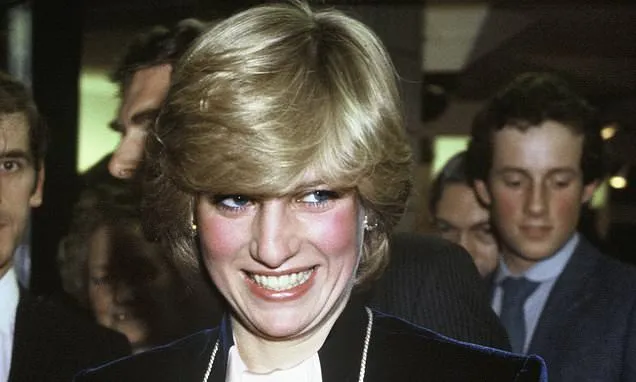
The first solo engagement Princess Diana ever undertook was to switch on the Regent Street Christmas lights in 1981. 'I left my old man at home watching the telly' she told the adoring crowds. What she didn't mention was that her father Earl Spencer, performing the same ceremony in Northampton, got an electric shock and fused the lights!
Old Queen Mary, George V's wife and King Charles's great-grandmother, was an odd one. During the war she continued to write to her German relations - which was illegal - and once encouraged an RAF serviceman to provide her with black-market sausages, which could have landed her in jail had she been an ordinary human being. One Christmas after the war's end her closest friends were left scratching their heads after receiving a brocade-covered miniature cupboard as their seasonal gift. Her Majesty helpfully added a handwritten note, explaining that these items were to conceal their telephones in, 'As I consider the telephone to be an instrument of unparalleled vulgarity.'
Princess Alice, Duchess of Gloucester grew up among the three stately homes owned by her father the Duke of Buccleuch, one of Europe's biggest landowners. The family was impossibly rich, so Alice was just the right kind of 'gel' to wed Harry, third son of King George V and brother of King Edward VIII and King George VI. She made her family home the baronial Barnwell Manor in Northamptonshire and lived the royal life, dedicated to supporting her hopeless husband. But Alice had a reputation for being as mean as mouse-droppings. One Christmas she lined up her staff to give them each their Christmas present - which turned out to be a pot-plant from the Manor greenhouses. 'When it dies,' she instructed briskly, 'be sure to return the pot.'
No carols, no holly, no ivy - and definitely no pantos. Plus the threat of arrest and jail if you dare to hold a Yuletide party. Yet that's just what happened when King Charles I lost his throne back in the 17th century. Charles's divine-right-to-rule attitude towards his people fuelled the rise of republicanism, and led to the outbreak of civil war in 1642. By 1647, Oliver Cromwell had won - and Charles was locked up at Hampton Court. Cromwell then set out on a mission to purge the nation of its most decadent excesses. Top of the list was Christmas, with all its festive trappings. For centuries churches had held special services, businesses respectfully kept shorter hours, and people decorated their homes with holly, ivy and mistletoe - just as they do today. Actors put on pantomimes - and taverns and taphouses brimmed with merrymakers. To Cromwell and his fellow Puritans this kind of behaviour was sinful. So in 1644, an Act of Parliament effectively banned Christmas. It didn't go down well. Within days, rebellion broke out across the country.
It was a sad day for the poorer folk of Windsor when Queen Elizabeth II took the decision to cut off their coal supply. Lilibet, the richest woman in Europe but a renowned penny-pincher notorious for going round Buckingham Palace switching off the lights, inherited the family tradition of handing over a hundredweight of coal each Christmas to less well-off Windsor residents to see them through the raw winter months. But with more and more people converting to gas and electricity, Her Majesty saw the opportunity to switch off their free heat as well.
It isn't always the season of good cheer around the royals - murder and mayhem are often a part of royal Christmases, even to this day. King Henry I once cut off the right hand of anyone found debasing his coinage, and chose Christmas as the appropriate time to do it. St Thomas a Becket was put to death in Canterbury Cathedral by knights acting on behalf of King Henry II. More recently King Edward VII turned his attention to murdering as many pheasants as he could - his record score of 3,207 at Sandringham over four days was only beaten by his son George V, who managed to exceed that total in a single day. George’s personal bag was over 1,000 birds. To this day King Charles & Co carry on the debatable tradition.
Christmas is nothing without a slap-up meal, and the royals are past-masters at making the most of their seasonal good cheer. Lunchtime at Sandringham may still be a lavish affair - but it's nothing compared with the old days. In mediaeval times a boar's head would take centre-stage on the royal dining table. There'd be pies filled with larks' tongues or seagull meat, some with lampreys and others with snails. Turkey then became the fashion, before Queen Victoria opted for a baron of beef, at least 3ft wide and weighing 180 lbs. At a Christmas dinner she gave at Osborne House in 1895, the menu stretched to 20 dishes including five different pies, washed down with lashings of wine and spirits.
The most important item at any Coronation over the past 650 years - apart from the crown on the sovereign's head - has been the Stone of Scone. On Christmas Day 1950 it went missing. A group of Glasgow University students were angered that the ancient block of red sandstone - also known as the Stone of Destiny and reputed to have been brought to Scotland in pre-history - remained in London. It had been captured by King Edward I in 1296 and brought to Westminster Abbey, where it was incorporated into the Coronation Chair. The students wanted it back - and hid in the Abbey on Christmas Eve with a getaway car nearby to whisk the stone back north of the border. A hilarious cops-and-robbers chase ensued once the police learned of the theft, but though they stopped the car, they failed to realise they had collared the culprits and let them go. They never found the stone, or the thieves. But a year later it mysteriously turned up on the altar of Arbroath Abbey. The students had made their point - and after nearly 700 years slumbering at Westminster Abbey, the Scone stone was eventually returned to Scotland, where it now lives in Edinburgh Castle - making the trip south only when there's another Coronation.