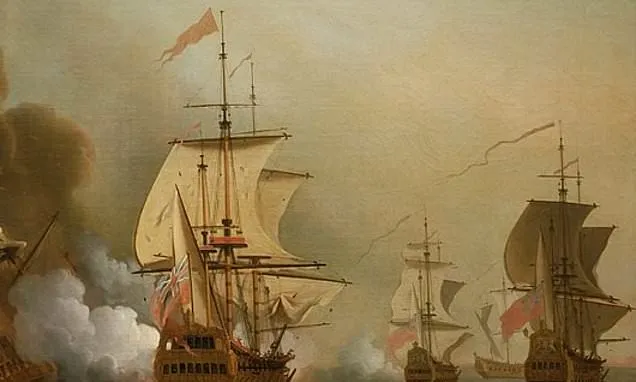
A cannon, three coins and a porcelain cup were among the first objects Colombian scientists recovered from the depths of the Caribbean Sea where the mythical Spanish galleon San José sank in 1708 after being attacked by an English fleet. The recovery is part of a scientific investigation that the government authorized last year to study the wreckage and the causes of the sinking. Colombian researchers located the galleon in 2015, leading to legal and diplomatic disputes. Its exact location is a state secret.
The ship is believed to hold 11 million gold and silver coins, emeralds and other precious cargo from Spanish-controlled colonies, which could be worth $20 billion if ever recovered. So much treasure is onboard that wreck has become known as the 'Holy Grail of shipwrecks'. The ship had been on its way to King Philip V of Spain when it sank along with 600 sailors. All but 11 of the seamen went down with the vessel. President Gustavo Petro's government has said that the purpose of the deep-water expedition is research and not the treasure's seizure.
Petro could be seen taking a look at the bronze cannon that was recovered, and which is still in excellent condition. Colombia's culture ministry said in a statement that the cannon, coins and porcelain cup will undergo a conservation process at a lab dedicated to the expedition. The wreckage is 600 meters (almost 2,000 feet) deep down in the sea. The prevailing theory has been that an explosion caused the 62-gun, three-masted galleon to sink after being ambushed by an English squadron. But Colombia´s government has suggested that it could have sunk for other reasons, including damage to the hull. The ship has been the subject of a legal battle in the United States, Colombia and Spain over who owns the rights to the sunken treasure.
Colombia is in arbitration litigation with Sea Search Armada, a group of US investors, for the economic rights of the San José. The firm claims $10 billion corresponding to what they assume is worth 50% of the galleon treasure that they claim to have discovered in 1982. Earlier this year photos were released showing dozens of coins lying scattered around the wreck. Archaeologist Daniela Vargas Ariza, of Colombia's Naval Cadet School and the National Institute of Anthropology and History, said her team used advanced underwater imaging to examine the site. This technique included high-resolution scans of silver coins found near the stern. Those coins, known as 'cobs' or 'macuquinas,' depict the mark of Lima, Peru, and are dated 1707 - the same year the San José set sail.
Some are stamped with the royal symbols of Castile and León, the emblems of Spain's empire. 'Hand-struck, irregularly shaped coins - known as cobs in English and macuquinas in Spanish - served as the primary currency in the Americas for more than two centuries,' she said in a statement. 'This body of evidence substantiates the identification of the wreck as the San José Galleon.' 'The finding of cobs created in 1707 at the Lima Mint points to a vessel navigating the Tierra Firme route in the early eighteenth century. The San José galleon is the only ship that matches these characteristics'. Also found near the site was Chinese porcelain from the Kangxi period 1662 to 1722, and 17th-century cannons dated to 1665.
In 2015 the Colombian government announced that a team from the navy had discovered the legendary ship lying beneath 3,100 feet of water. In 2022 another team brought back jaw-dropping images of its perfectly preserved cargo. And in 2023 the Colombian government said it would be raised before President Gustavo Petro's term of office ends in 2026. At the time a US firm claimed it found the boat and demanded half the loot. The Spanish government and an indigenous group also claimed to have rights over it.
Glocca Morra, an American research company, claimed it found the San Jose in 1981 and turned the coordinates over to the Colombians on the condition it would receive half the fortune once the vessel was recovered. But this was countered in 2015 by Colombia's then president, Juan Manuel Santos, who said the Navy had found the boat at a different location on the sea bed.
The 62-gun galleon was sailing from Portobelo in Panama at the head of a treasure fleet of 14 merchant vessels and three Spanish warships when it encountered the British squadron near Barú. Spain and Britain were fighting the War of the Spanish Succession at the time and the Royal Navy was approaching dominance on the high seas when it sent the San Jose to the bottom.