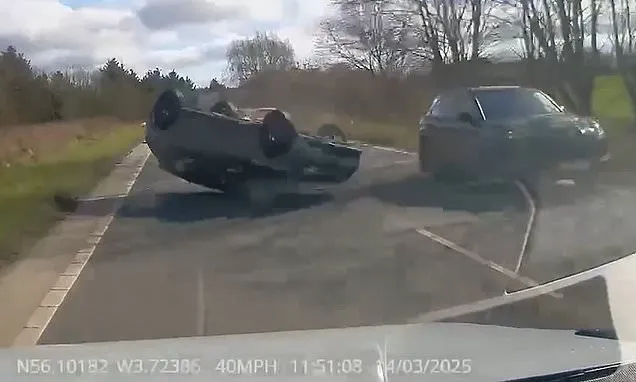
A record number of road users submitted footage of dangerous driving to police last year as the nation's motorists continue to turn vigilante to make up for a lack of enforcement as traffic officer numbers tumble.
Drivers across the UK submitted over 60,000 video clips captured on dashcams, helmet cameras and smartphones, marking the busiest year on record for the National Dash Cam Safety Portal (NDCSP), which was formed in 2018.
The seven-year high for submitted footage highlights the increasing risk on Britain's roads.
The 22 per cent year-on-year increase represents 60,198 submissions, up from 49,304 in 2024, and brings the all-time total to over 215,000 dangerous driving clips since the online system went live.
While the portal has saved an estimated 197 years of police time and become a vital tool in modern traffic enforcement, experts remain concerned that a lack of cops on the road has seen incidents of reckless driving increase in the last decade.
Latest figures show that the number of road traffic officers in England and Wales has fallen by more than a fifth since 2015 as the increasing reliance on camera enforcement sparks major concerns over who is policing the nation's highways.
A record number of road users submitted footage of dangerous driving captured on dashcams to police last year as the nation's motorists continue to turn vigilante to make up for a lack of enforcement due to dwindling traffic officer numbers.
The portal, created by dashcam manufacturer Nextbase, was designed to provide road users and police a system that allows public-captured footage to be used as evidence against some of the nation's worst drivers.
The company says that when it launched seven years ago it was met with some public hesitation. However, by 2025, that has now been replaced by a 'strong sense of civic duty'.
Nextbase exclusively shared with Daily Mail and This is Money some of the most blatant examples of dangerous and careless driving caught on film in Britain last year.
The first - which took place in April - shows a preoccupied young driver in a bright yellow Fiat 500 failing to stop when approaching a stationary car in front, with the rear-facing camera capturing the sickening point of collision.
Despite being at relatively low speed, the impact thrusts the female driver forwards into her deployed airbag, while the windscreen on the passenger side of the car cracks under the force of the airbag going off.
A montage of 10 videos showing incredibly careless and reckless driving - all captured in 2025 - have been exclusively shared with the Daily Mail.
The second clip involves a Highway Maintenance tipper truck pulling out of what looks to be a dual carriageway slip road or emergency refuge area, with the luckless driver unable to take evasive action and flipping their vehicle onto its side after striking the lorry.
Another clip from March shows a queue of traffic formed behind a slow-moving tanker.
When a fast-approaching driver is unable is unable to slow down in time, the footage shows them running into the back of another motorist, their car flipping onto its side and deflecting into the path of the dash cam user, who is unable to take evasive action.
One of the dramatic clips shows the moment an oncoming car fails to slow down for slow-moving traffic, collides with another vehicle and flips onto its roof before hitting the driver's car with the dash cam rolling.
A fourth sequence captured on film in July shows a Honda Jazz stopping to give way to an oncoming motorist, only for a van to career into the back of it.
The next video, captured in the early evening in November, shows a truck driver in the wrong lane of a roundabout smashing into the side of the dashcam-equipped car.
Another summer incident caught on camera in July - and arguably the most frightening of them all - shows a motorist attempting to undertake slow-moving traffic on a stretch of smart motorway with no hard shoulder.
However, when they move into lane one, they are quickly faced with a van and car already involved in a collision and the drivers out of the vehicles.
Unable to avoid the crash scene, the reckless motorist smashes into the back of the van at the moment a women can be seen trying to open the rear doors of the stricken car in front.
Another video, recorded in July, shows a driver colliding into the back of a van that has already been involved in a crash. A woman, who appears to have also been caught up in the initial collision, somehow manages to escape unscathed.
The penultimate clip shows a dangerous Mercedes-Benz drivers undercutting traffic at speed on a motorway, even using the hard shoulder to overtake, while the last video shows the dangers of motorists failing to respond to accidents up ahead on busy carriageways.
It is unconfirmed if all of these videos were uploaded to the portal.
Smart motorways dubbed 'catastrophic waste of time, money and effort'
Dashcam portal is 'an invaluable tool', say police
The portal - developed by Nextbase in partnership with Egress, a government-tier security data hosting specialist responsible for the platform's technology - allows motorists to quickly and securely upload footage of dangerous driving with every police force in England and Wales now utilising it.
Nextbase says that police forces have dubbed it 'an invaluable tool', with the percentage of submissions resulting in action increasing year-on-year as both forces and the public refine the process.
Around 70 per cent of videos result in some form of police action, from warning letters to the issuing of penalty points and prosecution.
Bryn Brooker, head of road safety at Nextbase, said: 'These 60,000 submissions represent a fundamental shift in how dangerous driving is documented and reported.
'When we launched this portal seven years ago, we hoped it would empower drivers to help make our roads safer. What we've witnessed is a remarkable cultural evolution - drivers are no longer passive witnesses to dangerous behaviour, they're active participants demanding accountability.'
'Most importantly, forces have confirmed that this collaborative approach is saving lives - dangerous drivers who might once have escaped consequences are now being identified and removed from our roads before they can cause harm.'
Analysis of submission patterns revealed that September had the highest number of dangerous driving reports (5,891), closely followed by July (5,762) and June (5,668).
The September spike coincided with the return of school traffic, foreign holidaymakers unfamiliar with UK roads, and deteriorating autumn light conditions as evenings drew in - creating a perfect storm that saw submissions jump by nearly 1,000 compared to the quieter winter months.
The summer months of June, July and August consistently showed high submission rates suggesting that longer daylight hours increased traffic from tourists and holiday travel patterns all contribute to more dangerous driving incidents being captured and reported.
While the portal has saved an estimated 197 years of police time and become a vital tool in modern traffic enforcement, experts remain concerned that a lack of cops on the road has seen incidents of reckless driving increase in the last decade.
West Midlands Police received the most submissions in 2025 with 23,027 reports - equivalent to one dangerous driving incident captured every 23 minutes.
Northumbria received the second highest volume of camera footage (6,162), followed by West Mercia (5,970), South Yorkshire (4,960) and Warwickshire (3,534).
Superintendent Stuart Bill from West Mercia Police said the portal - which it is using as part of 'Operation Snap' - has become a 'powerful way to address dangerous or irresponsible driving'.
He explained: 'Through a mix of education and enforcement, it helps us influence driver behaviour and keep people safer on the roads.
'Our roads policing officers already work around the clock, but members of the public also witness behaviour that is unacceptable and needs to be challenged.'
He added: 'The national portal provides a quick, secure and straightforward way to submit digital evidence directly to the relevant police force and since our launch of Operation Snap in 2018 has helped us deliver a more streamlined service for the public supporting our ultimate goal of improving road safety for all.'
Road casualties in Britain increased by 1% in 2024. As the graph shows, there has been little success in attempts to reduce deaths and serious injuries on our roads for over a decade.
Motorcyclist deaths rose 9% between 2023 and 2024. There was also an increase in pedestrian deaths, up 2%, according to DfT statistics.
Department for Transport figures published last year showed a 1 per cent increase in people killed on Britain roads - 1,633 last year up from 1,624 in 2023.
With 2020 and 2021 statistics considered outliers due to pandemic-related lockdowns dramatically reducing traffic levels, this is the first increase in annual road deaths recorded since 2017.
World Cup warning
With the 2026 World Cup kicking off in North America this June, road safety experts are warning drivers to be extra vigilant during tournament matches.
The timing presents a unique challenge for UK roads: late kick-off times due to time zone differences mean many games will finish during traditional pub closing hours, potentially creating a dangerous cocktail of celebration, alcohol, and late-night driving.
When England games finish at 10pm or 11pm UK time, police anticipate a spike in drink and drug driving incidents on top of the usual summer increases already evident in the data. Previous major tournaments have shown that match days see increased incidents, but the 2026 timing is particularly concerning.
'We're particularly concerned about the World Cup period this summer,' Bryn told Daily Mail and This is Money.'
However, the number of traffic officers to police our roads have fallen to a decade low.
The number of dedicated road cops in England and Wales has fallen from 5,005 officers in 2015 to just 3,889 in 2025, according to Home Office figures.
Last year, a study by the RAC revealed there were just 3,889 dedicated 'cops in cars' across forces in England and Wales at the end of March 2025; down 22 per cent on 5,005 officers road policing roles same date 2015 according Home Office figures.
Simon Williams RAC head policy called reduction traffic officers reversed 'significant new measures' crack down those break road rules.
He said: 'It's clear from our analysis that number officers dedicated roads policing 10-year low which can only seen bad enforcement motoring laws.
'Drivers we've surveyed express strong concerns dangers posed others road breaking traffic laws whether speeding drink drug-driving using handheld mobile phone driving aggressively not having tax insurance.'