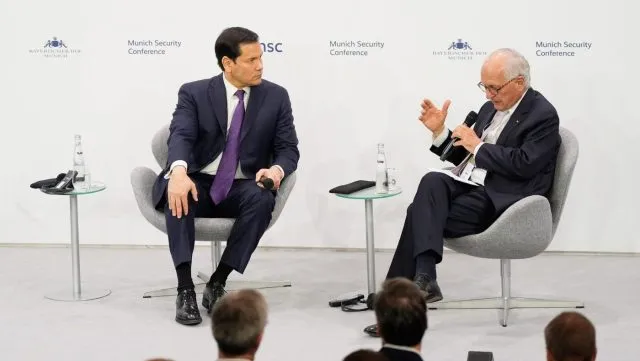
Strained ties between the U.S. and Europe took center stage at the Munich Security Conference over the weekend, as President Trump forces both sides of the transatlantic alliance to face the consequences of America's growing belligerence on the world stage.
The annual conference, a preeminent venue to debate the state of European and global security, was premised on the idea that the world has entered a period of "wrecking-ball politics."
German Chancellor Friedrich Merz warned that the U.S.-led, rules-based global order is over and urged European strength and solidarity. But he also appealed for healing ties with Washington.
While Secretary of State Marco Rubio repeated the Trump administration's warnings that Europe faces threats of "civilizational erasure," his speech was welcomed as a message of relative reassurance and partnership compared with Vice President Vance's scornful address at the conference last year.
Meanwhile, the venue served as a testing ground for hopeful American Democrats, looking to burnish their foreign policy credentials ahead of the midterms in November and with an eye to the 2028 presidential election.
Here are four key takeaways from the Munich Security Conference:
Merz pitches a repaired U.S.-European relationship
As the leader of the host country, the German chancellor had the distinction of giving the opening speech and setting the tone for the three-day conference.
Merz's speech was welcomed for confronting the breakdown in U.S. and European relations while offering an off-ramp.
"The restructuring of the world by the big powers is happening faster and more comprehensively than we can strengthen ourselves," Merz said.
"Sometimes people automatically demand Europe to just write off the U.S. as a partner. ... These claims have not been fully thought through. They ignore our geopolitical realities in Europe, and they underestimate the potential that our partnership with the U.S. continues to have despite all the difficulties that exist."
Merz's speech was not as provocative as Canadian Prime Minister Mark Carney's declaration at the World Economic Forum last month that a "rupture" had occurred between the U.S. and democratic nations, said Ian Lesser, a Brussels-based distinguished fellow with the German Marshall Fund.
"But Merz's speech did reflect some of the thinking at the Munich Security Conference even before the event took place," he said, referencing the publication of a report that great powers are blowing up the long-standing international order rather than reforming it.
"The theme of that was that the U.S. was accelerating the decline of the international order and there was, in a sense, very little hope of going back," Lesser said. "I think a little bit of that came through in the chancellor's remarks."
Rubio's remarks seen as olive branch after Vance's tirade
Rubio received a standing ovation at the conclusion of his speech in Munich, a stark contrast to the response to Vance, last year's keynote American official.
"We do not need to abandon the system of international cooperation we authored, and we don't need to dismantle the global institutions of the old order that together we built," said Rubio, referring to NATO and the United Nations. "But these must be reformed. These must be rebuilt."
European officials are still scarred from Vance’s 2025 Munich speech, in which he lectured Europe on the “threat from within,” criticized them as suppressing free speech and spoke out against mass migration.
While Rubio struck many of the same themes, he emphasized that the U.S. preferred relations with Europe rather than blowing them up.
Still, he drew pushback from the European Union’s top diplomat, Kaja Kallas.
“Contrary to what some may say woke decadent Europe is not facing civilizational erasure,” she reportedly said, and that many countries still “want to join our club -- and not just fellow Europeans,” pointing to Canada.
“Most surprise -- and controversy -- flowed from his [Rubio’s] paean to European civilization,” wrote Bronwen Maddox, director and chief executive of Chatham House, a London-based policy institute focused on geopolitical challenges and international problems.
“Europe gave the world the rules of law, universities, science, Beethoven and the Beatles,” he said. “No, we had our own civilization millennia ago,” was the retort from other continents.
But the secretary, who as a senator wrote legislation barring a president from withdrawing from NATO, said America’s “preference” is to partner with Europe on a new world order.
“I think Secretary Rubio came there with a message which was more welcome in many respects; not entirely what many people would prefer in Europe; but on key points overall he emphasized a U.S. commitment to Europe; the importance of the relationship; the importance of NATO,” Lesser said.
“Those were front and center and people in Europe found those reassuring.”
Ocasio-Cortez brings the progressive vision to the global stage
Rep. Alexandria Ocasio-Cortez (D-N.Y.) sought to bring a progressive vision to Munich, focusing on addressing income inequality and concerns of the working class as a guard against rising authoritarianism.
"Extreme levels of income inequality lead to social instability," she said during one panel on Friday, adding there was an "urgent priority that we get our economic houses in order and deliver material gains for the working class, or else we will fall to a more isolated world governed by authoritarians that also do not deliver to working people."
A four-term congresswoman, Ocasio-Cortez is stepping up her visibility and raising the prospect that she could be a 2028 presidential Democratic contender or challenge Senate Minority Leader Chuck Schumer (D-NY), who is up for re-election that year.
Ocasio-Cortez has not served on any major national security or foreign affairs committees, making the Munich trip a rare opportunity to build her international bonafides.
On U.S. policy toward Israel, she blamed American presidents from both parties for turning a blind eye to Israel's violations of Leahy Laws, which bar American military support to armies that violate human rights.
“And I think that personally, the idea of completely unconditional aid, no matter what one does, does not make sense,” she said. “I think it enabled a genocide in Gaza.”
Critics seized on her verbal stumble while responding to a question on whether the U.S. should commit troops to defend Taiwan in the face of a Chinese invasion. She eventually reiterated long-standing U.S. policy without answering the question.
Newsom reminds Europe that Trump is 'temporary'
California Gov. Gavin Newsom, who has made no secret of his ambitions for higher office in 2028, brought a climate-focused message to the Munich conference.
"Well, I'm here in many respects to remind everyone that Trump is temporary," he said. "He'll be gone in a matter of years. States like California are permanent. We're reliable, stable partners."
Newsom forged agreements with Germany and the United Kingdom to increase environmental cooperation during the same week that Trump upended America's climate guardrails.
Newsom said the people he spoke with during the summit signaled they no longer see the U.S. as the leader of the free world.
Newsom dismissed Rubio's remarks at the conference when he said the "old world is gone."
"I think it's not dead; it's dormant," the governor told CNN's Kasie Hunt. "It's waiting for different conditions to move forward; and I think that changes in the midterms; I think tonally begins to shift a little bit after November."
Zelensky seeks to keep Ukraine in spotlight
Ukrainian President Volodymyr Zelensky's 2022 address in Munich occurred days before Russia launched its full-scale invasion of the country. Many U.S. and European officials worried that the 2022 conference was the last time they'd see Zelensky alive.
Four years later, Zelensky's country is deeply battered, in the middle of negotiations to end the war, but with even U.S. officials expressing little optimism that Russian President Vladimir Putin is willing to make a deal.
Zelensky thanked European leaders for stepping in to fill the gap in military assistance left by Trump's decision to end direct American support while offering pointed criticism of Trump's approach to peace talks.
"The Americans often return to the topic of concessions - and too often those concessions are discussed in the context only of Ukraine - not Russia. Europe is practically not present at the table. It's a big mistake, to my mind," he said in his speech on the first day of the conference.
Yet Ukraine was sidelined compared to recent years, with the changing world order and questions over America's role taking center stage.
"Ukraine was put a la carte; it was put on the side because no one knows what to do," Steven Erlanger, chief diplomatic correspondent for the New York Times said on the World In Review podcast of the conversations at Munich.
"Everyone's waiting for [Trump's special envoy Steve] Witkoff -- the Europeans have a seat at the table but they're negotiating with the Americans and then we'll see what Putin has to say which is probably 'no'."
Zelensky issued an appeal not to forget Ukraine.
"Please, pay attention to Ukraine. And if exactly that had happened earlier, this war would not have begun."