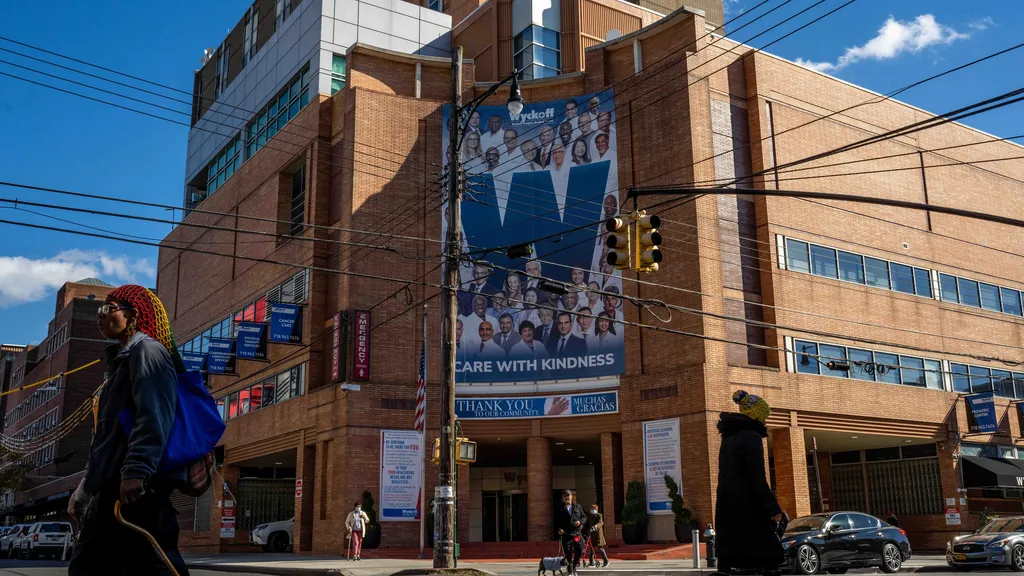
Protesters clashed with the police outside Wyckoff Heights Medical Center, where federal immigration agents brought a detainee for evaluation and later dragged him to a waiting car.
A man was dragged out of a Brooklyn hospital by federal immigration agents early Sunday morning as a crowd of people protesting his arrest clashed with police officers on the street outside, cellphone footage of the incident shows.
The chaos erupted just before 10:30 p.m., when agents brought the man to Wyckoff Heights Medical Center in the Bushwick neighborhood. The Department of Homeland Security identified him as Chidozie Wilson Okeke, an immigrant from Nigeria who had overstayed a visa. Agents had used force during his arrest and he had requested medical attention, the department said in a statement.
A local group that tracks Immigration and Customs Enforcement agents' vehicles had apparently followed them to the hospital, said Sandy Nurse, the local city councilwoman, who was present during the demonstration. As many as 200 protesters gathered outside the hospital while the detainee was inside, and some began throwing garbage cans into the street, the police said. Officers received numerous 911 calls and took several people into custody, the police said.
Hours later, agents brought the man out of the hospital. Around 2:15 a.m., officers responded to new reports of protesters blocking the ambulance bay, the police said. Videos show two federal agents dragging the detained man, who is handcuffed, out of a hospital exit, down a short staircase and into the ambulance bay, where he appears to fall to the ground.
The two agents then stand over him while police officers hold back protesters who are shouting at the agents. Moments later, the agents pull the man up by the arms and drag him into a waiting car.
Eight people were arrested during the protests, the police said. They were charged with reckless endangerment, resisting arrest, obstructing governmental administration and criminal mischief. Another person was issued a summons and released, the police said.
In New York, sanctuary laws bar the police from helping immigration authorities in civil deportation cases. In a statement, the Police Department said it does not conduct or participate in civil immigration enforcement and had "no prior awareness or coordination regarding the ICE operation that took place last night."
Mr. Okeke's arrest was the latest to draw outrage from residents as loose networks of activists in New York and around the country have mobilized to raise alarms about the presence of ICE agents in their neighborhoods. In October, more than 50 federal agents descended on Canal Street in Manhattan, where vendors sell bootleg designer sunglasses and handbags. Protesters tried to interrupt the raid as agents arrested nine men, who were mostly from West Africa and accused of living in the United States illegally.
Mayor Zohran Mamdani ran for office promising to protect New York City's large foreign-born population from the Trump administration, which has made mass deportation a central element of its agenda. Mr. Mamdani has struck up a surprisingly amicable relationship with President Trump. So far, New York City has not seen large-scale raids of the sort that have typified immigration enforcement in cities like Minneapolis and Chicago.
A spokesman for Mr. Mamdani referred all questions to the Police Department.
The Department of Homeland Security's statement provided few details about Mr. Okeke's arrest, which it said was the result of "a targeted enforcement operation." It did not say where in Brooklyn it occurred and who, if anyone, was with him.
During his arrest, the statement said, Mr. Okeke did not follow the agents' orders to step out of a car, and a scuffle ensued. Mr. Okeke was taken to the hospital for a medical evaluation, where he became combative, and he was discharged, the statement said.
Mr. Okeke was previously arrested on charges of assault and drug possession and had overstayed his tourist visa, the statement said. The department did not immediately respond to questions about when and where the earlier arrests occurred and what the final outcome of those cases was.
Ms. Nurse, the councilwoman, said a large crowd had already gathered outside the hospital when she arrived around 11 p.m.
"People tried to stop the vehicles from leaving," Ms. Nurse said. "That's when the police arrived, and then it was essentially a standoff for five or six hours because more and more people showed up from the neighborhood to try to keep that individual from being taken."
Around 1:30 a.m., Ms. Nurse said, she tried to speak with the detainee in the emergency room alongside Alex Franco, an immigration and human rights lawyer who said they had been contacted by the detainee’s family.
Hospital staff barred them from entering, both the councilwoman and the lawyer said.
“They basically said that they had to medically clear the person, the detainee, before I was allowed access,” Mx. Franco said. “And I explained to them, ‘Look, I’ve done this before; show me where that policy is. Because as soon as he’s discharged, ICE is going to take him away. So you are essentially denying them to right to counsel.’”
The staff was unmoved, Mx. Franco said, adding that failing to allow the detainee access to a lawyer was “highly irregular” and a violation of his due process rights.