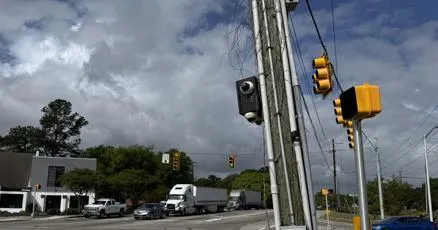
NORTH CHARLESTON -- Police in recent months added nearly 100 cameras to an extensive surveillance network that is envisioned as a way to use technology to deter crime and solve cases faster.
It has been four years in the making, with a final stage still to be developed -- an operations center that will serve as the hub for the surveillance project.
"NCPD views our surveillance cameras as a valuable tool for strengthening investigations, particularly in cases where time or circumstances limit traditional evidence," said Associate Chief Karen Cordray.
Some residents are thankful that more surveillance may help solve cases, especially when witnesses don't come forward. But there has been some opposition by people who fear the cameras will support discriminatory policing practices by amplifying surveillance in minority-occupied communities.
The camera units have been "strategically placed at various locations citywide," based on crime density statistics, Lt. Anthony King said.
The cameras are spread widely throughout the city, with increased clusters near the intersection of Ashley Phosphate Road and Rivers Avenue, as well as closer to the border with Charleston.
The technology is distinctive. Four Verkada-brand dome cameras, capped in white, are affixed to metal boxes. The cameras operate together as one unit, providing complete viewing coverage from different angles.
The new installations are mounted on 96 utility poles.
All told, North Charleston police have Verkada surveillance systems in 170 locations with around 680 camera units total, according to Cordray.
The public can view the locations of these cameras, along with crime density locations and recently investigated incidents via a NCPD mapping website.
In 2022, City Council allotted $100,000 to fund the camera installation. The money folds into a total of $2.5 million for the department's expansive surveillance initiative.
The rollout and installation has been steady. Last July, NCPD posted to their information platform CrimeWatch to alert communities that there were 585 cameras monitoring activity.
"If you come here with criminal activity on your mind, surveillance cameras are everywhere watching you. The odds are against you," the post read.
Now, with that initiative nearly complete, the agency’s next project is the Joint Operations Center. Authorities have long lauded the center as a future hub for crime fighting: a physical room with a wall of screens for police to monitor the cameras from within City Hall.
It is expected to be completed by year's end, Cordray said.
At present, detectives can pull up camera feeds individually to pore through recordings searching for possible evidence and clues. And active crime calls can be monitored in real time to assist responding officers, she added.
But activists have expressed concern over the operations center, specifically whether official department policies and procedures will properly protect the public from invasive surveillance.
Police have been slow to place measures to ensure the technology is being utilized in a way community members want, said Paul Bowers, a spokesperson for S.C. American Civil Liberties Union.
"The city has so far been unwilling to even place guardrails on the use of this technology, and the threat to our privacy has only worsened during an era of expanded AI, nationwide surveillance networks and facial recognition technology," he said.
Few policies are in place to police camera usage. Published Policy O-36 governs the use and storage of video data, specifically for "portable" cameras, which the Verkada cameras fall under, Cordray said.
These cameras can be used for a wide variety of purposes, including, but not limited to, investigating criminal activity, developing and establishing crime patterns and gathering intelligence.
The cameras can only be accessed by a password and investigators can only view the recordings on department-approved devices.
The official policy manual for the Operations Center is not yet in effect. A draft of the policy provided by NCPD specifies that recorded video "not associated with a crime" will be automatically purged from systems after 180 days. If investigators believe any footage provides evidence of a crime or links to a suspect, it will be tagged and saved, Cordray said.
It is a possibility that the center staff "may discover crimes in progress while monitoring cameras." If so, they must alert supervising officers, the draft policy states.
The Operations Center policy draft will be revised to fit the center once it is up and running, Cordray said.
"The department emphasizes that these tools are used in accordance with established policy guidelines to support public safety while maintaining accountability and oversight," she said.
When initial discussions surrounding surveillance took place in 2022, Pastor Thomas Dixon stood in opposition to naysayers.
If cameras can aid law enforcement in being able to more quickly and accurately identify perpetrators, especially those of gun violence, Dixon's all for it.
"I said, 'Listen, I'll take life-saving procedures any day.'" It's worth the community giving the cameras a try if it'll save a life, he said.
Now, nearly four years later, Dixon can't say with the same confidence that he's on board with the initiative due the lack of continuing communication from police about camera installation and their usage.
Dixon serves as the chair for the Charleston County Democratic Party and is outspoken as an ally and advocate in North Charleston.
While he says he hasn't actively pushed the matter with officials, Dixon feels there hasn't been meaningful conversation about surveillance since 2022. There were mentions at recent police-held community forums, but authorities didn't have many answers to citizens' questions, he said.
"If the public has got to reach out to ask questions, then that's not transparency in and of itself," Dixon told The Post and Courier.
The July 2025 CrimeWatch post mentioning the active camera numbers is the last thing the agency has done to communicate with the community, and it has made all camera locations visible on the NCPD crime map dashboard,Cordraysaid.
As the Operations Center buildout progresses,policeexpect to provide more information on surveillance developments,accordingCordray.
Holding the public accountable to assist in solving crimes is an issue as well. During initial talks about the camera rollout, community members were invited to a press conference held by North Charleston police and then-Mayor Keith Summey.
On April 26, 2022, a few victims of gun violence took a podium to discuss how surveillance systems can help solve crimes. One mother decried the lack of surveillance monitors in her Liberty Hill community. Her son's slaying had gone unsolved due to people unwilling or refusing to come forward with information for the detectives on his case,The Post and Courierreported.
"You don't need a person to come forward and put their life in jeopardy and risk their security and safety if you have cameras that can kind of speak for what the actual crime is," said Keith Smalls, local activist and leader of a nonprofit that provides mentorship and empowers youth restoration.
He said that he can absolutely see the benefit of cameras aiding in crime solving, but is disheartened in officials' lack of getting to the root of why crime occurs and persists.