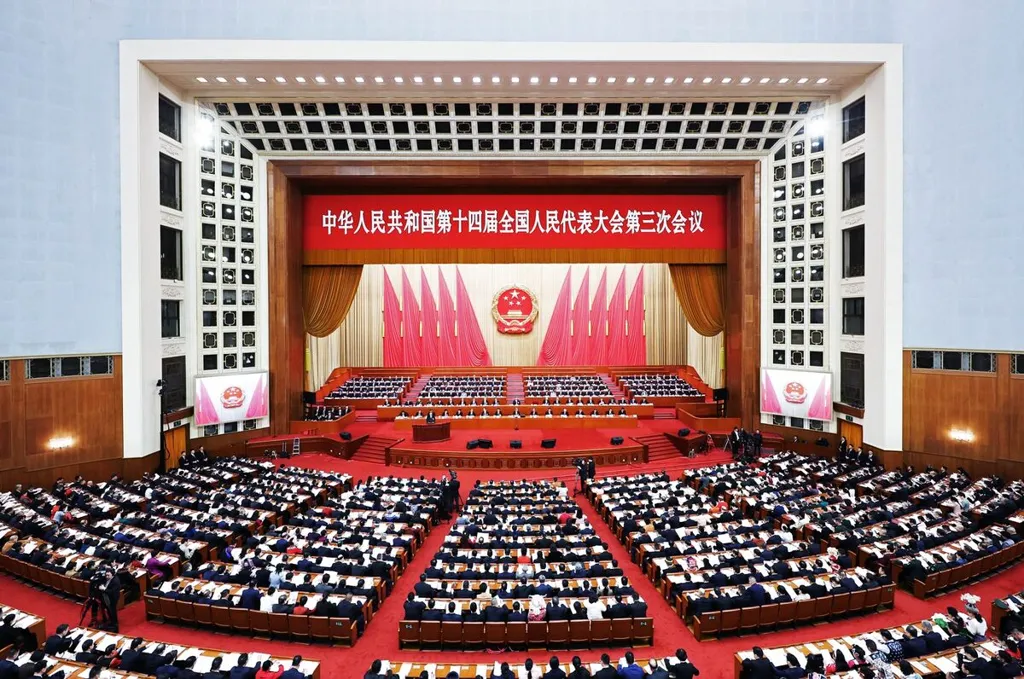
It's time for the annual National People's Congress in China, a meeting that will set the country's economic and political agenda through the end of the decade. This year's event will be particularly high stakes amid war, trade spats and AI competition.
Today's newsletter dives into how policies set in Beijing this week will shape the global energy transition. Plus, we look at how solar stocks are reacting to the war in Iran and how ESG funds that dropped exclusions on weapons manufacturers are benefitting.
China's next five-year plan set to be published this week will help dictate how fast the top polluter can cut greenhouse gas emissions and the extent of new support for clean technology sectors, policy settings that are critical to determining the world's success in tackling climate change.
Policymakers gathering in Beijing from March 5 for the National People's Congress, China's flagship annual political meeting, will review progress on green goals and most importantly endorse economic and policy strategy through 2030 -- President Xi Jinping's deadline for the nation to peak its carbon pollution.
Though the relentless adoption of renewable energy and electric vehicles has begun to limit growth in China's climate footprint -- with one analysis concluding carbon dioxide emissions fell 0.3% in 2025 -- there are concerns the nation's new strategy will focus more on stimulating growth in green manufacturing than on accelerating efforts to minimize greenhouse gases.
As pressure mounts on the Chinese government to boost growth, create jobs and compete with the US, "focusing on green industries and technologies helps Xi to advance all three of these goals," said Neil Thomas, a fellow on Chinese politics at the Asia Society's Center for China Analysis. However, "the trade off is a plateauing in China's ambition when it comes to emissions reductions."
Data published Saturday indicated China has missed a flagship climate target set in its previous five-year plan, to lower carbon emissions intensity per unit of GDP by 18% through 2025. A 5% reduction last year would take the cumulative decline to about 13% based on past statements.
Officials have signaled the 15th five-year plan will see China shift toward setting climate targets based on total volumes of emissions, alongside carbon intensity -- a measure that's faced criticism as it can obscure the true extent of progress in cutting pollution.
While experts don't necessarily expect a clear pollution cap, the new policies could include language calling for emissions to decline from a peak during the 2026-2030 period, or potentially set out how much they should fall, said Hu Min, co-founder of the Beijing-based Institute for Global Decarbonization Progress.
Clean energy sectors like solar, EVs and batteries contributed about 11% of China's gross domestic product last year, and without that contribution the nation would've missed its 5% growth target, CREA said in a note last month.
China is likely to offer further backing to manufacturers and also support growth in other decarbonization technologies like energy storage, green hydrogen and nuclear fusion. Officials will probably show more tolerance for excess capacity in green technology sectors -- unlike in mature industries like steel or cement -- because China is focused on capturing future global demand, the Tony Blair Institute for Global Change said in a February report.
In 2021, Xi called for China to begin reducing its coal consumption in the 15th five-year plan period. However, he has recently used slightly more conservative language -- instead calling for a peak in the next five years, without referencing any reduction. That same language has appeared in proposals for the 15th five-year plan.
The number of gigawatt-hours of electricity that China generated from solar power in 2025, up 40% from a year earlier. Solar overtook wind for the first time last year.
"Very soon, maybe even later this year we'll be producing more chips than we can turn on -- except for China."
That view is echoed by Nvidia CEO Jensen Huang, who pointed out in December that "China has twice the amount of energy we have as a nation."
Solar energy and battery suppliers are luring back investors as the Middle East war brings questions of energy security to the fore yet again.
Solar companies in China -- which is a top importer of oil from the Middle East -- have been among the biggest gainers on the S&P Global Clean Energy Transition Index this week. Inverter makers GoodWe Technologies and Ginlong Technologies are up more than 10% on the week.
As the Chinese government unfurls massive spending on grid enhancement and battery storage, those with healthier balance sheets stand to benefit the most, according to Bloomberg Intelligence.
By Frances Schwartzkopff
ESG funds that recently took the controversial step of dropping restrictions on weapons manufacturers are now reaping the financial rewards of that decision.
Defense stocks were among the best performers when markets opened on Monday after war erupted in the Middle East. That adds to a longer stretch of gains for the sector, with the MSCI Europe Aerospace and Defense Index almost doubling in value since the beginning of last year.
For ESG funds, those stocks would traditionally have been off limits. But last year saw a major shift in investor willingness to embrace arms manufacturers, with many casting the move as key to defending democracy. More than half of European funds registered as "promoting" environmental, social and governance goals were invested in defense assets by the middle of last year, Morningstar Sustainalytics reported in August. That marked a quadrupling since Russia's 2022 invasion of Ukraine, the research firm said.
Asset managers embracing defense assets include Allianz Global Investors and Deutsche Bank's DWS, while AkademikerPension is among institutional investors that have dropped defense exclusions as part of its evolving ESG strategy.
The shift underscores how ESG investing is adapting to a new geopolitical reality. Other major adjustments are showing signs of paying off. Some money managers have cut their exposure to US Treasuries, which slid on Monday on concern the war in the Middle East may trigger another bout of inflation.
At the same time, ESG funds that shun fossil-fuel producers for environmental reasons have missed out as oil and gas stocks rallied during the escalating conflict. The Bakersteel Global Funds Sicav - Precious Metals Fund ranks among this year's top-performing ESG funds, gaining roughly 35% after rising 218% last year.
China is quietly dominating yet another area of the global energy transition: long-duration energy storage.
Unlike conventional lithium-ion batteries that typically store power for four hours or shorter, long-duration energy storage, or LDES, can hold and release electricity for many more hours or even days. As intermittent renewables become a bigger part of the global power supply, LDES is badly needed to help balance energy supply and demand, and China is racing ahead of the rest of the world.
China also plans to upgrade its capability to recycle older solar modules in the coming years, as massive amounts of aging equipment are set to fall out of use.
Technology developer Syzygy Plasmonics made a series of preliminary deals aimed at building out production of low-emission jet fuel across the Americas.
TotalEnergies agreed to sell a 50% stake in a portfolio of German battery projects to European asset manager Allianz Global Investors as part of a strategy to boost returns from its green-energy investments.
Worth a listen
Societal collapses happen more often than you think, and there's much we can learn from the past to avoid or, at least, delay another one. This week's guest on Zero is Luke Kemp, author of Goliath's Curse, which draws lessons from the rise and fall of societies over 5,000 years of human history. Akshat Rathi asks Luke whether our current moment -- with climate change and AI -- makes us uniquely vulnerable to societal collapse or more resilient than we might think.
Listen now , and subscribe on Apple , Spotify or YouTube to get new episodes of Zero every Thursday .
About 60,000 plant species in our planet are used for medicinal purposes and are vital to both traditional and modern medicine, with 25% of all pharmaceuticals coming from plants. Lavender, aloes and ginseng are just some of the medicinal and aromatic plants that the UN is honoring today as part of the World Wildlife Day. "Today, this living heritage is under threat," said UN secretary general António Guterres. "I urge all countries to become gardeners of the global commons."
- Business of Food for a weekly look at how the world feeds itself in a changing economy and climate, from farming to supply chains to consumer trends
- Hyperdrive for expert insight into the future of cars
- Energy Daily for a daily guide to the energy and commodities markets that power the global economy
- Tech In Depth for analysis and scoops about the business of technology