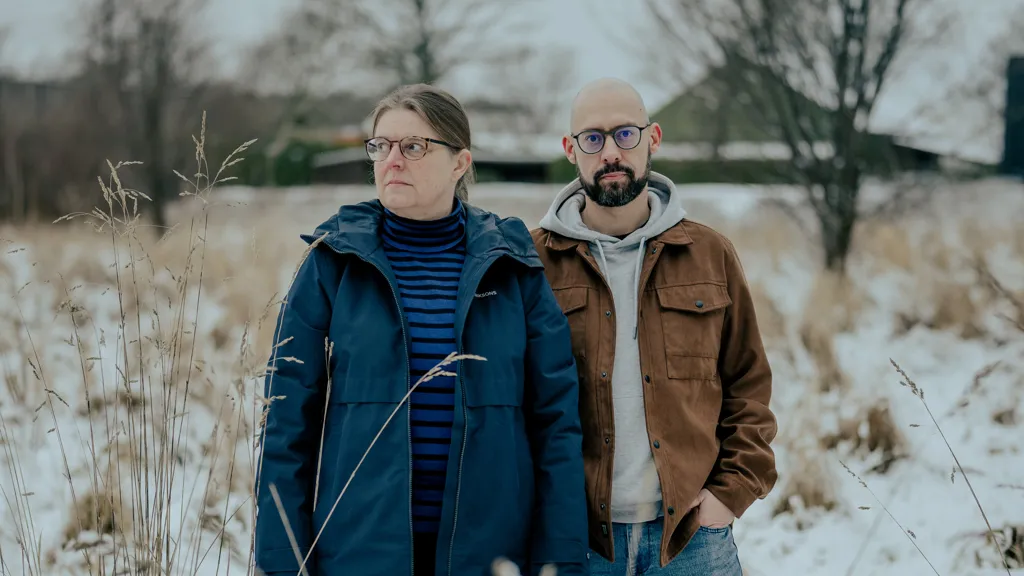
At a class reunion a few years ago, a former teacher asked Giuseppe Parlatore what he was doing these days. He was on a state disability pension, he said.
"Did you hurt yourself?" the teacher asked. When Mr. Parlatore said no, that he had a mental illness, paranoid schizophrenia, the teacher instinctively stepped back. "Oh, then you're dangerous," Mr. Parlatore remembered him saying.
The shame that immediately flooded Mr. Parlatore was familiar, he said. He wanted to protest that no, he wasn't dangerous, but he knew the conversation was already over, his life reduced to a crude stereotype.
"I have this diagnosis, and I have my challenges," Mr. Parlatore said. "But that doesn't make me less of a person."
For years after he was diagnosed in 2009, Mr. Parlatore, 42, felt like schizophrenia had swallowed him up, leaving him "more or less a vegetable," he said. But he has worked hard to manage the voices he hears -- making deals, setting boundaries -- and to carve out a life beyond his illness.
Today he is one of Denmark's leading mental health advocates, working with the country's top health officials to change how the public sees mental illness.
This government initiative, called One of Us, works with people who have mental health challenges -- the program calls them ambassadors -- to share their stories in schools, hospitals and police stations, with a focus on their recovery.
Stigma is one of the stubborn realities of mental illness: In a European Union survey in 2023, three-quarters of respondents said that people with mental illness are treated as less capable and as contributing less to society than others are. Decades of research has linked such stigma to higher health care costs and fewer job opportunities, as well as delays in seeking treatment, lower-quality care, worse mental health symptoms and reduced rates of recovery.
"Stigma has such an effect that people do not seek psychiatric services," Niels Sandø, the former director of prevention and inequity at the Danish Health Authority, said. "If I want to do something about strengthening treatment, we have to do something about the stigmatization."
Anti-stigma campaigns have a mixed record in mental health, often demonstrating immediate benefits but struggling to achieve lasting change. Nonprofits have led most of these campaigns, but they rarely have the scale or the funding to sustain them. So in 2021, Denmark brought One of Us into its Ministry of Health, Mr. Sandø said, effectively turning a grass-roots program into national policy.
"It makes a huge difference whether or not the state is involved," said Bernice Pescosolido, a professor of sociology at Indiana University Bloomington. Yet with few parallels, it is uncertain whether Denmark can make stigma reduction stick or if it, too, will see the immediate benefits fade.
What actually reduces stigma
Most campaigns against stigma have relied on building awareness -- using posters, language guides and public service announcements to educate the public. But in mental health, research suggests that "education just really doesn't work," said Patrick Corrigan, a professor of psychology at the Illinois Institute of Technology. It can build knowledge and sympathy but often does not change people's underlying attitudes, at least in the long run.
Rather, according to an analysis of 216 systematic reviews in 2022, social contact is the best way to reduce mental health stigma.
Sara Evans-Lacko, a mental health services researcher at the London School of Economics, said this does not mean just putting people together or meeting people with mental illness during a crisis but meeting on equal footing, with the space to appreciate shared humanity and common interests.
When ambassadors from One of Us speak openly about their conditions and recovery, it gives the public something sturdier than a stereotype, said Anja Vedelsby, the program manager for One of Us.
The ambassadors' accounts are also framed around solutions, not indictments, Ms. Vedelsby said. "Even if it's a really bad story about encountering discrimination, ambassadors will always say, 'I wish this had happened instead,'" she added.
This can be especially helpful for health care workers and police officers, said Ulla Lindgren, a regional coordinator of One of Us, since they "don't meet people when they have recovered -- they only meet them when they are the most sick," often at the height of a mental health crisis.
Christina Philipsen, a social nurse at Amager and Hvidovre Hospital in Copenhagen, said she had long been nervous about patients with schizophrenia: She just couldn't understand them. “When we are afraid of patients and things escalating, we can be a little more strict and rough,” Ms. Philipsen said.
But when ambassadors from One of Us visited the hospital for the first time in 2023, Ms. Philipsen said that she was moved by their stories—hearing how it felt to wake up in a hospital and not know what's happening, to plead for an explanation and get none, to be confused and desperate to leave but instead be pinned down by nurses.
And the ambassadors made space for Ms. Philipsen and her colleagues to ask questions they had long had, like: “Are you hearing voices all the time? Is that everybody’s voices or just one voice?”
Julie Andersen, a student at the Danish Police Academy, said the ambassadors had taught her what it was like to try to comply with an officer’s instructions while voices were drowning them out. One ambassador read a story while at the same time playing a recording of the voices she heard in her head—the running insults and interruptions. It felt, Ms. Andersen said, like an impossible cacophony. And it helped her realize that, while policing, she needed to slow down—repeating herself, checking for understanding, being more patient—and not just default to anger and force.
"Sometimes we can do a lot of harm," Ms. Andersen said,"but we don't always have to."
A different kind of recovery
Stigma tends to flow from stereotypes to prejudice to discrimination, Dr.Corrigan said, and social contact can help break this cascade. But society's contempt can also become internalized, as people with mental illness begin to doubt their worth and blame themselves.
That self-stigmatization, Dr.Corrigan said, can turn people into echo chambers of shame, feeding thoughts like: "Why should I even try to get a job? Somebody like me is not worth it. Why should I even try to live on my own? Somebody like me is not capable."
But serving as an ambassador might help, Dr.Evans-Lacko said, empowering people with mental illness to tell their stories.
Pernille Petersen, 48, said she had been committed to psychiatric wards more than 100 times because of her mental health challenges: She has been given diagnoses, at various times, of schizophrenia, a personality disorder, an anxiety disorder and an eating disorder. For a decade, she lived in a long-term-care facility, where the staff told her that she would not get better -- that she should vacuum, do the dishes and stop expecting more. “All hope was out for me,” Ms.Petersen said.
After a suicide attempt and a stay in intensive care, Ms.Petersen was committed again. But this time, a psychologist asked her questions no one had in years: “What are you good at? What did you like to do before you got sick?” she recalled.
The psychologist’s questions forced her to picture a self beyond her condition. “If I have to change things, I have to take responsibility,” Ms.Petersen said.
One of Us offered Ms.Petersen a way to make her lost years mean something. Since 2015, she has become an ambassador and shared her story in nursing, occupational therapy, social work and medical schools. Being part of this national effort, she said, has built her confidence, helping her “become more than my diagnosis.”
Still, this work is not entirely innocuous. Every time ambassadors bare their stories, they risk reopening old wounds, Mr. Parlatore said.
"It takes a lot of courage and mental strength to go back and relive those experiences," he added.
Fighting a daily drumbeat of stigma
Social contact is not a magic bullet; it requires the right person to tell the right story, Dr.Pescosolido said. “If it happened to them and they were successful, that can happen to me too.”
It is a fine balance, with ambassadors needing to be stable enough to be sympathetic, she continued, but not so polished that they are seen only as exceptions.
No research has yet examined whether One of Us has changed the public's attitudes or societal stigma against mental illness, but some evaluations have suggested that the program has shifted attitudes among key gatekeepers.
In a 2025 survey of 181 health care workers by the Scandinavian consulting firm NIRAS, 85 percent of health care workers said they had sometimes or often lacked knowledge about patients with mental disorders. Gertrud Øllgaard, an anthropologist with NIRAS, said some nurses had described caring for patients with schizophrenia as “just something I have to get over with,” or said “the shorter time I spend with the patient,the better.”
After meeting the program’s ambassadors, however, Ms. Øllgaard found that 98 percent of health care workers felt somewhat or much better prepared to meet and care for patients with mental disorders and 89 percent said they expected to change their behavior to be less stigmatizing.
The survey did not measure if this shift in attitudes had lasted over time or if it had translated into better behaviors. Still, in follow-up interviews,the health care workers described seeing themselves in the ambassadors’ stories and better appreciating the toll of stigma, Ms.Øllgaard said.“This made an impression emotionally,” she recalled many of them saying.
But even if social contact has more staying power than education, experts say they are still fighting a daily battle against entrenched stigma.
For Mr.Parlatore, this struggle is a matter of persistence.“I don’t feel like we’re losing the war,” he said, adding,”It’s a generational project—at least for me.”