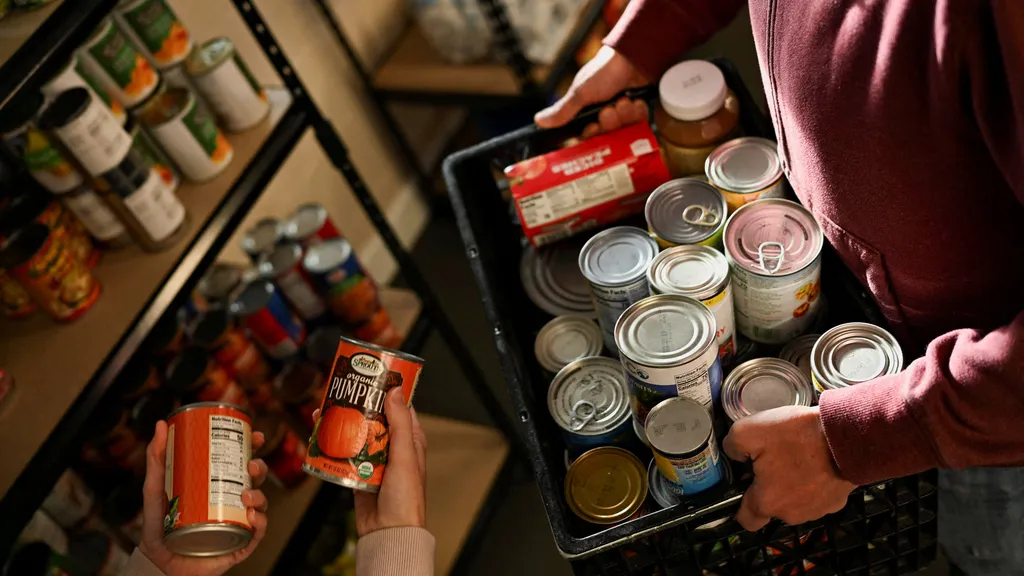
A Minnesota-based food pantry network that served thousands across the Midwest for more than two decades has suddenly shut down, affecting many families already struggling with rising grocery and fuel costs.
Ruby's Pantry stocked 85 food locations at churches and community centers across Minnesota, Wisconsin, North Dakota and Iowa, and provided recipients with grocery bundles typically worth $125 in exchange for a $25 donation. Volunteers said the assistance was vital for the small, rural areas served by the nonprofit organization.
"These are folks, oftentimes you can tell by their conditions, their vehicles, that they really need it," said Erich Heppner, the volunteer coordinator of a pantry in Staples, Minn.
But on March 31, just a week before his pantry's next food distribution was set to take place, Mr. Heppner said he received an unexpected email from Ruby's.
"We have decided to end the operations of Ruby's Pantry effective immediately," the email read. "We recognize that this is difficult news to receive and do not take this decision lightly."
At first, Mr. Heppner, the director of student life at Central Lakes College, where his pantry has been based for five years at the school's Staples campus, thought it was an April Fool's joke. He repeatedly called and emailed the headquarters of Ruby's in search of answers. He never heard back.
"We would have liked a little more notice for sure," he said. The distribution scheduled for Tuesday has been canceled, leaving around 150 families without easy access to food.
The closure comes at a tenuous time for many Americans. As the cost of groceries has surged, federal food assistance programs have been threatened, and recent conflicts in the Middle East have caused fuel prices to skyrocket.
Volunteers wondered if these financial pressures could have played a part in the closure of Ruby's. According to Mr. Heppner, the organization said a few weeks ago that it would be increasing the donation for groceries from $25 to $30.
Beth Kennedy, who volunteered at a Ruby's Pantry distribution site in Grand Marais, Minn., for 12 years, said she noticed the organization's leaders begin to downsize around two months ago, selling off storage facilities and vehicles.
"I think they got in over their heads," she said, pointing to rising fuel costs from the war in Iran as the tipping point.
The services Ruby's Pantry provided for Ms. Kennedy's small, lakeside community -- collecting, storing and shipping food items -- were not, she said, something it would be able to easily recreate. Ruby's Pantry sourced most of its food supply from corporate donors.
"We don't have access to that kind of food," she said.
According to tax records from 2024, the nonprofit's expenses outweighed its revenues, although it still held millions of dollars in assets.
RoxAnn Sahr, an executive director at Ruby's Pantry and the daughter of founder Lyn Sahr, did not respond to requests for comment.
"Please note that Ruby's Pantry is no longer in operation," an auto-reply message from her email read. "I am also no longer employed with the organization and am unable to assist with inquiries."
Ruby's Pantry's Facebook page posted a statement online -- the same message that Mr. Heppner and other volunteers received in their inboxes. The website is now defunct. According to an archived version of the website, Ruby's Pantry distributed approximately 242,000 grocery bundles a year.
Dozens of sites affiliated with Ruby's Pantry took to social media to express frustration. In Bloomington, Minn., the chapter encouraged recipients who had prepaid the $25 donation to contact their banks "given reports that no one from the main Ruby's Pantry office has been answering the phone or emails for several days now."
"We're very sorry it has come to this," the Facebook post continued.
Stacie Silk, who has seven adopted children to feed at her home in Brainerd, Minn., had gone to her local Ruby's Pantry on-and-off for a decade. Recently, she had been relying on the pantry more frequently to supplement a tight grocery budget.
"Everything's doubled, and we’re just trying to make things work," she said.
For her family, the loss means cutting back on meat, bread, and fresh produce, she said, all of which they usually received in their monthly distribution.
"We’re going to have to live off the canned goods for a while," she said she told her children, many of whom have special needs. "Fresh fruits are going to be here and there."
Ms. Silk, 56, said they’re also going to be relying more on other local food banks in the area.
Tony Buttacavoli, the executive director of Family Pathways, which operates nine emergency food shelves in North Branch, Minn., said he anticipated that more families like Ms. Silk’s would be turning to their services. They are also losing out on a source of donations, as Ruby’s Pantry often gave extra food items to Family Pathways.
He hopes that other organizations like Ruby’s Pantry, which are geared toward people who need supplemental help but are not yet in need of emergency food, manage to stay afloat. "Because the food shelves were never built to take care of everybody in every situation," he said.