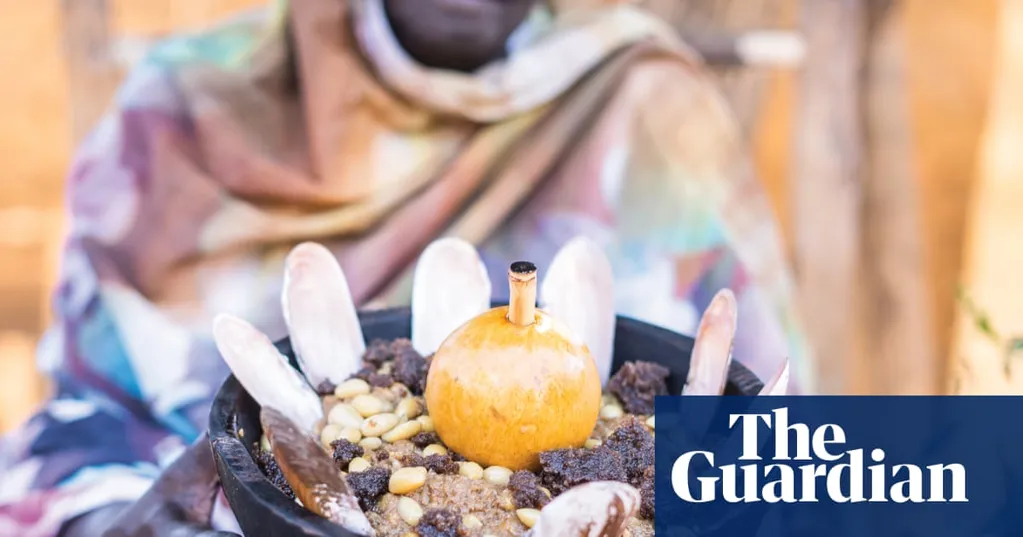
The loss of sacred spaces during the period of observance and the ongoing conflict reminds us of the importance of cherishing food.
Today starts the first week of Ramadan, and I have the great pleasure of digging into The Sudanese Kitchen by Omer Al Tijani. The war in Sudan has been going on for almost three years now, and Ramadan is a month that arrives with heightened feelings for those fasting in the middle of conflict and displacement. The cookbook, a first-of-its-kind collection of Sudanese recipes, is both a celebration of Sudan and a reminder of all that is at stake.
Al Tijani first realised he needed to learn how to make his own Sudanese food while he was a student at the University of Manchester in the early 2010s. The packages of treats his mother prepared never lasted long enough; he grew sick of student food and began looking for recipes, but there were few resources. Over 15 years, his passion for tracing and documenting Sudanese recipes took him all over Sudan, and his work became, as he told me, "bound" in Sudan's political story. He gathered recipes and food culture on the ground during the revolution that overthrew president Omar al-Bashir, Sudan's dictator of 30 years.
"As I embarked on the project," Al Tijani told me, "we were embroiled in the revolution; we drove all over Sudan during fuel cuts, protests, sit-ins. Khartoum itself was teeming with revolutionary spirit."
What he found is a cuisine that is not uniform, just as Sudan is not.
A diverse country and cuisine
Sudanese food, Al Tijani tells me, encompasses a colossal range of dishes across a vast country, mixing African and Arab influences. But because Sudan's political and economic power was centred in Khartoum and the heartlands of the country's elites, so much of Sudan's food is unknown to its own people. The Sudanese Kitchen, he said, is a revelation to both non-Sudanese and Sudanese people. He himself was astonished to find that mushrooms were grown in parts of Sudan, and that they were cooked in a dish called "chicken stew without bones". (I tell him that I was similarly astonished that "gurasa", a thick salty pancake that was a staple in our household, was not something everyone else consumed. It was like hearing that others didn't eat toast.)
Perusing the book is an experience of meeting the country, so diligently has Al Tijani traced recipes to regions and topographies. But there is an inescapable sense of loss that hovers over the whole endeavour—one made even more poignant by all the imagery of homes, yards, and mothers and grandmothers at their stoves. For so many, life is either suspended or erased due to a war that has led Sudan to experience the largest displacement and hunger crisis in the world.
Food in the long shadow of war
If The Sudanese Kitchen had come out before the war, it would have inspired a very different response. Today, it feels like something much more fraught and inflected with trauma. "It hit a nerve with many people," Al Tijani said. "Many were emotional at the launch - it was the first time the country came back to them; it was alive again; it was well again; it was full of joy. It inspired a visceral reaction."
Now, Sudanese food is simply no longer the thing that you enjoy in peace, even if you are not in the conflict zone. It is a reminder, an artefact, a relic, even a symbol. I was reminded of meeting a friend for dinner in Nairobi—a city that is now the home of many Sudanese refugees—and seeing a drink on the menu named after the iconic Sudanese female warriors of the past, the “kandakas”. “Once your culture becomes a cocktail,” my friend said, “you know your country is in trouble.”
Food now, Al Tijani said, is “not just dinner” but something you are experiencing in a new way that is hard to process outside home and context. This feeling is even heavier during Ramadan. Al Tijani described the aura around Ramadan in Sudan: how hyper-domestic it is; how swirlingly social. Sudanese food has little street or casual cafe-friendly features. Heavy in long-stewed meat dishes; hand-processed and cut leaves and spices; fermented, hand-spun savoury crepes and pancakes; it’s not a cuisine you’re grabbing in the street. It’s something you go home for.
Even before Ramadan starts, the streets are full of caramelised and dried ingredients for juices and stews. “The few days at the start of Ramadan are a culinary climax. People are way more open in Sudan during Ramadan,” Al Tijani said—houses open up, and invitations are extended. “The whole preparation takes weeks. Your house looks different; it feels different. Different people are in it because you can’t prepare for Ramadan on your own. So you’ll find women going from one house to another.”
There’s a whole social formation and opening up of domestic spaces that makes the sense of loss of those spaces even more painful. On top of that, I think, there is the heightened taste of the food itself consumed after a long fast that forges a love and passion for its richness. Breaking the fast with a hot, salty, lemony broth of peanut paste, for example, is - no pun intended - a religious experience.
Keeping Sudan on the map
With food, though, Al Tijani said, there is an element of keeping something alive. We are all renegotiating our relationship with an identity that is still very much alive and a country that is being destroyed. "Ever since the war, I have felt even more of a calling to make it a mission of mine," he said of getting information about Sudan out to as many people as possible.
"For me, this book is my form of resistance. The one way that I can put Sudan on the map to counter destructive narratives, to tell Sudan's story. It's the opposite of erasure; these are fixed things. We lived in these houses; we cooked these ingredients; we used these utensils - this is how we constructed our lives."