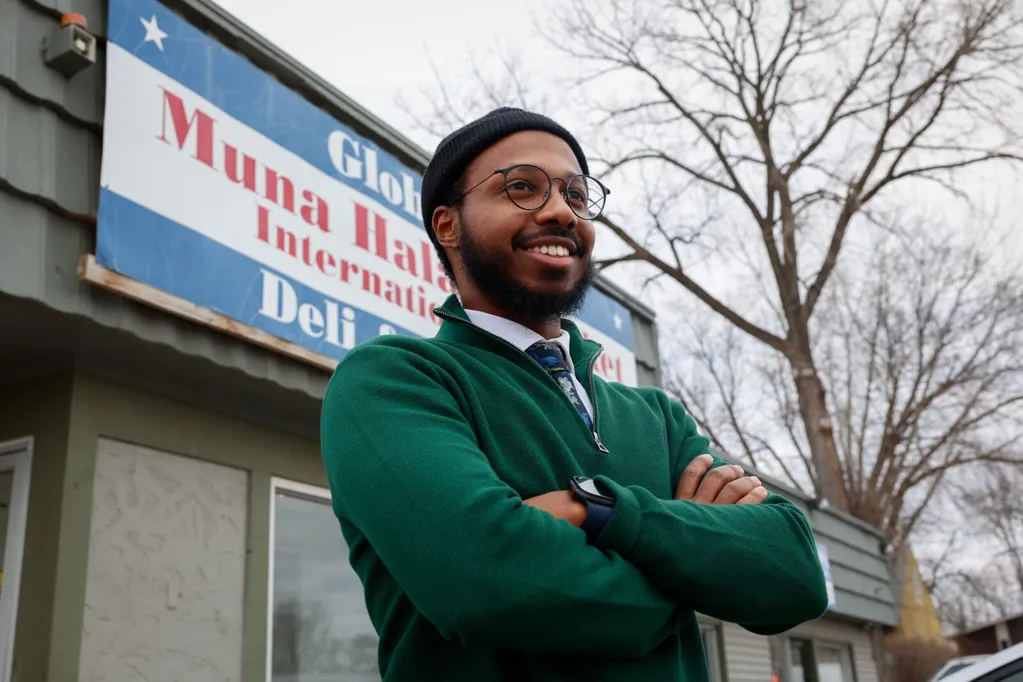
ROCHESTER -- On a trip to his parents' home country, Ayub HajiOmar had his phone stolen while in Mogadishu, Somalia. With help from a bus driver, HajiOmar tracked the thief and confronted him, creating a commotion. The thief pulled a knife.
"I took a step back," said HajiOmar, a Rochester artist born to Somali immigrants.
Then, something turned the tide. People began to pick up rocks. The thief relinquished the phone and fled.
"These were ordinary people," HajiOmar said. "No one else had a knife, but we had our collective selves."
In a way, he sees something similar happening as Minnesota Somali communities find themselves at the center of increasingly volatile federal law enforcement activity in Minnesota.
On Jan. 7, Renee Good, 37, was shot and killed by an Immigration and Customs Enforcement agent in a south Minneapolis neighborhood with a large Somali population.
Neighbors there said Good worked to observe ICE operations in the neighborhood to help ensure people's rights were being protected.
"Renee was one of those observers that was trying to help," said Minneapolis resident Saleban Duale, of the Somali Neighbors organization.
"We feel like she got into the situation because she was trying to advocate for us," HajiOmar said.
As restaurants in Rochester closed Monday and Tuesday due to staffing issues, a small Somali restaurant was open and business seemed as usual Tuesday.
Some Rochester restaurant owners who declined to be identified confirmed they are having staffing issues due to federal operations and concerns about Department of Homeland Security immigration officials, specifically Immigration and Customs Enforcement.
At Muna Halal, the small restaurant requires few staff to run. However, Somali customers said they're a determined group who know their rights.
Most of the more than 100,000 Somali people in Minnesota are citizens -- about 95% are either naturalized or were born in the U.S., according to CAIR Minnesota.
That's one reason Somali people aren't being intimidated by ICE operations here, HajiOmar said.
"When you look at the numbers, when you look at the facts, there's nothing to be afraid of," he said.
It also makes him wonder why the Somali community is being targeted by ICE operations when most are in the U.S. legally.
"It looks like it's politically motivated," HajiOmar said. "I feel like this is really calibrated toward the Somali community."
HajiOmar said a people who have faced a bloody civil war aren't easily intimidated.
"If you're able to bounce your way back from that and make your way to one of the most prosperous areas in the world and become lawmakers, and become mayors, that shows just how resilient we are as a community," he said.
Even before the fatal shooting Jan. 7, focus had already been on Minnesota's Somali communities in the last two months due to rhetoric at a national level.
In early December, President Donald Trump aimed remarks at Minnesota Somalis, saying Minnesotans are afraid to leave their homes because of Somali gangs. His rhetoric culminated in calling Somalis "garbage" and threatening to revoke the legal status of Somalis living here.
The recent increase in ICE activity was predictable, HajiOmar said.
"ICE has been trying to provoke the Somali community for so long in so many ways," he said.
HajiOmar noted that people have since stood up to protest and speak out against ICE, including thousands marching in south Minneapolis the day after the fatal shooting.
"Even if elected officials just say that this is wrong, this is unjust, it goes a long way," he said.
In some ways, it's starting to feel similar to when people stood up for him that day a decade ago in Mogadishu, he added.