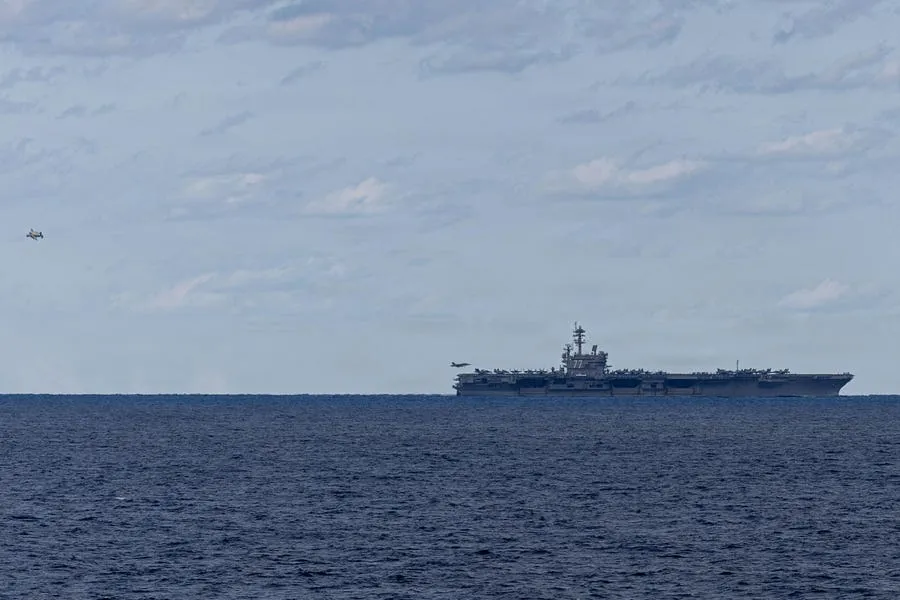
The United States Navy's final Nimitz-class nuclear-powered aircraft carrier completed a key pre-deployment training exercise last week, but the Pentagon hasn't indicated if USS George H.W. Bush (CVN-77) would head to the Middle East to support the ongoing Operation Urgent Fury.
CVN-77 wrapped up its Composite Training Unit Exercise, which brought together all of the elements of a carrier strike group, ensuring the various assets, including escort ships can operate as "a cohesive, multi-domain fighting force under realistic conditions through simulated scenarios, live, virtual, and constructive training," the U.S. Fleet Forces Command announced.
"COMPTUEX is the certification event for the strike group to let us know we are ready for major combat operations around the world," explained Rear Adm. Alexis Walker, commander, Carrier Strike Group 10. "It brings the entire strike group team together and enables us to operate as we would when we're forward deployed."
There has been speculation that CVN-77 could be ordered to the Middle East, where the USS Abraham Lincoln (CVN-72) has been operating since January. On Friday, the U.S. Navy's newest and largest supercarrier, the USS Gerald R. Ford (CVN-78), transited the Suez Canal into the Red Sea, marking the first time since last spring that two U.S. carrier strike groups have operated in the Middle East at the same time.
Both of those warships have already seen longer-than-expected deployments. In an email last week, Bryan Clark, senior fellow at the Hudson Institute in Washington, D.C., said it is possible that USS George H.W. Bush would replace the Ford or Lincoln, but he added that it was unlikely that the U.S. Navy would maintain three carriers in the region.
Beyond the toll it may take on the crews of the already-deployed carriers, and the wear and tear on the ships, the U.S. Navy still needs to worry about other global hotspots. It lacks the carriers to maintain such a large presence indefinitely.
A French Carrier Is Now In The Region
Even if the United States won't, or can't, keep three of its carriers deployed in the Middle East, there is an additional flattop operating in the region. France deployed its flagship carrier to the eastern Mediterranean to deter an escalation to the largest conflict the Middle East has seen in years.
The Marine Nationale's Charles de Gaulle arrived in Cyprus on Monday, just hours before French President Emmanuel Macron met with Cypriot President Nikos Christodoulides and Greek Prime Minister Kyriakos Mitsotakis on the island nation.
Macron, who visited the flagship on Monday afternoon, stated that French naval forces will be part of a defensive mission to reopen the Strait of Hormuz as the Middle East war enters its second week.
In total, eight French warships are being dispatched to maintain security in the busy Middle Eastern waterway, yet the French leader reaffirmed that this mission was entirely defensive in nature.
"Our objective is to maintain a strictly defensive stance, standing alongside all countries attacked by Iran in its retaliation," said Macron.
Britain Doesn't Rule The Waves
Even as the Charles de Gaulle, the only non-U.S. Navy nuclear-powered aircraft carrier in service, is now in the Mediterranean, the British remain uncommitted about sending one of its two carriers to the region.
Yet, efforts are underway in the UK to speed the deployment HMS Prince of Wales.
According to reports from the British press, Royal Navy personnel continue to ready the conventionally-powered flattop for deployment after the warship was placed on a five-day notice to sail.
Even as it remains unclear whether the carrier will be sent to the Mediterranean, just a week ago, it seemed unlikely that London would be able to deploy either of its flattops if needed. The Royal Navy's former flagship, HMS Queen Elizabeth, is still undergoing a docking and certification period at the Royal Navy's Rosyth Dockyard in Scotland. That process is reported to be months behind schedule, leaving the carrier sidelined for the foreseeable future.
HMS Prince of Wales only returned to the UK in December, after completing her eight-month-long Operation Highmast deployment to the Indo-Pacific, leading Carrier Strike Group 2025. The second of the Royal Navy's two carriers was nearing the end of a planned maintenance period when the notice to sail order was issued. However, the warship remained at high readiness due to the ongoing maintenance troubles with HMS Queen Elizabeth.
Readying HMS Prince of Wales for her next deployment is a huge undertaking.
"Reducing the notice to sail from 14 days to 5 days requires preparations to be accelerated. Final maintenance tasks must be completed, the ship's company recalled from leave and training courses, and all systems checked to ensure the ship is at the highest state of readiness," the UK-based Navy Lookout explained.
The fact that the aircraft ordnance and munitions were kept intact from last year's deployment would certainly help speed the time to get HMS Prince of Wales back to sea.
Still,the larger issue forthe Royal Navyis what escorts might be available,should a Middle Eastern operation be on the table.
For last year's CSG25,as well asthe 2021 Indo-Pacific deployment of HMS Queen Elizabeth,the Royal Navy hadto turn to international partners.For both missions,the CSGs were assembled well in advance of their respective deployments.
Were the Prince of Wales to head to the Middle East,it is unclear which vessels are available as escorts,apart from the Royal Navy's Type 23 Duke-class frigate HMS Dragon,which was ordered to Cyprus earlier this month but had not yet deployed as of Monday.
Then there isthe question of what a Mediterranean mission would mean forthe upcoming Operation Firecrest,a planned Royal Navy-led exercise with NATO partners in the North Atlantic and Arctic currently scheduled for April.The status of those drills is now in question,and since the start of the Middle Eastern conflict,the U.S. Navy's involvement in Firecrest has seemed increasingly unlikely.
Showing The Union Jack?
London has remained uncommitted to sending HMS Prince of Wales to aid the U.S. in its operations against Iran,a fact noted by President Donald Trump on Sunday,who very publicly rejected any UK offer to sending such a warship to the Middle East.
"The United Kingdom,our once Great Ally,maybe the Greatest of them all,is finally giving serious thought to sending two aircraft carriers to the Middle East," Trump wrote on Truth Social."That's OK Prime Minister Starmer,we don't need them any longer -- But we will remember.We don't need people that join Wars after we've already won!"
Still,the UK has placed greater emphasis on the situation in the Middle East.
"We have been bolstering our UK military presence in the Middle East since January,and we have already deployed capabilities to protect British people and our allies in the region including Typhoons,F-35 jets,air defence systems and an extra 400 personnel into Cyprus," a UK Ministry of Defence spokesperson said in a statement to the media.
It is still unclear if the Royal Navy's flagship would or even could be deployed to the eastern Mediterranean,but the MoD confirmed it was ready if needed.
"HMS Prince of Wales has always been on very high readiness and we are increasing the preparedness of the carrier,reducing the time it would take to set sail for any deployment,"the MoD added.
The carrier will soon head to sea,but less clear is where it might be directed.