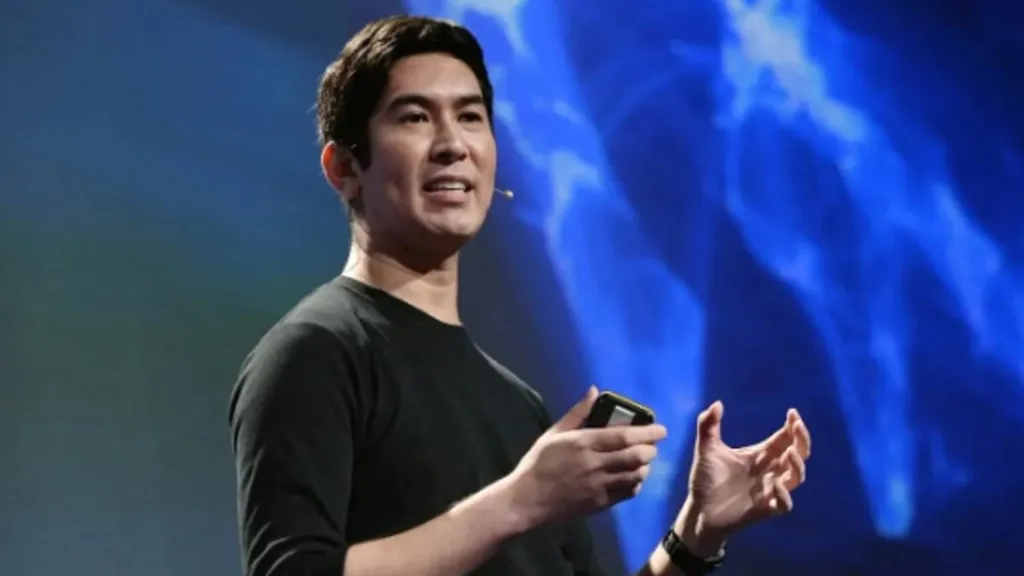
The world is teetering on the edge of an Artificial Intelligence (AI) disaster in which a tiny elite class live in luxury while the majority suffer.
That's according to Dex Hunter-Torricke, a former communications chief at Google's AI arm DeepMind, who has worked for Mark Zuckerberg and Elon Musk.
Mr Hunter-Torricke, who is a non-executive board member of HM Treasury, wrote in an essay that Big Tech's leaders are driving society towards a radical and disastrous transformation.
'By mid-century, on this trajectory, we arrive at something that goes beyond inequality and begins to look like economic speciation.
'An elite class with AI-augmented capabilities enabling lives of luxury, equipped with medical breakthroughs that deliver longer lifespans, living in parallel with a global majority whose economic prospects, healthcare access, and political power have been permanently curtailed.
'This is not a prediction I make lightly. We can see the forces already clearly in motion.'
The main thrust of Mr Hunter-Torricke's dire prediction is the idea that rapid advances in AI will lead to the majority of jobs being displaced by automation.
Dramatically, he claims the International Monetary Fund's estimates that 60 per cent of jobs are vulnerable to replacement 'low-ball the true impacts'.
Mr Hunter-Torricke's predictions come from having spent over 15 years working with Silicon Valley's leaders in the AI revolution.
The former PR boss has worked with Google's Eric Schmidt, Meta's Mark Zuckerberg, and SpaceX's Elon Musk.
He says that he has spent 'nearly two decades with people who are supposed to be making the plan for the future'.
However, after dramatically leaving his job with Google's AI arm, Mr Hunter-Torricke claims: 'It's crystal clear to me now: there is no plan.'
At the heart of this argument is the idea that AI is developing far faster than anyone is prepared for.
While critics have consistently argued that AI's capabilities are 'flattening', successive generations of new models appear to show rapid advances.
Critically, Mr Hunter-Torricke also claims that these developments are trending towards a more general form of intelligence, one that can be applied to almost any task or activity.
While the Industrial Revolution replaced manual labour with machines, it opened up new avenues for work in jobs that require thinking and decision-making.
However, since a more general form of AI can do anything, some experts warn that it won't leave any gaps in the job market at all.
While the economic benefits will likely be vast, Mr Hunter-Torricke is more concerned about how those gains will be distributed.
'The productivity gains will be real - but there is no automatic mechanism that translates them into broadly shared prosperity.'
'The most likely outcome is an economy in which corporate profits explode as labor costs fall, while workers' share of output shrinks. Wealth concentrates at an unprecedented rate at the top, while the vast middle loses ground.'
Based on the current fractured state of global and domestic politics, the former Google chief adds that these changes will likely lead to mass political upheaval.
'The demagogues of today will look restrained compared to what fills that space,' he ominously concludes.
Mr Hunter-Torricke is not alone in his scepticism over the societal benefits of AI.
Recently, the head of safeguarding at leading AI company Anthropic quit his position, writing on X: 'The world is in peril.'
This comes after Dario Amodei, founder of leading AI firm Anthropic, warned that humanity was not ready to handle the consequences of the AI his firm seeks to create.
Even Anthropic's founder, Dario Amodei, recently warned that the world isn't yet ready to face the consequences of AI.
Mr Amodei wrote in an essay: 'Humanity is about to be handed almost unimaginable power, and it is deeply unclear whether our social, political, and technological systems possess the maturity to wield it.'
Separately, leading AI researcher Professor Michael Wooldridge warned that the technology could face a 'Hindenburg moment'.
He told The Guardian: 'The Hindenburg disaster destroyed global interest in airships; it was a dead technology from that point on, and a similar moment is a real risk for AI.'
'Because AI is embedded in so many systems, a major incident could strike almost any sector.'
Mr Hunter-Torricke now predicts that the world's governments and institutions have 'roughly ten years left to rethink many of the fundamental assumptions'.
He has founded a new London-based non-profit, the Center for Tomorrow, which will address the issue.
The firm has pledged not to accept any funding from Big Tech and instead has funding from the Scottish billionaire Sir Tom Hunter, who is the uncle of Mr-Torricke's wife.