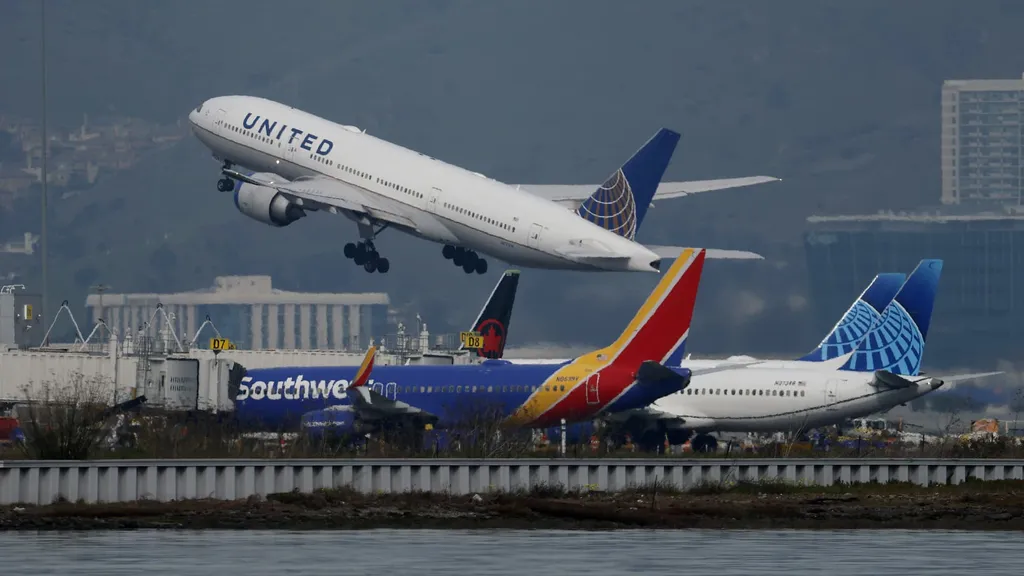
Airline stocks were some of the worst performers during the Middle East violence tied to the U.S.-Iran war. While the current ceasefire is welcome news for the group as crude oil prices -- and jet fuel -- pull back, the carriers remain vulnerable, analysts warn. Two worries from the war in the Middle East weighed on the domestic airlines: higher jet fuel prices stemming from surging oil prices, and demand destruction from strapped consumers avoiding more expensive ticket prices as airlines passed along increased costs. With the exception of Delta, domestic carriers slumped between 16% and 28% between the start of the war until last week's ceasefire.
The last three times oil prices soared -- 2008, 2014 and 2022 -- airline stocks actually outperformed the broader market in the following month, with that pattern repeating over three and six months, Wolfe Research wrote in a report late last week. But over the following year, the airlines tend to only perform in line with the market. As a result, the recovery in the airlines since the April 7 ceasefire may prove nothing more than a temporary, knee-jerk reaction. Few analysts, for example, are signaling that higher energy prices are over, meaning a sustained stock rally may be hard come by.
Delta Air Lines in its earnings report last week estimated that average jet fuel costs will reach $4.30 a gallon in the second quarter, though CEO Ed Bastian said in an interview with CNBC's Phil LeBeau the estimate was based on data before the ceasefire sent energy prices tumbling. "It's getting to the point where it's beyond sort of an immediate crisis, and it's now become a sustained, brutal headwind that is not going to dissipate in most people's minds for a while," former United Airlines CEO Oscar Munoz said in an interview.
As a result, analysts are reluctant to declare the all clear for airlines. "It's hard to understand exactly where these things are going to settle out," said Conor Cunningham, an analyst at Melius Research. "These remain highly volatile names, and will remain so in the immediate near-term."
Barring a permanent ceasefire between the U.S. and Iran, attention now turns to management commentary tied to March quarter financial results. Investors will listen for how much capacity carriers are willing to cut to offset higher costs, and for how consumers are responding to increased fares and added fees for checked bags.
One other consideration is prior surges in oil prices in the early 1990s and late 2000s drove increased mergers and acquisitions among airlines, according to Tom Fitzgerald, a TD Cowen analyst, who thinks that could happen again now. For example, United Airlines bought Continental Airlines in 2010 and American bought US Air in 2013.
"Prior to the war, things were relatively fine, and you had a lot of weaker players who had deeply negative profit margins," Fitzgerald said. "In a normal year, maybe you'd have a little bit more runway before things started to get precarious, but it probably hits a lot faster now."
United Airlines CEO Scott Kirby reportedly floated the idea of a merger with American Airlines to Trump Administration officials earlier this year, before the war broke out. If high jet fuel prices last beyond one or two quarters, the effects of the war on the airlines "get very sinister," Fitzgerald said.
For now, the focus is on how the airlines performed in the quarter ended March 31. Management teams are likely to address not just the effect of the war on passenger demand, but also the impact from long TSA lines caused by the partial shutdown of the Department of Homeland Security. And while Delta said last week it wasn't seeing weaker demand as a result of higher fares, data from Bank of America showed that in late March the number of airline transactions slowed and year-over-year growth turned negative.
Weaker reports from other domestic carriers over the next two weeks "wouldn't be surprising," Fitzgerald said.