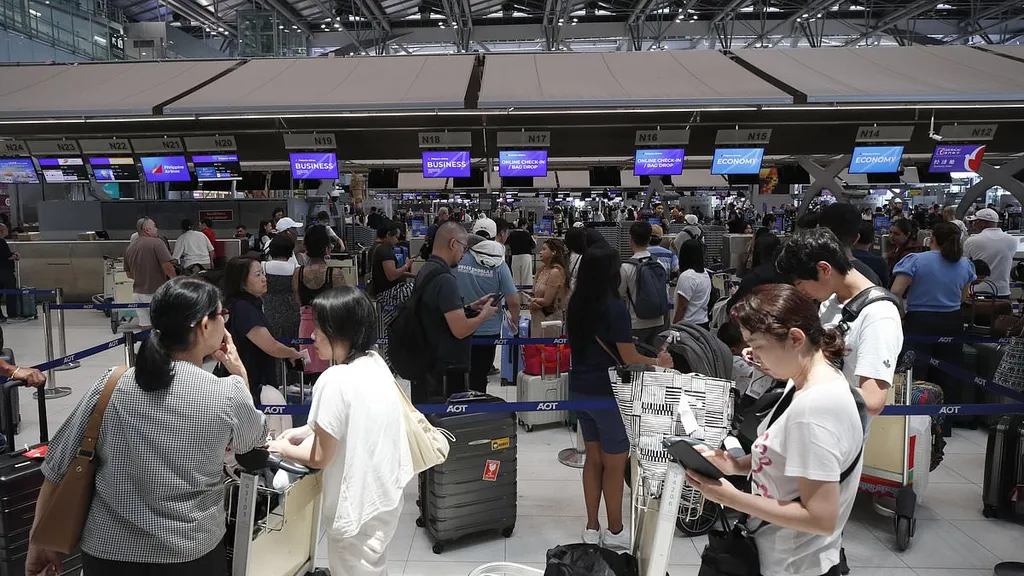
Airlines have cut two million seats from their schedules for this month within the past two weeks as concerns intensify over jet fuel shortages caused by the Iran war.
The total number of seats available on all carriers in May has fallen from 132 million to 130 million between mid and late April, according to analytics firm Cirium.
Gulf airlines such as Qatar, Etihad and Emirates have been worst-hit by airspace closures and airport disruption in the Middle East along with rising fuel costs.
European operators such as Lufthansa, Air France-KLM and SAS have also reduced schedules - while US airline Spirit has gone out of business following the closure of the Strait of Hormuz, through which 20 per cent of global crude supply passes.
Lufthansa had the most seat cancellations after cutting 20,000 flights between May and October, with Air China second after axing internal services, reported the FT.
The average global jet fuel price increased for the first time in a month last week to $181 per barrel, according to the latest International Air Transport Association data.
This 1 per cent week-on-week rise followed three consecutive weeks of decline after a peak of $209 (£155) at the start of April - up from $99 (£73) at the end of February.
It comes as investment bank Goldman Sachs warned Britain is particularly vulnerable to jet fuel shortages amid a rationing risk as supplies could fall to 'critically low levels'.
A note seen by the Times claimed the European jet fuel supply was facing 'extreme tightness' because of the Strait of Hormuz's closure - with the UK 'most exposed' to the crisis because of high reliance on imports, poor refining capacity and low stocks.
Goldman Sachs said: 'The UK is the largest net importer of jet fuel in Europe, and it holds no strategic reserves, leaving commercial inventories as the primary buffer.
'As a result, inventories in some countries, especially the UK, could fall to critically low levels, increasing the likelihood of rationing measures.'
Britain now only four operating oil refineries - Fawley in Hampshire, Stanlow in Cheshire, Humber in Lincolnshire and Pembroke in Wales - after the closure of Grangemouth in Scotland in April 2025 and Lindsey in Lincolnshire last August.
Meanwhile the European Commission warned yesterday that airlines and member countries should prepare for all scenarios as uncertainty continues over supplies.
Spokesperson Anna-Kaisa Itkonen told a briefing in Brussels: 'I don't think anyone knows how long this situation will last, so the best we can do and the most effective thing that we can do and that we are doing is to prepare for all eventualities.'
She added that the commission will issue guidance to airlines this week, including on anti-tankering rules, passenger rights and using US-type Jet A fuel in Europe.
The UK Government has now introduced a temporary rule change allowing airlines to group passengers from different flights together on to fewer planes as part of plans to save fuel.
This could see passengers moved from the service they originally booked to a similar one to reduce the amount of wasted fuel from flying planes that have not sold out and might have been cancelled.
But the move has been criticised by consumer group Which? who said rules should not be 'bent in favour of airlines'.
The Prime Minister warned last week that Britons may need to change their summer holiday plans because of the jet fuel crisis.
Sir Keir Starmer said people might rethink 'where they go on holiday this year' if the war continues to impact airlines.
His intervention went further than the Government's current messaging, which is that there is 'no current need to change upcoming travel plans'.
And Transport Secretary Heidi Alexander insisted on Sunday that summer holiday plans will not face major disruption because of jet fuel shortages, adding that more fuel has been imported from the US while refineries have upped their production.
The International Energy Agency has called it the world's largest oil output disruption and warned on April 16 that Europe had six weeks of jet fuel left before shortages begin.