The U.S. State Department's naming of Riley Barnes as special coordinator for Tibetan Issues signals a vital resumption of high-level engagement with the region -- and it arrives not a moment too soon.
The appointment followed a bipartisan push led by Sens. Jacky Rosen (D-Nev.) and John Curtis (R-Utah) and is bolstered by the restoration of U.S. funding for the Central Tibetan administration and Tibetan-language media services.
This renewal of focus arrives at a perilous moment. With global eyes fixed on the Taiwan Strait, the Chinese Communist Party has been accelerating a coercive transformation in Tibet that threatens to extinguish a distinct civilization under the banner of economic progress.
The grim reality on the ground demands this urgency. New regulations effective January 2025 have institutionalized state interference in religion, formally requiring clergy to prioritize party ideology over ancient lineage.
This bureaucratic suffocation is paired with physical erasure. The historic Atsok Monastery was razed in 2024 for a hydropower dam, and mass protests in Dege County were crushed by security forces. Meanwhile, the state has forcibly shuttered the last private Tibetan schools, funneling children into assimilationist boarding schools while expanding a panopticon of biological surveillance that extracts DNA from kindergarteners without consent.
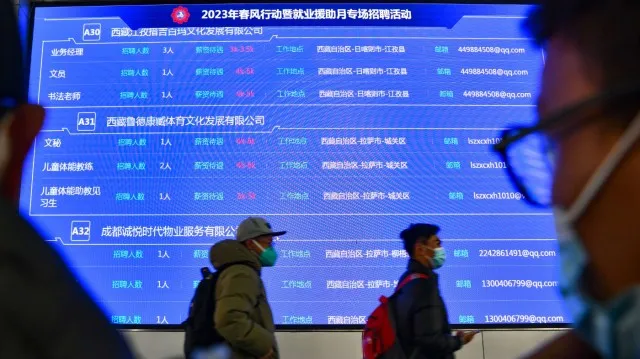
While physical destruction captures headlines, the most pervasive mechanism of control lies in the radical re-engineering of daily life through "labor transfer." The Chinese Communist Party frames this as poverty alleviation, but the statistics reveal a relentless drive to uproot Tibetans from their land. In 2025 alone, the Tibet Autonomous Region transferred 660,000 farmers and herdsmen into state-mandated employment. This figure -- the highest recorded in recent years -- exceeds the state's own targets and represents a massive proportion of the rural workforce in a region of only 3.7 million people.
"Labor transfer" may sound like a benign economic initiative. In the context of China's ethnic policy, however, it is a euphemism for coercive displacement. Validating this reality in January, five United Nations experts issued an urgent warning that China's vocational training and labor transfer schemes are coercive instruments threatening the irreversible erasure of Tibetan identity.
The Chinese Communist Party views the traditional Tibetan way of life not merely as economically inefficient, but as an ideological threat. State-funded researchers have explicitly labeled traditional Tibetan culture -- with its prioritization of spiritual pursuits over material gain -- as a source of so-called spiritual poverty that strangles the competitive spirit. The state's prescribed antidote is to stimulate inner motivation, a chilling party term for breaking the populace's will to remain on their land.
This is not market-driven migration but command-economy mobilization. Village-based work teams go door-to-door issuing work requirements and using what they call "grid management" surveillance to identify resistance. Refusal is branded as "laziness," often resulting in state retribution. The message is clear: The only state-sanctioned livelihood requires abandoning the traditional pastoral life.
By 2025, this system had hardened from a mobilization campaign into a normalized bureaucracy of control. Simultaneously, the scope of this erasure is widening. While many are moved to urban centers within Tibet, there is a concerted effort to transfer Tibetans to eastern Chinese provinces, severing them from their cultural roots. This drive for maximum employment serves a darker national security goal: atomizing the cohesive communities that act as incubators for dissent.
Facing this reality, the United States must look past the transactional allure of trade agreements. Mere condemnation is insufficient; Washington requires a strategy that imposes real costs on the architects of this erasure.
First, Washington must implement targeted sanctions against Chinese communist officials enforcing work programs that erase traditional livelihoods. Tibet's forced labor is, in effect, an illicit state subsidy that steadily undercuts American workers with artificially cheap goods.
Second, the U.S. must expand its supply chain scrutiny. Just as the Uyghur Forced Labor Prevention Act targeted abuses in Xinjiang, we must rigorously investigate supply chains connected to Tibetan labor transfers -- particularly in sectors receiving these transferred workers in eastern provinces.
Finally, we should leverage the International Labor Organization's newly updated guidelines, which now explicitly recognize these state-imposed transfers as forced labor, to challenge Beijing's narrative in international fora.
The 660,000 Tibetans transferred last year are not merely statistics in a government report; they are the victims of a silent, bureaucratic erasure. U.S. policy must reflect that reality.
Adrian Zenz, Ph.D. is director and senior research fellow at China Studies at Victims of Communism Memorial Foundation.