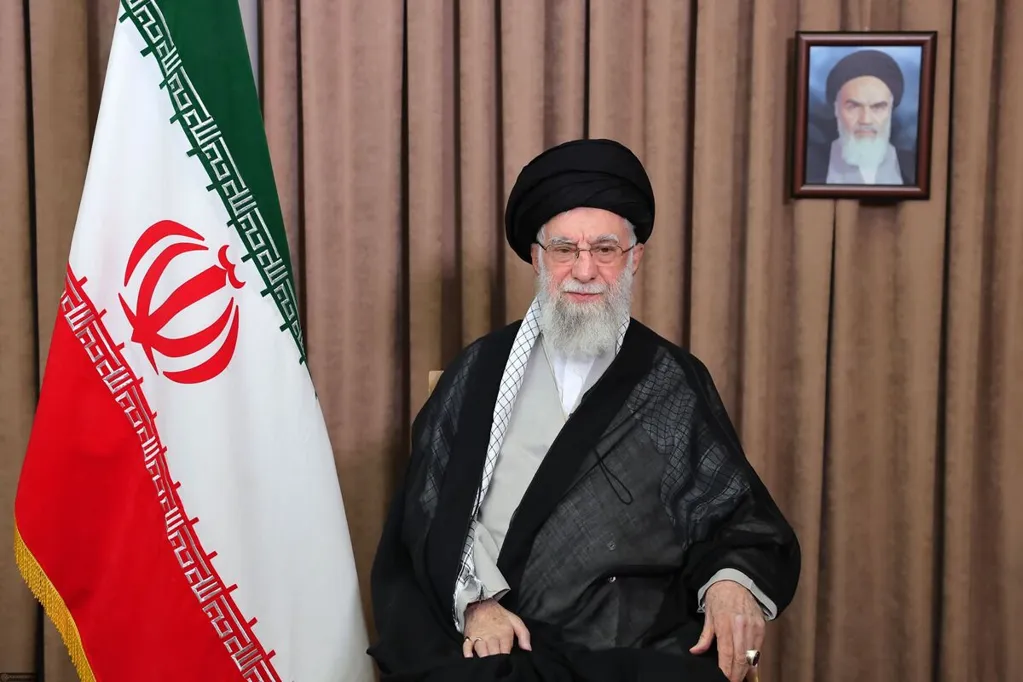
Khamenei dominated every aspect of Iran for more than three decades, defining Iran's position in the Middle East as a staunch enemy of Israel and an uncompromising obstacle to US attempts to influence and shape the region.
Ayatollah Ali Khamenei, the supreme leader of Iran who dominated every aspect of the country for more than three decades as it faced off with the West, was killed Saturday after the US and Israel launched airstrikes on Iran, according to President Donald Trump. He was 86.
"This is not only Justice for the people of Iran, but for all Great Americans, and those people from many Countries throughout the World, that have been killed or mutilated by Khamenei and his gang of bloodthirsty THUGS," Trump wrote in a social media post.
With Khamenei's demise, a hugely consequential chapter in Iran's modern history closes with little certainty over what comes next or who's lined up to succeed him.
A senior member of the clergy, or ayatollah, Khamenei emerged from the religious, anti-imperialist movement that took control of the country's 1979 revolution. With his white beard, clerical robes and black turban, he projected the image of an austere and puritanical patriarch. An unsmiling figure, Khamenei never left Iran after taking office. He used his authority to suppress protests against his leadership and the Islamic system that he helped build. His unflinching response to the backlash against his views on women's rights and civil liberties reinforced his reputation as a leader willing to kill hundreds of civilians to stay in power.
Khamenei defined Iran's position in the Middle East as a staunch enemy of Israel and an uncompromising obstacle to US attempts to influence and shape the region. He made sure his deep-seated distrust and contempt for the US -- which stemmed from Washington's history of interference in Iranian politics and its propping up of a monarchy that had imprisoned him -- was always at the forefront of Iranian political life. He repeatedly called for the destruction of Israel, characterizing it as a cancerous tumor in the region.
Commitment to Jihad
Khamenei "sought relentlessly to transform the traditional Islamic concept of jihad" -- a faith-based struggle against evil, as represented by the West and especially the US -- "and to establish it as the central issue in the Islamist regime's ideology," wrote Mehdi Khalaji, a senior fellow at the Washington Institute for Near East Policy.
While Khamenei was far from alone in his emphasis on jihad, his "novel contribution" was to make it "the grounding of the entire ideological system of the Islamic Republic and the sole basis of the Iranian regime's statecraft," Khalaji wrote.
From 1989, when he succeeded Ayatollah Ruhollah Khomeini as supreme leader, Khamenei protected the interests of hard-line religious institutions and the military -- often going against the grain of popular opinion, which mostly favored reform and closer ties to the West. When an uprising began in 2022, Khamenei responded with a deadly crackdown involving both the security forces and the use of judicial executions.
Khamenei's impact went well beyond Iran's borders. A self-styled global leader of Shiite Muslims, the faction of Islam dominant in Iran, he oversaw the expansion of the Islamic Revolutionary Guard Corps, Iran's premier military force and an agent for its projection of power abroad. He allowed the guard -- which has its own ground, air and naval divisions and plainclothes militia -- to build a business empire encompassing as much as 40% of the economy. In return, its commanders gave him unflinching loyalty.
Iran built a powerful network of state and non-state allies throughout the Middle East that would fight on Iran's behalf and act as a ring of deterrence against Israel and other US allies. As its use of these proxies -- including Hezbollah in Lebanon, Hamas in Gaza, militias in Iraq and the Houthis in Yemen -- expanded, Iran invited heavy criticism from Arab neighbors, many of whom decried it as dangerous interference.
Khamenei gained significant influence for Iran in Iraq, Syria, Lebanon, Yemen and the Palestinian territory known as the Gaza Strip. He did it in part by backing militias and fighting proxy battles against the US and its allies, including the Sunni Arab monarchies in the Persian Gulf who helped fund Iraq's war against Iran in the 1980s and later supported US sanctions on Iran's economy.
The terrorist attacks on the US on Sept. 11, 2001, brought a rare period of cooperation between Washington and Tehran over their mutual war on the Taliban. But this abruptly ended when then-US President George W. Bush referred to Iran as part of an "axis of evil" in his State of the Union address the same year, erasing any goodwill that had been established by the erstwhile foes.
After the US-led invasion of Iraq in 2003 brought 150,000 American troops to Iran's border, the Revolutionary Guard began organizing and arming Shiite militias to attack US forces in Iraq.
In 2014, Iraq's government formally endorsed the militias as a means of fighting the Islamic State group. Their firepower and prominence gave Iran leverage to shape Iraqi governments.
Iran provided on-and-off assistance to the Palestinian group Hamas, the Sunni organization that opposes Israel's existence and controlled Gaza, from which it launched a deadly attack on southern Israel in October 2023. The crushing Israeli response fundamentally altered the power balance in the Middle East and devastated Khamenei's so-called Axis of Resistance.
Israel killed Hamas' top leadership and thousands of its fighters, and its strikes on Lebanon crippled Hezbollah, Iran's flagship ally. Syrian President Bashar al-Assad’s sudden ouster in December 2024 -- just months after he was photographed meeting with Khamenei in Tehran -- was the final blow to Khamenei’s Levantine alliance.
While Khamenei insisted that Iran didn't seek atomic weapons, which he said were forbidden under Islam, he directed his country's development of a complex nuclear program that the West long suspected of having a military dimension. In 2015, it agreed to cap its nuclear activities in exchange for relief from economic sanctions. But that international accord was undercut three years later when Trump, during his first term, withdrew the US.
After Israel launched a surprise attack on Tehran last year -- wiping out most of the Islamic Republic's air defenses and killing several top generals as well as hundreds of civilians -- the US bombed key nuclear sites using some of the biggest ordnance in its arsenal. At the time, Trump claimed they'd been "obliterated."
The nationwide revolt against Khamenei that erupted in January 2026 followed a slump in the national currency that made even basic goods unfordable for much of the population. Students, workers and other groups called not just for an improvement in living standards but an end to Khamenei's theocratic regime.
Security forces killed thousands and arrested many more, as Khamenei declared that "rioters must be put in their place."
Studied Under Khomeini
Khamenei was born on July 17, 1939, in a one-room house in the northeastern city of Mashhad, the son of a religious scholar. At 19, he settled in Qom, the center of Shiite scholarship. There he studied under Khomeini, who later became the Islamic Republic's first supreme leader.
He joined the underground movement seeking to overthrow the US-backed monarch, Shah Mohammad Reza Pahlavi, and was repeatedly arrested and tortured. He spent three years in internal exile.
After Islamic revolutionaries took over Iran in 1979, Khamenei was appointed to lead Friday prayers in Tehran. An assassination attempt two years later crippled his right arm; but within months he became president—Iran’s top elected official.
Although always conservative, Khamenei entered politics as a pipe-smoking soft-spoken cleric with an interest in poetry and fiction. The father of six children with his wife Mansoureh Khojasteh Bagharzadeh he cultivated friendships with musicians and secular intellectuals.
An early test of his presidency came in 1980 when neighboring Iraq under Saddam Hussein invaded Iran plunging country into a grinding eight-year war. During that span Khamenei developed an ever-closer relationship with Revolutionary Guard.
It was largely through Guard that Khamenei expanded Iran’s influence abroad. The initial focus was in Lebanon where Iran backed Hezbollah—the Shiite group formed in 1982 in response to Israel’s invasion and subsequent military occupation of country’s south. The Guard’s Quds Force—or international brigade—was created in 1988 to “establish popular Hezbollah cells all over world,” as Khamenei put it.
Constitutional Amendment
At the time of Khomeini’s death in June 1989 Khamenei wasn’t the obvious choice to become Iran’s next ultimate ruler. His scholarly credentials were below those required by constitution necessitating an amendment.
Starting in 1989 with Ayatollah Akbar Hashemi Rafsanjani Iranians elected several moderate conservative and reform-minded presidents during Khamenei’s long rule. All the while he took steps to appease burgeoning public support for change in Iran’s cities while ensuring mood didn’t threaten his hardline clerical rule.
Protests over alleged fraud in the 2009 reelection of President Mahmoud Ahmadinejad an acolyte of his challenged Khamenei’s hold. He responded by harshly suppressing the so-called Green Movement an experience that showed he could rule with an iron grip if he needed to. From that point on “death to the dictator” or “death to Khamenei” were popular slogans in protests and uprisings and security forces became increasingly violent and brutal in their response.
In 2013 Ahmadinejad was succeeded by a relative moderate Hassan Rouhani. It was he who two years later secured the deal with US and other world powers to lift sanctions in exchange for limits on Iran’s nuclear program.
Khamenei grudgingly blessed the agreement while expressing skepticism that other parties would adhere to it. Trump’s decision in 2018 to abandon the deal and reimpose sanctions vindicated Khamenei’s apprehension. It also doomed Rouhani —who had been touted by moderates as a potential successor to supreme leader—to political purgatory.
In 2019 a sudden hike in gasoline prices provoked some of worst violence between civilians and security forces country had seen since revolution at time. Hundreds of people were killed according to rights groups.
Hard-line conservatives took control of parliament in 2020 just as Covid-19 was taking its toll on Iran’s already struggling economy. As pandemic was killing more people in Iran than anywhere else region Khamenei announced a ban on vaccines that were manufactured by pharmaceutical firms based US or Europe.
The Revolutionary Guard was condemned by public in 2020 when it shot down a Ukrainian airliner filled with Iranian nationals in tense aftermath of US drone attack that killed Khamenei’s top general Qassem Soleimani. Khamenei,in rare sermon defended Revolutionary Guard making clear pain victims’ families wider public came second loyalty security apparatus sustained him.
The 2022 uprising was led by women and youth in response to death custody of 22-year-old woman arrested for allegedly violating Iran’s strict female dress code. Khamenei’s ossified worldview archaic laws were being directly challenged by generation born decades after revolution that he helped lead. It was bloodiest most powerful convulsion against state until protests early 2026.