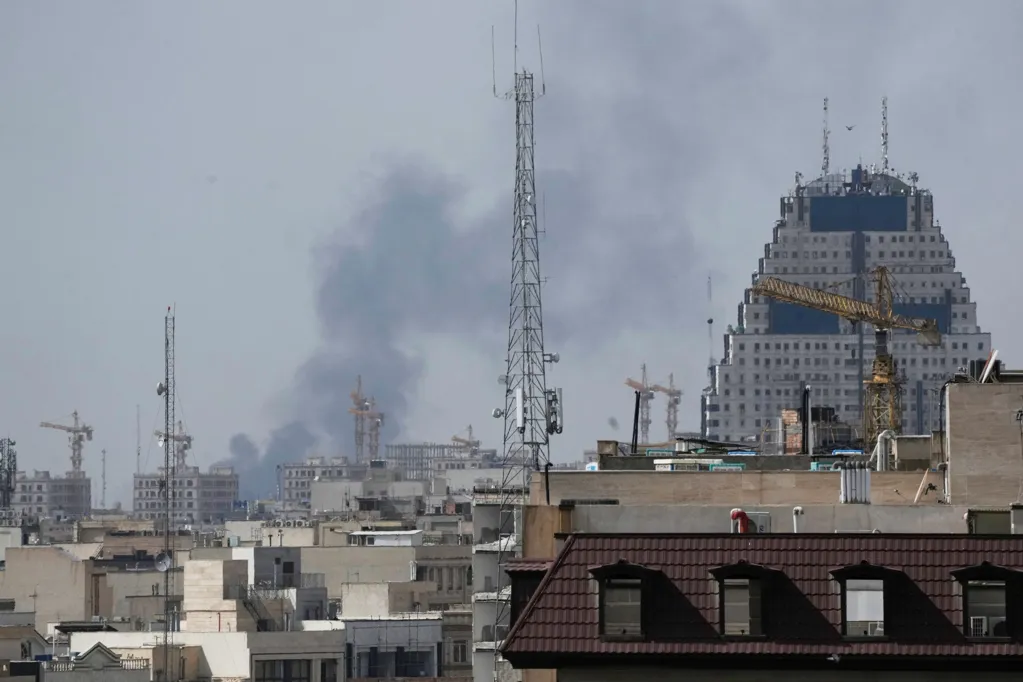
INDIANAPOLIS (WISH) -- Two members of Indiana's best political team on Sunday said the air strikes on Iran could pose a risk to President Donald Trump depending on what happens next.
Joint U.S.-Israeli air strikes that began early Saturday morning already have killed a number of top Iranian leaders, most notably Supreme Leader Ayatollah Ali Khamenei, who has held final say over all Iranian policy since 1989. The strikes have also hit a number of targets related to Iran's armed forces and domestic security apparatus.
In remarks shortly after the strikes began, President Trump called on the Iranian people to rise up and overthrow the Islamic regime, which has ruled the country since the 1979 Islamic Revolution that toppled Mohammad Reza Pahlavi, the last shah of Iran. So far, there are no reports of any significant uprising in the country.
Trump has long made opposition to what he calls "forever wars" a central campaign platform. The Iraq War was still fresh in voters' minds during his run for his first term in 2016 and the Afghanistan War, which lasted from 2001 until 2021, is by far the longest war in American history.
Whitley Yates, former Director of Diversity and Engagement for the Indiana Republican Party and an All INdiana Politics contributor, said she doesn't think the strikes on Iran go against that platform, noting Iran's decades-long support for terrorism directed at the United States and its allies in the Middle East, particularly Israel.
Yates said Trump will still have to think carefully about his next steps in order to ensure the United States does not end up in another long war with Iran.
Democratic members of Congress, including Indiana Rep. Andre Carson, have said Trump failed to adequately notify or consult with Congress prior to launching the strikes, criticism they also leveled at the January raid in which special operations forces captured Venezuelan President Nicolas Maduro.
Democratic strategist and All INdiana Politics contributor Lara Beck said that will be a problem for Trump, particularly if the United States gets dragged into another protracted conflict in the Middle East.
Iran and the United States have waged numerous proxy campaigns against each other since 1979 but direct military confrontations are rare. With the exception of the strike by American B-2 stealth bombers in June of last year, the last major combat operation against Iran was Operation Praying Mantis in 1988, when the United States attacked Iranian oil rig military installations and vessels in retaliation for the near-sinking of the USS Samuel B. Roberts by an Iranian mine. That operation played out against a broader effort by the U.S. Navy to protect Kuwaiti oil tankers transiting in and out of the Persian Gulf in the waning days of the Iran-Iraq War.
Iranian officials have said a provisional leadership council has already been formed and they expect a new supreme leader will be chosen in the next couple of days. That process is carried out by an elected body of 88 senior clerics known as the Assembly of Experts. Both Beck and Yates said post-Khamenei Iran carries tremendous risks.
"They are sophisticated cyber actors," Beck said. "They can do quite a bit to us. They could also, the instability with their military could also cause issues, especially to American issues in Europe."
Yates said U.S. leaders will have to be decisive.
"I'm not going to pretend as though we have not had issues in the Middle East," she said. "But I will say that making sure that there is a dismantled nuclear program within Iran as well as ensuring that the Islamic regime is not active and continuing to push the line and create terror, specifically among our allies in Israel, is important to the United States."
All INdiana Politics airs at 9:30 a.m. Sundays on WISH-TV.