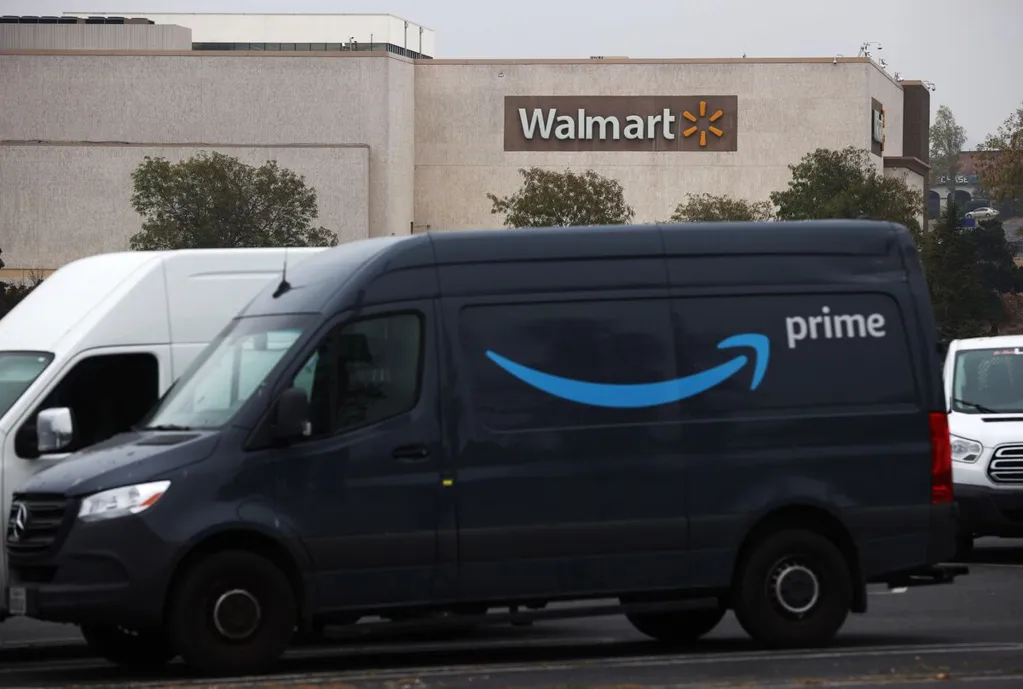
The world's largest company measured by revenue is now Amazon. Spencer Soper covers the company and writes about why this milestone passed quietly on Wall Street. Plus: Five Below is where kids want to spend their allowances.
Amazon.com Inc. shocked investors this month when it announced plans to spend $200 billion in 2026 on data centers, chips and similar indulgences, intensifying fears that the tech industry's investments in artificial intelligence infrastructure are so colossal, they may never be fully recouped. The pledge followed other big-spending commitments from Alphabet, Meta Platforms and Microsoft.
Wall Street's obsession with AI appears to have buried the lead, though. While analysts and investors were poring over the details of the company's tech strategies and what they might mean for the broader AI market, many seem to have missed an important detail: Amazon has dethroned Walmart Inc. as the world's biggest company by revenue. The retailing giant this morning reported sales of $713 billion for the fiscal year that ended Jan. 31, below Amazon's $717 billion in sales for calendar year 2025.
Leading the world's companies in sales is seen more as a measure of global scale and consumer reach than overall value and profitability, but it's still worth some bragging rights. Walmart had been on that perch for more than a decade, joining a rarefied club that includes the likes of Exxon Mobil Corp. and General Motors Co.
Amazon's ascendance is only partly attributable to its strength in retail and shouldn't be viewed as an imminent threat to Walmart's grip on the US consumer. Instead, the shift highlights the importance of cloud computing in the modern economy. Amazon is the world's biggest data center owner, a business that's growing faster than the web store most people know. Its revenue without cloud computing was $588 billion -- huge by any yardstick, but more than $100 billion shy of Walmart's overall sales. And the IRL behemoth’s annual e-commerce sales in the US are expected to grow nearly three times as quickly as Amazon’s this year, indicating it’s gaining market share, according to EMarketer Inc.
The retail fight between Amazon and Walmart will likely play out for years to come, with Walmart refining its thousands of stores as mini e-commerce distribution hubs and Amazon pushing deeper into rural America for more sales, where the competition from Walmart will be toughest.
But Wall Street is barely paying attention to that fight. On recent Amazon earnings calls, analysts have narrowly focused on what the company is spending on its data centers and how fast its cloud-computing revenue is growing. If the cost of the expansion outpaces sales growth, investors get skittish.
It’s a familiar pattern for veteran Amazon observers. The company’s push into a national warehouse network, which played out largely from 2007 to 2015, was fraught with tension between founder Jeff Bezos and shareholders, who accused him of operating a “nonprofit.” Bezos reinvested in the company’s growth at the expense of profit margins, and it took years for him to get investors fully on board.
Today, Bezos’ successor as CEO, Andy Jassy, finds himself in a similar tussle, but this time it’s about data centers rather than warehouses. And just like Bezos, Wall Street is more focused on how much he’s spending than on how much he’s bringing in. That’s as good an explanation as any as to why Amazon seizing the revenue crown from Walmart has generated such scant interest among investors.
In Brief
- Andrew Mountbatten-Windsor, the brother of the UK's King Charles III, has been arrested on suspicion of misconduct in public office after further details emerged of his relationship with convicted sex offender Jeffrey Epstein.
- OpenAI is close to finalizing the first phase of a new funding round that's likely to bring in more than $100 billion, according to people familiar with the matter.
- The US military build-up in the Middle East means Iran's window to reach a diplomatic agreement over its atomic activities is at risk of closing, according to the head of the UN nuclear watchdog.
I remember very little about Little House on the Prairie, but I remember this: On Christmas morning, Laura and her sister each receive in their stockings a tin cup, a peppermint stick, one heart-shaped cake and a shiny new penny. “Think of having a whole penny for your very own,” the book reads. “There had never been such a Christmas.” Even at 6 years old, I remember understanding that this was very exciting for them, given their time and place, their wholesome-seeming simplicity and Protestant work ethic. I also remember thinking, guiltily, “I would not be excited by this.” Later in the book, she is given -- and thrilled by -- a decorative comb.
Standing in a subterranean Five Below in Downtown Brooklyn, inspecting a package of fidget toys shaped like butts, I think about Laura, who would, in contemporary times, be in Five Below Inc.’s target demographic. Five Below, a kids’ retail giant, isn’t simple and is only debatably wholesome. It doesn’t sell tin cups. It does, however, sell a wide selection of oversize Stanleyesque tumblers. Neither a toy store nor a dollar store, it’s a wonderland of stuff, most of it imported, much of it plastic and almost all of it $5 or less. (Last year the company began integrating higher-priced items, once relegated to their own special “Five Beyond” section, onto the regular shelves.) It seems they’ve tapped into the youth psyche. Five Below will end the 2025 fiscal year with more stores than ever: 1,921 stores in 46 states. The goal is to top 3,500 over the next decade.
When the first Five Below opened outside Philadelphia in 2002, it positioned itself as a tween and teen destination—a store for 8- to 15-year-olds with allowance-friendly prices. It’s working, Rachel Sugar writes: Kids Want Cheap Stuff, and Lots of It. Five Below Delivers
Hedge Fund Haul
$3.4 billion
That’s how much Steve Cohen took home from his hedge fund, Point72 Asset Management, in 2025. That payday, which works out to more than $9 million a day, puts the New York Mets owner at the top of Bloomberg’s annual list of the world’s best-paid hedge fund managers for the first time.
Cost of Living
“I think about what life used to be like: We could go on vacations; we could afford to eat out without worrying about living paycheck to paycheck.”
Justin Kevin Rodriguez, 25
North Plainfield, New Jersey resident who is helping his parents and grandmother keep up with rising household expenses
The great inflation shock of the 2020s, which helped bring President Donald Trump back to power, is in the rearview mirror. But the hangover is all around. Shoppers have been forced to get used to a new normal they plainly resent. While inflation has slowed overall, the costs of things Americans often want or need the most continue to rise -- like groceries, utilities and housing.