The United States used a form of artificial intelligence during the military operation to capture Venezuelan President Nicolas Maduro.
The use of Anthropic artificial-intelligence tool Claude highlights how AI use is gaining traction in the Pentagon. But the program's makers have raised concerns about the risks of using modern technology.
It is understood that Anthropic was the first AI model developer to be used in classified operations by the US's Department of Defense following a $200 million contract with the company last year.
However, the developers have refused to comment on whether the software was used in any specific operation.
They have also said Anthropic's usage guidelines prohibit Claude from being used to facilitate violence, develop weapons or conduct surveillance.
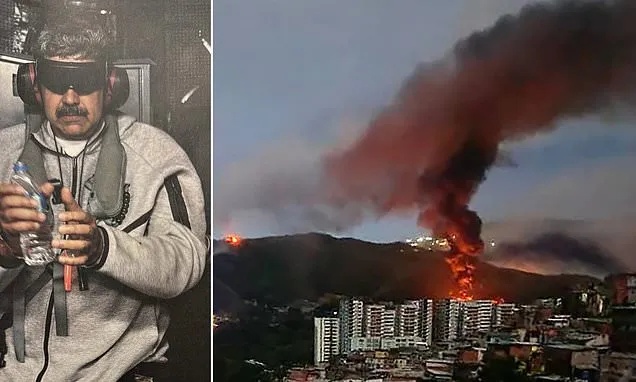
Despite this, the mission to capture Maduro and his wife on January 3 involved the bombing of several sites across Venezuela's capital Caracas.
'We cannot comment on whether Claude, or any other AI model, was used for any specific operation, classified or otherwise.'
Multiple fires were blazing across the Venezuelan capital of Caracas following the US's military operation. It is understood that Anthropic was the first AI model developer to be used in classified operations by the US's Department of Defense.
'Any use of Claude - whether in the private sector or across government - is required to comply with our Usage Policies, which govern how Claude can be deployed. We work closely with our partners to ensure compliance,' a spokesperson for Anthropic told the Wall Street Journal.
The use of Claude occurred through Anthropic's partnership with data company Palantir Technologies.
However, the companies' concerns about how Claude can be used by the Pentagon have pushed administration officials to consider canceling its contract worth up to $200 million.
And Chief Executive Dario Amodei has been publicly grappling with the power of the technology and the risks they could pose to society; he's called for greater regulation and guardrails to prevent harms from AI.
Mr. Amodei's intervention has put the company at loggerheads with the Trump administration after Anthropic also publicly expressed concern about AI's use in autonomous lethal operations and domestic surveillance.
It was later accused of undermining Trump's low-regulation AI strategy by calling for more guardrails and limits on AI chip exports.
Despite this, the adoption of AI by the US military is seen as a key boost for AI companies that are competing for legitimacy and seeking to live up to their enormous valuations from investors.
Other companies such as OpenAI and Google's Gemini are now used by three million US military personnel including a custom version of ChatGPT which will be used for analysing documents, generating reports and supporting research.
After weeks of meticulous planning and waiting for the weather to be 'perfect', Mr Trump gave the go-ahead for Operation Absolute Resolve at 10.46pm Eastern Standard Time on Friday January 3 (11.46pm in Venezuela, 3.46am on Saturday in the UK) with the words: 'Good luck and God speed.'
US forces reached the Venezuelan leader's home at 1.01am EST and were back over the sea returning to the USS Iwo Jima by 3.29am, although a Pentagon source said the ground firefight and capture of Maduro took less than 30 minutes.
Around a dozen Special Forces troops entered Maduro's heavily guarded compound by 'fast roping' - deploying rapidly from helicopters by sliding down ropes - before facing heavy gunfire.
After Maduro and his wife were found they were were taken out in a matter of seconds', Trump said.