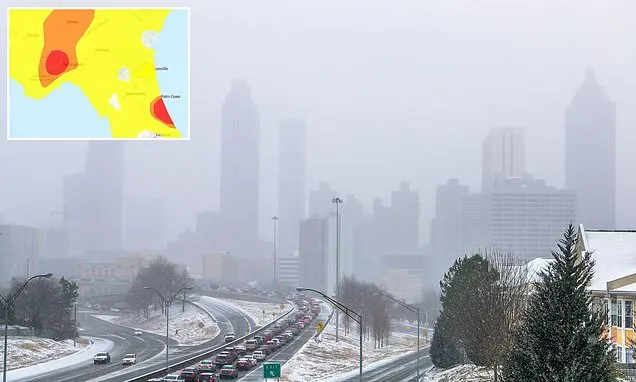
Thousands of Americans near two major cities have been warned to stay inside as airborne pollutants have risen to dangerous levels for human health.
Air quality meters from the US Environmental Protection Agency (EPA) sounded the alarm Tuesday morning, showing unsafe conditions in both Daytona Beach, Florida and Atlanta, Georgia.
Live tracking data captured sharply elevated levels of PM2.5, microscopic particles composed of toxic compounds or heavy metals that are small enough to penetrate the lungs, inflame the respiratory system, and even contribute to heart attacks.
The increased levels have been tied to recent wildfire smoke exacerbating a condition called stagnant air, where little to no wind and high atmospheric pressure trap pollution near ground level.
Unhealthy Air Spikes Across Florida and Georgia
In Daytona Beach, a coastal city with roughly 80,000 residents, PM2.5 concentration was recorded at 12.5 times higher than the World Health Organization's recommended safe limit.
Both the EPA and air quality-tracking website IQAir warned that the air in Florida had reached 'unhealthy' levels for all residents, exceeding 150 on the Air Quality Index (AQI).
Around Atlanta's suburban areas, multiple readings surpassed 150 and even 160, including in Dallas, Powder Springs, Roswell, and Vinings.
Air quality levels are measured on a scale from 0 to 500: good (0-50) carries little risk, moderate (51-100) may affect sensitive individuals, unhealthy for sensitive groups (101-150) poses increased risk, and unhealthy (151-200) impacts everyone, limiting outdoor activity.
Air Pollution Soars to 15× Safe Limits
Parts of the Georgia suburbs saw PM2.5 concentrations more than 15 times higher than the WHO's recommended safe levels.
Residents in the affected areas have been advised to avoid outdoor exercise, wear a face mask if going outside, close all windows to prevent polluted air from coming inside, and turn on air purifiers if you own one.
Even short-term exposure to high levels of these particles can cause concerning health problems, including irritation of the eyes, throat, and nose.
Among vulnerable individuals, breathing in particles produced by smoke, car exhaust, and factory emissions can also lead to irregular heartbeats, asthma attacks, coughing, chest tightness, and shortness of breath.
On Sunday and Monday, a portion of I-95 was shut down just south of Daytona Beach due to wildfire smoke and low visibility.
To understand the impact of stagnant air on this situation, it's helpful to look at atmospheric pressure. Pressure is measured in millibars, with normal sea-level pressure being 1,013 millibars.
Calm Skies, Toxic Air: Why Pollution Isn't Clearing
High pressure in both areas of Georgia and Florida registered above 1,020 millibars on Tuesday, often bringing calm, stable, dry weather with clear skies and light winds.
However, it also keeps whatever is in the air from moving out or scattering higher up in the atmosphere.
In 2025, the American Lung Association gave Daytona Beach's Volusia County a 'B' grade in terms of particle pollution, noting that the area had some of the cleanest air in the state.
Georgia's Cobb and Fulton counties, which include Atlanta, also received a healthy 'B' grade from the American Lung Association.
However, Paulding County, which includes Dallas and Pickett's Mill, did not receive a grade from the group in 2025.
Both towns saw PM2.5 levels soar into the 'unhealthy' range on Tuesday and are near an area reportedly at risk for wildfires in Braswell, Georgia.
According to the EPA, there are also six 'prescribed fires' taking place just 75 miles west of the Atlanta suburbs, in Alabama's Talladega National Forest.
A so-called prescribed fire, or controlled burn, means officials have carefully planned and intentionally set fire to areas to reduce their overall wildfire risk, clear excess brush and dead plants, improve wildlife habitats, or restore healthy natural ecosystems.
Americans told to 'stay inside' as air fills with toxins
Thousands of Americans are at risk of breathing in dangerous toxins on both the East and West Coasts, with officials warning that local air quality could cause 'serious health effects.'
The US Environmental Protection Agency (EPA) reported on Wednesday that air quality levels had reached 'unhealthy' levels in portions of California and Oregon, including over the city of Los Angeles, home to nearly four million people.
The increased leaves are due to little to no wind and high atmospheric pressure trapping pollution near ground level.
In parts of Hollywood, Air Quality Index (AQI) readings reached 170, classified as unhealthy for all residents.
Air quality maps showed sharply elevated levels of PM2.5, microscopic particles composed of toxic compounds or heavy metals that are small enough to penetrate the lungs, creating hazardous conditions, especially for those with ailments such as asthma.
These particles come from automobile exhaust, factory fumes, and burning wood, which, when inhaled, can inflame the human respiratory system.
A large swath of Oregon, including the La Pine and the Deschutes National Forest, has seen AQI levels rise above 160 on Wednesday morning, fueled by polluted air being unable to move out of the area.
The EPA's AirNow monitoring system also highlighted large areas of Georgia and South Carolina, including cities like Savannah and Valdosta, that are seeing air quality deemed 'unhealthy for sensitive groups.'
Air quality levels are measured on a scale from 0 to 500: good (0-50) carries little risk; moderate (51-100) may affect sensitive individuals; unhealthy for sensitive groups (101-150) poses increased risk; and unhealthy (151-200) impacts everyone, limiting outdoor activity.
According to the live air quality-tracking website IQAir, Los Angeles is currently the most polluted city in the US. IQAir warned that PM2.5 levels in the city were 5.2 times higher than the World Health Organization's recommended safe limit on Wednesday.