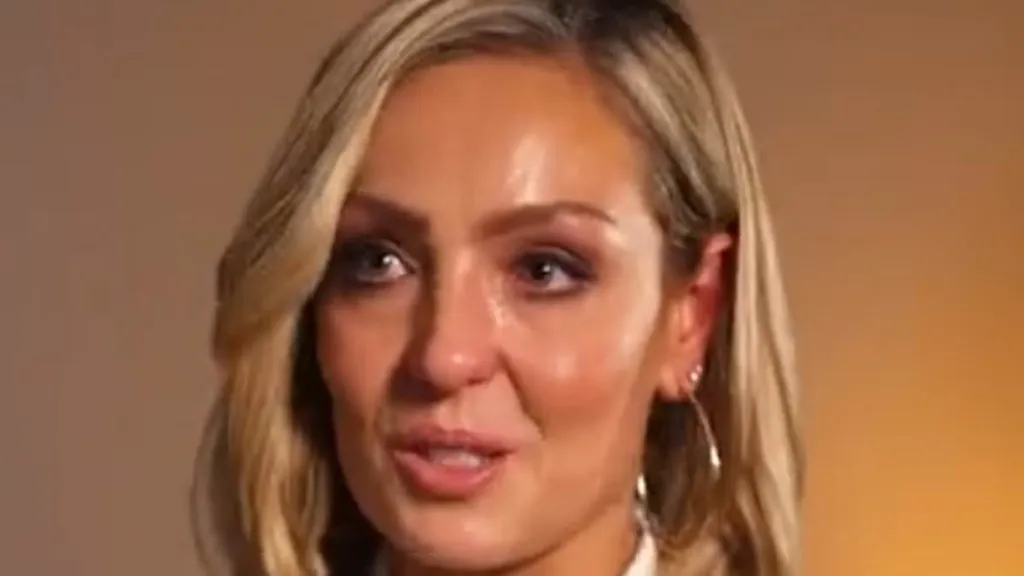
Amy Dowden has opened up about her desire to have children after being forced into medically-induced menopause following her chemotherapy treatment for cancer.
The Strictly professional, 35, emotionally revealed that whether or not she will become a mum is still a 'big dark cloud'.
Amy was diagnosed with cancer in May 2023 and underwent treatment including a mastectomy, chemotherapy, fertility treatment and also almost died of sepsis, before undergoing a second surgery in November last year.
In February 2024, Amy was given the all clear for the disease and has since returned to Strictly Come Dancing, having been paired with Thomas Skinner on last year's series.
The Welsh star has been married to fellow dancer Ben Jones since 2022, and the couple previously said they have frozen five embryos.
'Obviously, there is a big, dark cloud over me. Will I become a mother? I've wanted to be a mummy since I was a little girl,' Amy told The Mirror.
Amy Dowden, 35, has opened up about her desire to have children after being forced into medically-induced menopause following her chemotherapy treatment for cancer.
Amy was diagnosed with cancer in May 2023 and underwent treatment including a mastectomy, chemotherapy, fertility treatment and also almost died of sepsis, before undergoing a second surgery in November last year.
'I was one of those girls who would always have a little baby Annabelle. And I have two gorgeous nephews, who I love to pieces. But we will cross that bridge when it comes to it and I will explore every option going.'
In December, Amy reflected on her cancer battle with a poignant post depicting 'the lowest she's ever been' compared to her joyous current self.
The star shared a heartbreaking image from two years previously showing her in a hospital bed having lost her hair and displaying a cannula in her hand, while an accompanying image showed her as a picture of health.
Her heartbreaking caption detailed how she felt she would 'never get the old Amy back' and that she was sure cancer 'taken away her dancing shoes', yet paid tribute to her husband Ben and co-star Carlos Gu for helping her recover.
Alongside the duo of images, Amy wrote:
'EXACTLY two years apart THIS WEEKEND. When I see memories like this it makes me so very proud...
‘The bottom picture was after I was rushed into hospital via ambulance very poorly. I didn’t know at the time but I had another blood clot on the lung but also all the sides effects of 8 rounds of gruelling chemotherapy...
‘I still remember now as I entered the ambulance I turned to [my husband] Ben and my dear friend and said cancer has taken me, I’ll never be the same again, ill never dance again ( i was at at the lowest point I’d ever been)...
‘My foot also broken and I couldn’t see how I could ever get the old Amy back. Pic 2 two years later exactly, after a year of two dancing tours, strictly and fabulous opportunities but most importantly three weeks after another mastectomy...
‘It didn’t come easy, after a year of real hard work but it got me feeling like me again. I’m posting this to show it’s POSSIBLE. Yes it’s been hard but I DID IT...
‘I wish I rewarded myself more along the way. But gosh am I so proud of how far Ive had to dig deep, especially in the past 12 months...
‘A year ago I thought cancer took my dancing,I told myself I needed to hang my dancing shoes up but my darling husband Ben and [fellow Strictly star] Carlos Gu proved and made sure it didn’t...
‘Tonight I raise a glass to the past year, working hard, allowing my passion of dance to save me along with my incredible medical team,family and friends. Thank you I love you all endlessly. Cancer you didn’t take and will not take who I am!’
In November 2025, Amy shared a health update as she marked two weeks since having a second mastectomy. She shared a 'post surgery' selfie wearing a compression bra and brown checked trousers.
She gushed she is 'proud of how far' she's come post-surgery and is 'focusing on little things' every day and 'celebrating the small wins'.
Amy wrote: 'This picture I took the day I come out of hospital, post surgery! Tomorrow marks two weeks since my surgery, and I'm feeling proud with how far I've come...
'Focusing on the little things, I'm seeing gradual improvements in my movement and being able to do more each day. I have been taking it slow, listening to my body, being kind with myself, and celebrating the small wins.
'But this week I've really seen a difference and feeling so like me again. Please remember to check yourself.'
Breast cancer is one of the most common cancers in the world and affects more than two MILLION women a year
Breast cancer is one of the most common cancers in the world. Each year in the UK there are more than 55,000 new cases, and the disease claims the lives of 11,500 women. In the US, it strikes 266,000 each year and kills 40,000. But what causes it and how can it be treated?
What is breast cancer?
It comes from a cancerous cell which develops in the lining of a duct or lobule in one of the breasts.
When the breast cancer has spread into surrounding tissue it is called 'invasive'. Some people are diagnosed with 'carcinoma in situ', where no cancer cells have grown beyond the duct or lobule.
Most cases develop in those over the age of 50 but younger women are sometimes affected. Breast cancer can develop in men, though this is rare.
Staging indicates how big the cancer is and whether it has spread. Stage 1 is the earliest stage and stage 4 means the cancer has spread to another part of the body.
The cancerous cells are graded from low, which means a slow growth, to high, which is fast-growing. High-grade cancers are more likely to come back after they have first been treated.
What causes breast cancer?
A cancerous tumour starts from one abnormal cell. The exact reason why a cell becomes cancerous is unclear. It is thought that something damages or alters certain genes in the cell. This makes the cell abnormal and multiply 'out of control'.
Although breast cancer can develop for no apparent reason, there are some risk factors that can increase the chance, such as genetics.
What are the symptoms of breast cancer?
The usual first symptom is a painless lump in the breast, although most are not cancerous and are fluid-filled cysts, which are benign.
The first place that breast cancer usually spreads to is the lymph nodes in the armpit. If this occurs you will develop a swelling or lump in an armpit.
How is breast cancer diagnosed?
Initial assessment: A doctor examines the breasts and armpits. They may do tests such as a mammogram, a special X-ray of the breast tissue which can indicate the possibility of tumours.
Biopsy: A biopsy is when a small sample of tissue is removed from a part of the body. The sample is then examined under a microscope to look for abnormal cells. The sample can confirm or rule out cancer.
How is breast cancer treated?
Treatment options which may be considered include surgery, chemotherapy, radiotherapy and hormone treatment. Often a combination of two or more of these treatments are used.
- Surgery: Breast-conserving surgery or the removal of the affected breast depending on the size of the tumour.
- Radiotherapy: A treatment which uses high energy beams of radiation focused on cancerous tissue. This kills cancer cells, or stops them from multiplying. It is mainly used in addition to surgery.
- Chemotherapy: A treatment of cancer by using anti-cancer drugs which kill cancer cells, or stop them from multiplying.
- Hormone treatments: Some types of breast cancer are affected by the 'female' hormone oestrogen, which can stimulate the cancer cells to divide and multiply. Treatments which reduce the level of these hormones, or prevent them from working, are commonly used in people with breast cancer.
How successful is treatment?
The outlook is best in those who are diagnosed when the cancer is still small, and has not spread. Surgical removal of a tumour in an early stage may then give a good chance of cure.
The routine mammography offered to women between the ages of 50 and 71 means more breast cancers are being diagnosed and treated at an early stage.