It was billed as an awe-inspiring mission that highlighted the astonishing ingenuity and sophistication of the world's most powerful military.
But now the story of how an American air force crewman of an F-15 fighter jet was rescued in Iran is at the centre of an extraordinary online debate over whether it was all an elaborate smokescreen to cover up a disastrous US attempt to snatch Tehran's enriched uranium.
One post by a defence commentator on X, which described the official story as 'nonsense', has attracted 1.5 million views.
Details of the drama - tailor-made for a Hollywood action film - were given by a triumphant Donald Trump two days after the plane was shot down.
The mission to rescue one airman, he said, involved a staggering 'air armada' of more than 155 planes, including four bombers, 64 fighters, 48 refuelling tankers and 13 rescue aircraft, as well as hundreds of special forces troops.
The Ghost of SEAL Team 6
The actual on-the-ground rescue was carried out under the cover of darkness by a strike force led by Navy SEAL Team 6 - the US military's most elite unit - and Delta Force commandos flying in on two Special Operations transport planes also carrying small helicopters for the mission.
But a technical foul-up - the planes got bogged down on a muddy runway - allegedly necessitated a second rescue mission with US bombers creating a ring of fire around their makeshift air base to repel Iranian forces.
The missing aviator is now safe, according to Trump, who says the team that extracted him suffered no casualties.
But the events surrounding the 'rescue' are now being hotly disputed, not least by Iran. So who is telling the truth?
Suspicions about the White House version of events have been fuelled by the lack of information about the rescued air force colonel, the plane's weapons systems officer, who has only ever been referred to by his call sign, 'Dude 44 Bravo'.
Meanwhile, his ability to walk more than a mile up a 7,000 ft ridge while - in the words of President Trump - being 'seriously wounded' and having very limited water has only strengthened the sceptics' case.
The Heartbeat Signal
The pilot of the F-15 - who ejected separately and could have landed some distance away from his fellow crew member - swiftly switched on his special beacon (which transmits an encrypted signal) and was rescued within six hours.
The US military was puzzled by why the other airman didn't do likewise but it now appears he was intent on finding a location where his signal transmission would be stronger.
Pentagon officials now say that when he did finally activate his beacon, they feared it might be an Iranian trap, as his initial radio messages were highly unusual.
According to the US TV network CBS, his first message was 'God is great' (Allahu Akbar in Arabic), which he followed with a four-digit number that the US military only belatedly realised was a police code for an officer in distress.
Rescuers were only fully convinced he was genuine when they asked him a question about his father.
It helped that he was almost simultaneously located by a new top-secret CIA device codenamed Ghost Murmur, which uses long-range 'quantum magnetometry' to trace the electromagnetic fingerprint of a human heartbeat.
The cutting-edge technology, developed by defence giant Lockheed Martin, uses AI software to isolate the correct heartbeat from 'background noise'.
The Iranian government - along with myriad online voices questioning the official US narrative - claims that the huge operation to rescue Dude 44 was, in fact, a mission to snatch its estimated 450kg of highly enriched uranium, which ended in 'complete failure'.
They cite the fact that the two Super Hercules MC-130J military transport planes involved were deployed to an airstrip near Isfahan, a city 200 miles away from where the F-15 was shot down.
Isfahan is, however, close to the Natanz nuclear site, and an attempt to seize Iran's uranium would explain the huge number of planes and special forces troops involved.
Far more, they say, than would be required for the relatively minor job of extracting a single downed airman.
Logistically Absurd
US-based defence commentator Tyler Weaver, who calls himself Armchair Warlord on X, where he has 150,000 followers, claimed the downing of the F-15 crew and the search operation were 'both fake', adding: 'Using multiple heavy transports, assault helicopters for 100+ operators is logistically absurd for rescuing one or two isolated airmen in a remote area.'
'A standard search operation would have used one-two silent helicopters at night and not of this scale.'
Destroying Iran's deeply buried uranium stockpiles has long been a priority target for Israel and the US, and numerous commentators have argued that removing them would be the strongest justification for putting American 'boots on the ground' in the country.
Prior to the rescue mission, there had been reports that Trump was seriously considering sending special forces troops to do exactly that in a limited land operation.
'What was that F-15 doing up in that area? What was its mission? I think it was preparing for a ground attack on the Natanz nuclear reactor,' said defence consultant and former CIA agent Larry Johnson in a podcast. 'The story we've been given is a lie.'
Retired US special forces officer Anthony Aguilar was among those who said the use of such large transport planes - the MC-130 is a four-engine aircraft with a 132ft wing span - indicated a much bigger objective than rescuing an airman.
He claimed the 'rescue operation expanded' to become the 'desired... high-risk operation to ALSO seize the uranium in Iran'. He added: 'This WAS intended to be that operation. It failed.'
$200 Million in the Sand
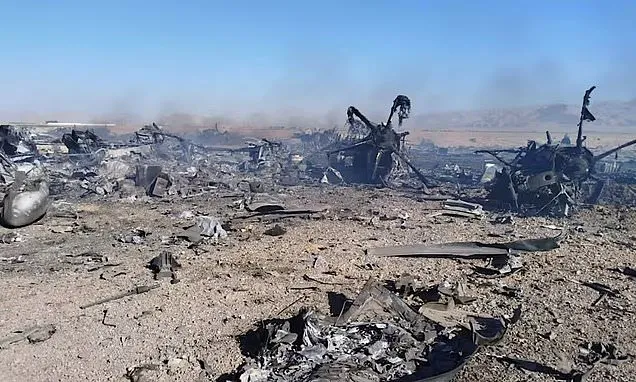
Despite being adapted to use the roughest of runways, the two Super Hercules that took part in the rescue operation allegedly couldn't take off again after landing on an abandoned airstrip.
'We blew them up to smithereens,' Trump claimed, adding: 'It was sandy, wet sand, so we thought there may be a problem taking off because of the weight of the plane. And then we also had all the men jumping back on to the planes, and they got pretty well bogged down.'
It's standard US military procedure to destroy hardware to prevent it falling into enemy hands.
Iran, however, insists the two $100million (£74million) Hercules were actually destroyed - along with two Black Hawk helicopters - by their forces in a ferocious firefight.
Anthony Aguilar disputed the claim the planes got stuck.
'I have seen MC-130Js plough through dirt, mud, snow and gravel. It is more likely that the aircraft took hits upon entry and... while on the ground,' he tweeted.
Whoever destroyed the planes, detractors have scoffed at the Trump administration's boasts about the success of an operation that cost such a vast amount in ruined high-tech kit.