Regent Theatre, Melbourne
A few great performances can't save a musical that fudges history and narrative stakes in service of sentiment and sparkle.
The real Grand Duchess Anastasia Romanov was murdered alongside her father Tsar Nicholas II and the rest of her family during Russia's Bolshevik revolution in 1918. Rumours of her survival persist - despite irrefutable evidence to the contrary - because the myth of the lost princess is a heady and seductive one, fodder for cheap historical fiction and, yes, animated kids movies. This 2017 Broadway musical - which premiered in Australia in Melbourne at the weekend, before a national tour - isn't a Disney production but it apes Disney's approach slavishly: heap with sentiment, dazzle with bling and try to say as little as possible.
Based on the 1997 film, with music by Stephen Flaherty and lyrics by Lynn Ahrens, this Anastasia (Georgina Hopson) naturally survives the completely fictional storming of her family's palace (there was one but years after their deaths) to become a street sweeper in St Petersburg. She conveniently has amnesia and believes her name is Anya, a lazy plot device from the movie that the book writer, Terrence McNally, doesn't fix.
In Petersburg, now renamed Leningrad, Anya meets two "loveable rogues": handsome Dmitry (Robert Tripolino) and portly Vlad (Rodney Dobson), the kind of emotionally generous conmen you only ever meet in musicals. With a plan to pass the young woman off as the lost princess she unknowingly already is, the trio head to Paris to meet Anastasia's grandmother, the empress dowager (Nancye Hayes), pursued by a zealous Bolshevik general, Gleb Vaganov (Joshua Robson).
It should be thrilling and evocative, the grand sweep of history underscoring the emotional upheaval in the characters' lives in the manner of Les Misérables. But there is something deeply ill considered and empty about this adaptation, not just of the animated source material but also the historical record. The Romanovs fell for complex, multifaceted reasons but they're depicted here as fragile and beautiful innocents, pure victims of Bolshevik aggression; almost nothing is made of the family's appalling wealth as their citizens starved, nor the fact that life in Paris represents banishment and shame. Never mind, let's compare tiaras.
An animated film targeted to young families can get away with this but a stage adaptation with pretensions to grandeur should respond with more nuance and sophistication to historical events, especially ones that continue to shape our world. McNally captures a sense of the shifting loyalties required in revolutionary times but he has nothing to say about power and its relationship to money. And in jettisoning the film character of Rasputin in favour of the boorish and derisive Gleb, he hobbles the narrative stakes without solving the central dilemma: how do we cheer the heir to an entirely unearned fortune as she runs to her ludicrously wealthy grandmother for confirmation of her monarchical rights?
We do it in the grand Disney tradition, by fudging historical facts in service of the most platitudinous of resolutions. We're given a story of a plucky young person "finding their identity" and "finally coming home" to Paris (despite never having lived there).
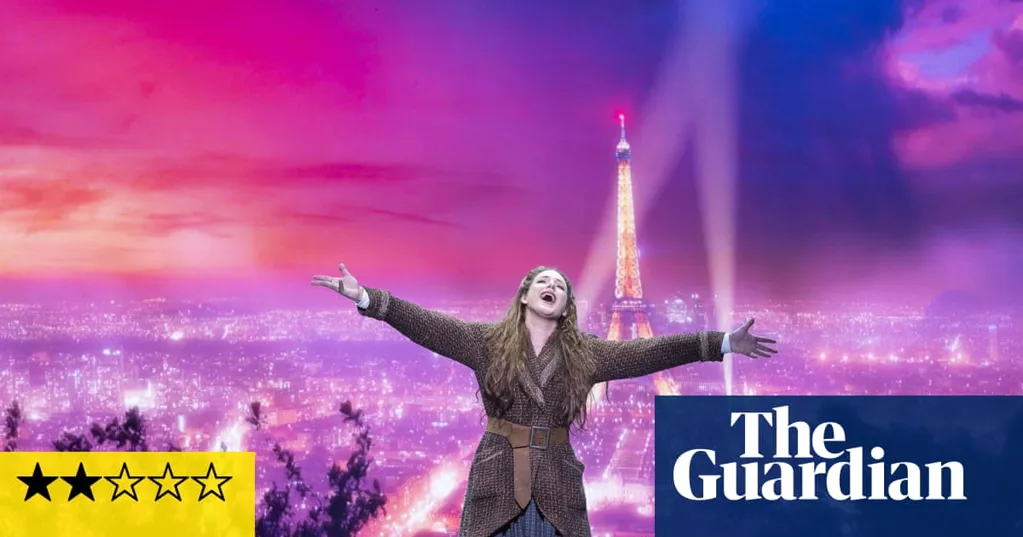
The production has a veneer of luxury - with costumes by Linda Cho and lighting by Donald Holder that evoke the sparkly magnificence of imperial Russia and jazz-crazy Paris - but is dominated by frankly ugly projections (Aaron Rhone) that are stuffed with visual cliches and lack depth and clarity. Historical images whip past us without impact or substance, from the opulence of Paris's Palais Garnier to the bustling streets of St Petersburg, and the props seem weirdly cheap and unconvincing (a key Fabergé music box looks like a dropped carburettor).
Tripolino and Dobson make a likable enough pair of Shakespearean clowns, and Robson pours some malice into the intensely committed Bolshevik. Hayes brings much-needed gravitas to the empress dowager, and Rhonda Burchmore is indispensable as the Countess Lily, the dissolute but thankfully vivid White Russian who protects the royal person. Whenever she's on stage the production heaves to life.
Crucially, and perhaps fatally, Hopson is simply miscast as the young ingenue and engine of our story. She has gumption and determination but little of the effortless charm and vulnerability the part requires, and her voice often sounds stretched and inelegant. Some terrible wigs and a Paris costume that brings Nurse Ratched to mind don’t help.
The creative team that brings Anastasia to the stage was responsible for the stately and rousing Ragtime—a musical that confidently threads real historical figures into a tale of great breadth and precision, resonant and moving—but they can't seem to conjure magic a second time. Anastasia might be about the end of imperialism in Russia but it is utterly dominated by the cultural imperialism of America.
Why else would Australian performers speak in American accents when playing Russian characters? Why would songs ostensibly inflected with Russian folk music and Parisian chanson sound so contrived and blandly repetitive?
The producers might hope audiences will be swept away by the romanticism but watching this tone-deaf celebration of privilege feels uncomfortably contemporary in all the wrong ways. Like a renovated ballroom during a cost-of-living crisis, this is royally off-putting.