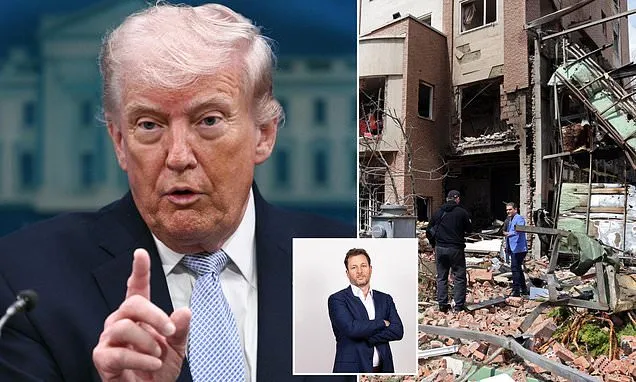
The difficulty in discussing Donald Trump and Iran is that too many people struggle to separate the man from the issue.
The US President makes that harder than it needs to be, because he can't resist turning even a serious strategic debate into a circus.
Trump regularly lapses into expletive-laden threats, theatrical social media posts and language so overblown that the argument itself gets buried under the performative ritual.
The result is predictable: Large sections of the media and the broader anti-Trump ecosystem fixate on his delivery, his coarseness and his ego.
It even happens here among Australian commentators. In doing so, they often avoid confronting the far more important point on Iran.
The analytical question isn't whether Trump is vulgar or erratic. It's whether Iran represents a real and continuing strategic danger.
Iran isn't a benign state actor being unfairly targeted by an American blowhard. It's a revolutionary regime with a long record of sponsoring proxies, destabilising its neighbours and embedding itself in conflicts across the region.
During this conflict, it has bombed nations that have had nothing to do with the US and Israeli attacks.
America still formally designates Iran as a state sponsor of terrorism, and senior US officials continue to describe it as the world's leading state sponsor of terrorism.
Even in recent weeks, Iranian-aligned or directed activity has extended well beyond any narrow battlefield, with attacks on Gulf infrastructure and diplomatic targets in Iraq.
The regime's reach has never been confined to one front or one grievance. It projects power through intimidation, militias and asymmetric violence because that is how the Islamic Republic has chosen to operate for decades.
Most concerning of all Iran has millenarian tendencies, meaning that if it ever acquires a nuclear weapon there is every chance it uses it to bring about a Holy Armageddon.
At the very least, the regime's ideological character is such that no responsible government can simply assume classic Cold War deterrence logic would operate cleanly or safely when it comes to Iran.
Concern about its nuclear ambitions isn't a Trump invention. The International Atomic Energy Agency has reported that Iran accumulated more than 400kgs of uranium enriched to up to 60 per cent purity before the strikes, which by the agency's own yardstick is enough material, if further enriched, for about ten nuclear weapons.
That's not speculative commentary or partisan spin. It's the assessment of the world's nuclear watchdog and has been reiterated in multiple subsequent reports and briefings.
A regime doesn't need to have assembled a completed bomb for the world to treat its conduct as gravely dangerous. The whole point is to prevent the completion.
A regime that arms proxies, threatens Israel, suppresses its own people and stockpiles weapons-grade uranium isn't suddenly made less dangerous because its most vocal adversary is also theatrically objectionable.
The difficulty in discussing Donald Trump and Iran is that too many people struggle to separate the man from the issue, according to Daily Mail political editor Peter Van Onselen (pictured)
Enrichment at the level Iran has done has no convincing civilian explanation. Throw in that inspectors have been denied the transparency they require to properly inspect, and key stockpiles remain difficult to verify.
IAEA findings note both that there is no civil justification accepted by Western powers for enrichment at the levels Iran has been, and renewed inspections are considered 'indispensable and urgent'.
No wonder Israel has such grave concerns. No Israeli government of any political stripe could reasonably be expected to treat such a trajectory with indifference.
Iranian leaders and state organs have long framed the Jewish state not merely as a rival state actor, but as something to be eradicated altogether, and senior officials have issued threats that go well beyond ordinary geopolitical hostility.
The Anti-Defamation League has documented years of Iranian leadership rhetoric calling for Israel's elimination, pairing that language with Holocaust denial and propaganda.
It's not unreasonable, therefore, for any US president to conclude that passivity carries its own risks.
We can argue about timing, proportionality and execution, but it's much harder to argue (in good faith) that there's no real problem to confront here.
That's the core point too often lost in the anti-Trump reflex: the existence of a genuine policy problem doesn't disappear because the person speaking about it is objectionable.
Even in recent weeks, Iranian-aligned or directed activity has extended well beyond any narrow battlefield. Pictured is smoke rising from the site of an Israeli strike in Beirut, Lebanon
And let's not forget, Iran also murders its own citizens on an all-too-frequent basis. Dissent within the regime isn't tolerated.
A United Nations fact-finding mission has said Iran continues to escalate surveillance, arbitrary detention and violent repression, especially against women, girls and peaceful protesters.
This is where Trump's critics often lose the forest for the trees. They dislike him so much, and in many cases so viscerally, that they interpret any policy he pursues as wrong by definition.
For them, the first question isn't whether Iran poses a genuine strategic threat that needs addressing, or whether it's a murderous state actor. If Trump acts he can't be in the right.
That reflex is analytically lazy. It replaces judgment with tribalism. It also leads to the absurd position where hatred of one man becomes a filter through which an objectively dangerous regime oppressing millions of its citizens is implicitly sanitised.
The irony is that Trump makes it easier for opponents to evade the harder arguments about Iran.
When he posts threats in bombastic language and folds foreign policy into culture war theatrics, he unwittingly shifts attention from the regime in Tehran back onto himself.
He turns himself into the story, which is politically self-indulgent but also strategically useful to those who would rather debate his tone than Iran's conduct.
The broader absurdity here is that some of the people who present Trump as uniquely unhinged end up minimising bad behaviour by Iran and its allies that's plainly more extreme than anything they claim to fear in Trump.
To speak as though the truly outrageous feature of this conflict is Trump's tone rather than Tehran's conduct is to invert reality.
A regime that arms proxies, threatens Israel, suppresses its own people and stockpiles weapons-grade uranium isn't suddenly made less dangerous because its most vocal adversary is also theatrically objectionable.
Yet commentator after commentator focuses on Trump rather than the challenge at hand.