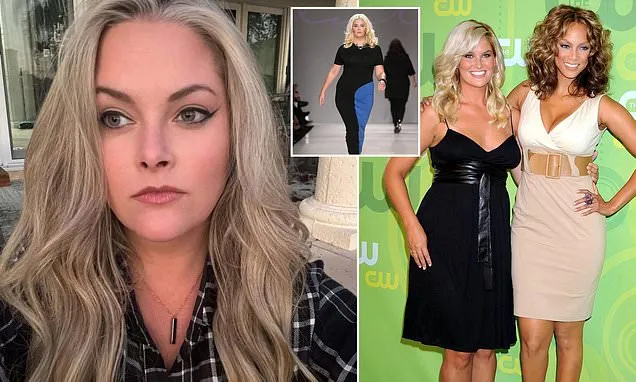
Whitney Thompson, the first plus-size winner of America's Next Top Model, has opened up about the struggles she faced feeling fat shamed on Tyra Banks' show.
Ahead of the Netflix tell-all documentary Reality Check: Inside America's Next Top Model, the 38-year-old blonde beauty - who won cycle 10 of the show in 2008 - recalled some of her lowest moments, including feeling that certain challenges were made deliberately harder for her as a plus-size model.
Thompson, who was just 20 and a size 6 when she started on ANTM, told People that not having proper clothes for the plus-size contestants 'felt intentional'.
'I just pretended like it didn't bother me, but, and I'm sure most of the girls would do this, I would cry in the shower every day because the shower is the only place that the cameramen couldn't come, so that was your safe place to release and be like, "Why are they doing this to me?"'
She added, 'I knew that they were trying to poke me and get something out of me, so I just played it cool, like, "That's fine. We'll just duct tape my dress. No worries."'
She also spoke candidly about the judging panel, admitting the whole experience was a 'nightmare'.
'I took Xanax before every judging,' she said.
'You're standing there for eight, nine hours under those hot lights waiting for people to tell you that something is wrong with how you look. It was emotionally exhausting.'
As modeling gradually embraced curvier figures, Thompson says the idea of being a 'plus‑size"'model still came with a strict, narrow look that didn't always fit her - or what she calls reality.
She told People that even when agencies accepted fuller figures, the expectation was oddly specific and sometimes downright artificial.
'We would go with our pads to castings and photo shoots, and the padding would make our waist larger, our hips larger but we'd still have the same jawline, arms and ankles. You could have a belly but you still had to have a cut jawline.'
Thompson's revelations highlight the ongoing battle in fashion, where token nods to body diversity clash with the same old rigid standards.
Even when brands and runways flirted with fuller figures in the 2010s, the industry often treated inclusivity as a passing trend, not a permanent change.
Despite high‑profile bookings and a successful post‑ANTM career, Thompson grew weary of ever‑shifting expectations and the relentless focus on her body.
'I took Xanax before every judging,' she said, adding: 'You're standing there for eight, nine hours under those hot lights waiting for people to tell you that something is wrong with how you look. It was emotionally exhausting.'
On top of that, being known as a reality TV personality sometimes worked against her in a world that supposedly wanted 'just the clothes,' she explained.
'You were buying who I was on Top Model,' Thompson said.
'If a brand wants a girl to just show clothes and they don't want someone [recognisable in a catalog] because that takes away from their product, then you're not going to get that job.'
The controversy around America's Next Top Model didn't start with Whitney Thompson - it's been simmering for decades.
When old clips began resurfacing online in 2020, viewers reignited debates about the show's treatment of contestants and the way producers pushed boundaries for drama rather than talent.
Many called out judges, including Banks, for body‑shaming, harsh comments and humiliating challenges that seemed more designed for shock value than genuine modeling critique.
One of the most infamous examples was the so‑called 'race swap' photo shoot, in which contestants were styled in heavy makeup to resemble different ethnicities - a stunt that even ANTM's creative team now acknowledges has not aged well.
Critics also pointed to moments like Cycle 6 winner Danielle Evans being pressured about the gap in her teeth, or producers sending models into situations that felt exploitative rather than empowering.
'I felt like I was actually making a difference in people's lives or with brands that hadn't worked with plus-size models before. Me winning the show definitely made a shift in the fashion industry,' she said
Banks herself has addressed much of this criticism in recent years.
At the 2025 ESSENCE Black Women in Hollywood Awards, she admitted ANTM didn't always get things right, saying 'Hell no. I said some dumb s---,' while also defending her intent to broaden diversity on television.
Despite the challenges, Thompson says she's thankful for the opportunities America's Next Top Model gave her, particularly the chance to be a voice for plus-size models and help open doors in an industry that had long ignored them.
Fans from around the world reached out to tell her how inspiring they found her journey, something she hadn't fully realized at the time.
'I didn't realize at the time what a big deal it was,' she tols the outlet. 'People saw me on the show and felt inspired.
'I felt like I was actually making a difference in people's lives or with brands that hadn't worked with plus-size models before.
'Me winning the show definitely made a shift in the fashion industry.'