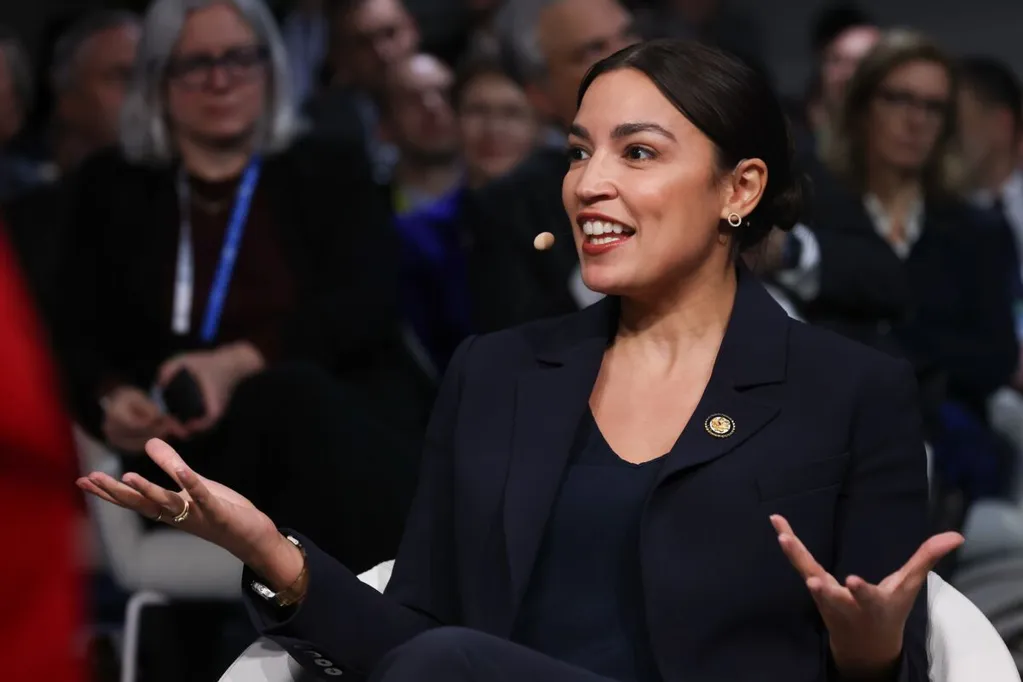
Her appearance at the conference fueled speculation of a presidential run in 2028, but Ocasio-Cortez refused to join in the speculation about her plans.
Representative Alexandria Ocasio-Cortez is better known for her strong progressive stances than her foreign policy views over the course of her seven years in Congress. An appearance at this weekend's Munich Security Conference suggested a shift in approach and fueled more speculation of a presidential run in 2028.
Ocasio-Cortez, who was invited by organizers of the annual event that attracts a host of world leaders, joined two panels, laying out her vision on the dangers of authoritarianism, Taiwan, Greenland and Gaza. Her appearance functioned as both audition and classroom and gave audiences an inkling of what Democrats' post-Joe Biden foreign-policy vision might look like.
She demanded a foreign policy approach that counters record inequality and looks to undo a world "dominated by a handful of elites, a handful of oligarchs that sit in pretend democracies and make backdoor deals with one another." In one panel, she said unconditional US aid to Israel had "enabled a genocide."
"We're at a fork in the road, I believe that leaders are increasingly acknowledging that we must present an alternative vision," she said.
The New York congresswoman was one of several Democrats with future political aspirations to attend, including Michigan Governor Gretchen Whitmer and California Governor Gavin Newsom. He sought to reassure Europe that there would be life after President Donald Trump.
"He'll be measured in years, not decades," Newsom said.
But it was Ocasio-Cortez who drew the most buzz. It was her first time at the annual conference, and she doesn't sit on the House foreign affairs or armed services committees. What foreign-policy work she's done has centered mostly on Latin America and her opposition to Israel's war in Gaza.
Republican commentators back home declared her unprepared for primetime for what they called a flubbed answer to a question from Bloomberg's Francine Lacqua on whether the US would come to Taiwan's defense if China attacked.
Normally quick to respond, Ocasio-Cortez was at a loss for words, saying, "this is such a, a, you know, I think that, this is a, um, this is of course, a, ah, a very longstanding, um, policy of the United States," she said.
But she recovered with a cogent response. The US should "avoid any such confrontation and for that question to even arise," she said.
Ocasio-Cortez hesitated "because she wanted to be careful about what she was saying," Matt Duss, who advises Ocasio-Cortez on foreign policy, said in an interview. "I wish more politicians would wait to answer instead of rattling off talking points."
Attending was the event "an opportunity to bring a perspective that is rarely heard at Munich and other security conferences -- the need to have a policy that supports the working class, that addresses inequality," Duss said.
In contrast to Vice President JD Vance, who met with far-right politicians last year, Ocasio-Cortez connected with members of the center-left Social Democrats, including German Vice Chancellor Lars Klingbeil, Environment Minister Carsten Schneider and Siemtje Möller, a former deputy defense minister.
"She was interested, engaging and sharp," Möller said in a text message of their meeting.
At the same time, most Europeans in attendance, while intrigued by Ocasio-Cortez and the other Democrats, were more immediately interested in and agitated by the position espoused by the Trump administration, especially Secretary of State Marco Rubio. He faulted Europe for straying from what he called shared western values even as he said the two continents' fates were "intertwined."
"It's really been hard for people to look ahead," said Stephen Wertheim, a senior fellow in the American Statecraft Program at the Carnegie Endowment for International Peace. "That's a little too much for the Europeans to absorb right now."
Ocasio-Cortez also refused to join in the speculation about her plans, and Duss declined to engage. In one panel, she dodged a question about whether she would impose a wealth tax when she runs for president.
"There have been many leaders who have said we will go back but I think we have to recognize that we are in a new time," she said. "Many of us are here to say, 'We are here, we are ready for the next chapter, not to have the world turn to isolation but to deepen our partnership on greater and increased commitment to integrity to our values.'"
The remark drew sustained applause from the crowd.