Apple fans have already had plenty of reasons to celebrate this week with the release of several new devices, but the tech giant may have saved the best for last.
The iPhone maker has now unveiled a brand new budget MacBook aimed at students.
At £599 ($599 US price), the MacBook Neo is a quarter the price of the new £2,199 ($2,199) M5 MacBook Pro and almost half that of the £1,099 ($1,099) MacBook Air.
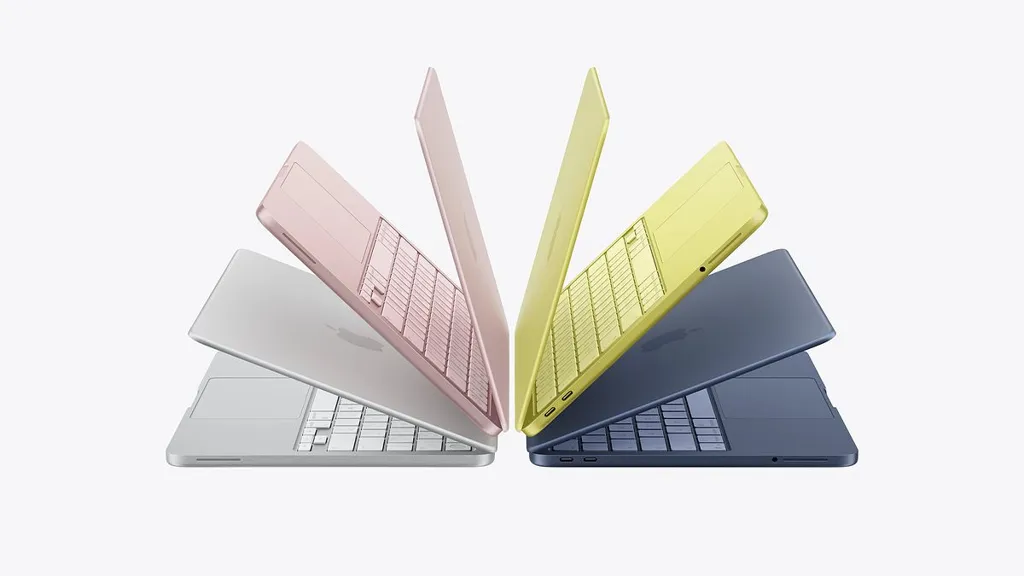
And, for the first time, fashion-conscious tech enthusiasts will have a range of stunning colours to choose from.
The MacBook Neo's aluminium frame will be available in 'blush', a pastel pink, 'indigo', a deep blue, 'citrus', a yellow-ish green, and silver.
The computer is powered by Apple's A18 Pro chip, the same powerful processor found in the iPhone 16 Pro.
The student-focused laptop promises to be perfect for video calls with a 13-inch Liquid Retina display, 1080p front camera, and speakers that support spatial audio.
John Ternus, Apple's senior vice president of Hardware Engineering, says: 'We're incredibly excited to introduce MacBook Neo, which delivers the magic of the Mac at a breakthrough price.'
Apple's new £599 budget MacBook Neo is available in four bright colours: Silver, Blush, Citrus, or Indigo
The student-focused laptop also features a 13-inch display, a 1080p front camera, and speakers that support spatial audio
The bright colours used for the aluminium frame extends to the Magic Keyboard and Multi-Touch trackpad
Mr Ternus adds: 'Built from the ground up to be more affordable for even more people, MacBook Neo is a laptop only Apple could create.'
The laptop starts at £599 for a 256GB model without Touch ID, while the 512GB model with Touch ID costs £699 (£599 US price).
The cost of the basic model can be reduced even further to just £499 ($499 US price) with an education discount, making this Apple's cheapest ever laptop.
This latest release continues Apple's renewed push to break into the budget electronics market.
The MacBook Neo comes only days after the release of the wallet-friendly iPhone 17e, which also starts at just £599 ($600).
Despite its incredibly low price point, the MacBook Neo is made of lightweight and durable aluminium rather than cheaper plastic.
According to veteran Apple reporter Mark Gurman of Bloomberg, Apple has created a new manufacturing process that allows the shells to be made faster and cheaper, allowing for such a low price.
That aluminium shell can also come in one of three new, bright colours, which extend to the Magic Keyboard and Multi-Touch trackpad.
The MacBook Neo is powered by Apple's A18 Pro chip, the same powerful processor found in the iPhone 16 Pro
Fans of retro tech can celebrate as Apple has finally reintroduced the headphone jack, supporting wired earbuds and other accessories
Besides the bold new look, the MacBook Neo boasts an array of features that could make it a great choice for any student on a budget.
Apple claims that its battery supports 16 hours of continuous use, meaning that it should last all day without needing to charge.
And at just 1.2 kg (2.7 lbs), the laptop is small and light enough to slip into a bag.
Fans of retro tech will also have reason to rejoice as Apple has finally introduced an AUX headphone jack, supporting wired headphones and other accessories.
MacBook Neo is available to pre-order starting today, with availability beginning Wednesday, March 11.
THE TRILLION DOLLAR RISE OF APPLE
1976: Founders Steve Jobs, Steve Wozniak and Ronald Wayne created the company on April 1, 1976, as they set about selling computer kits to hobbyists, each of which was built by Wozniak.
The first product was the Apple I.
1977: Apple released the Apple II in June, which was the first PC made for the mass market.
1981: Jobs became chairman.
1984: The Macintosh was introduced during an ad break for the Super Bowl and later officially unveiled during a launch event. It was discontinued a year later and Jobs left the firm.
1987: Apple released the Macintosh II, the first colour Mac.
1997: Apple announces it will acquire NeXT software in a $400 million deal that involves Jobs returning to Apple as interim CEO. He officially took the role in 2000.
2001: Apple introduced iTunes, OS X and the first-generation iPod.
The first iPod MP3 music player was released on October 23, 2001, at an event in Cupertino and was able to hold up to 1,000 songs.
2007: Apple unveils the iPhone.
2010: The first iPad was unveiled.
2011: Jobs resigned in 2011 due to illness, handing the CEO title to Tim Cook. Jobs died in October from pancreatic cancer.
2014: Apple unveiled the Apple Watch. It also unveiled its first larger iPhones - the 6 and 6 Plus.
2015: After purchasing Beats from Dr Dre, Apple launched Apple Music to compete with Spotify and other music streaming services.
2016: Apple returned to its roots and announced the 4-inch iPhone SE. Meanwhile, the firm is embroiled in a legal battle with the FBI, involving the agency demanding access to the locked phone used by Syed Farook, who died in a shootout after carrying out a deadly December attack in San Bernardino, California, with his wife. The court order was dropped on March 28 after the FBI said a third party was able to unlock the device.
2017: Apple introduces the iPhone X, which removes the home button to make way for a futuristic edge-to-edge screen design and a new FaceID system that uses advanced sensors and lasers to unlock phones with just the owner's face.
2018: In a first for the company, Apple introduces new features in its latest operating system, iOS 12, that encourage users to manage and spend less time on their devices. The move was spawned by a strongly worded letter from shareholders that urged the firm to address the growing problem of smartphone addiction among kids and teenagers.
2019: In January, Apple reports its first decline in revenues and profits in a decade. CEO Tim Cook partly blamed steep declines in revenue from China.
2020: In March, Apple closes all its brick-and-mortar retail stores outside of China in response to coronavirus.
2021: In an online virtual event in April, CEO Tim Cook declares Apple's goal of becoming carbon neutral for Earth Day. Later in the year, the iPhone 13 was announced.
2022: In September, the iPhone 14 was announced. One of the new features included a new sensor to detect if a user had been in a car crash, as well as an improved camera system.
2023: Apple brings back its 'Home Pod' after the first generation was discontinued. The 'Home Pod' can be seen as an alternative to Amazon's Alexa or Google Home, as it is powered by voice commands.
2024: Apple makes its first steps into artificial intelligence with the release of Apple Intelligence. The features are not all released at once, with many delayed until the following year.