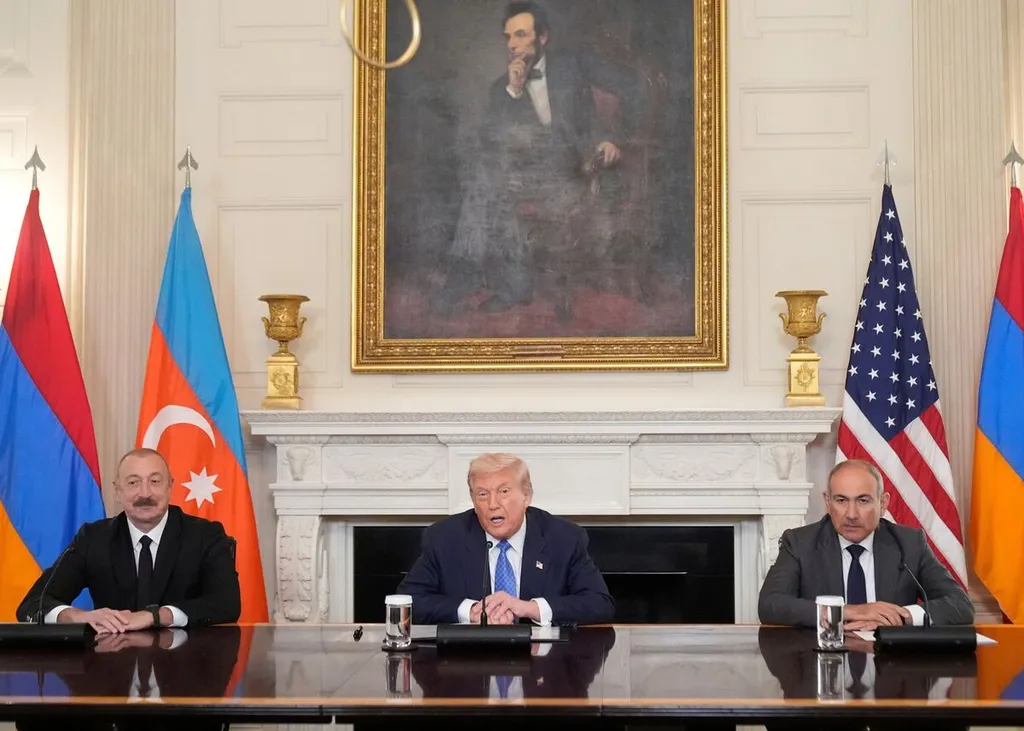
Twin European summits in Armenia are pointing to an intensifying contest for influence between major powers in the strategic Caucasus region.
The end of a decades-long conflict between Armenia and Azerbaijan is helping to sharpen the rivalry for dominance over energy and trade routes across the narrow belt of land linking Europe and Asia.
The wars in the Middle East and Ukraine are adding to the significance of the Caucasus, with routes to the north and south constrained by conflict, sanctions and geopolitical frictions.
Russia, long the dominant force in the region, faces growing competition from the US as President Donald Trump pushes a new transport and energy corridor in Armenia, as well as from Turkey, the European Union, and China.
"The current US interest in the South Caucasus is unprecedented and has permanently undermined Kremlin interests in Azerbaijan and Armenia to a degree," said Kate Mallinson, a partner at PRISM Strategic Intelligence in London. "Washington's approach is to facilitate the economic integration of the nations of the South Caucasus" and to expand those ties to include Turkey and Central Asia, she said.
Leaders from 48 countries have been invited to the European Political Community meeting on Monday in Armenia's capital, Yerevan, where they'll discuss economic and energy security as well as "democratic resilience" and hybrid threats.
Canadian Prime Minister Mark Carney is expected to attend the annual gathering as the first head of a non-European state, a signal of stresses in relations between the US under Trump and its traditional allies. NATO Secretary General Mark Rutte is also due to take part.
The first European Union summit with Armenia will take place the next day, aiming to strengthen bilateral ties. The government in Yerevan last year announced it would seek EU membership, pulling away from Moscow's orbit amid bitterness at Russia's failure to defend it during clashes with Azerbaijan over the territory of Nagorno-Karabakh.
The EU plans to strike a connectivity partnership with Armenia, including a potential funding package of as much as €2.5 billion ($2.9 billion), a senior official in Brussels said.
The goal is to support transport, energy and digital ties as regional borders open up in the wake of Armenia's peace accord with Azerbaijan and warming relations with neighboring Turkey. That's helping to bind the region together in the same way as coal and steel cooperation did in Europe, according to the official.
The bloc also intends to step up security cooperation with Armenia including with a new civilian mission to advise on responses to cyberattacks and disinformation, particularly ahead of June 7 parliamentary elections in the republic of about 3 million people.
Deep Economic Stake
The US-backed corridor, the Trump Route for International Peace and Prosperity, emerged after the president held White House talks with Armenian Prime Minister Nikol Pashinyan and Azerbaijani President Ilham Aliyev in August.
It gives the US a deep economic stake in the region for as long as 99 years through a partnership with Armenia to manage a rail and road route across the country's south connecting Azerbaijan with its exclave of Nakhchivan. The agreement extends to development of oil and gas pipelines and fiber optic networks for digital infrastructure.
The global turmoil triggered by disruption to trade through the Gulf from the war in Iran is only increasing its strategic significance.
Turkey, which has a mutual-defense pact with its long-term ally Azerbaijan, is also close to opening its border with Armenia that it closed in 1993 in solidarity with Baku. Air services already run between the two states even as they've yet to formally establish diplomatic relations.
Armenia is turning toward the EU and the US despite currently being a member of the Moscow-led Eurasian Economic Union customs zone. It also hosts Russia's only military base in the south Caucasus.
Russia President Vladimir Putin made clear his displeasure at Kremlin talks with Pashinyan on April 1, where he highlighted Yerevan's dependence on Moscow for heavily discounted gas supplies.
"Simultaneous membership in the Customs Union with the European Union and the EAEU is impossible," Putin told Pashinyan. "It is simply untenable by definition."
This was the first instance when Russia used "quite direct threats against Armenia," said Tigran Grigoryan, director of the Regional Center for Democracy and Security in Yerevan. "They are trying to show that there are certain red lines and if you cross them there will be consequences."
That's why Armenia is trying to tread carefully. The government in Yerevan asked to remove a reference to sanctions circumvention from the summit draft conclusions it's negotiating with the EU, according to people familiar with the matter. The EU refused, they said, speaking on condition of anonymity because the talks are private.
Turning Point
Neighboring Georgia offers a cautionary tale. Its application for EU membership stalled after the Georgian Dream government passed a "foreign agent" law in 2024 targeting independent media and non-governmental organizations that Brussels and the US labeled as "Kremlin-inspired." Opposition parties accuse the government of drawing closer to Russia.
The EU-Armenia talks come after the bloc held its first summit with the five Central Asian states -- Kazakhstan, Uzbekistan, Turkmenistan, Tajikistan and Kyrgyzstan -- in April last year, signing a €12 billion investment program focused on transport, critical minerals and energy.
Trump hosted the central Asian leaders at the White House in November, a month after Putin met with them in Tajikistan. Chinese President Xi Jinping joined a summit with central Asian states in Kazakhstan in June to discuss boosting investments under his Belt and Road infrastructure program.
The TRIPP corridor is intended to link to the Trans-Caspian Trade Route from Azerbaijan to central Asia and China, while joining up with routes in Turkey that connect to Europe.
Pashinyan in January called the implementation of the project as part of the peace process with Azerbaijan an "historic and turning point opportunity" for Armenia.
"The involvement of the United States is viewed in Armenia as a form of political anchoring, offering reassurance," said Narek Sukiasyan, a political scientist at Armenia's Center for Culture and Civilization Studies. "While the official framing is economic, its strategic implications are clear."
Aliyev told the Munich Security Conference in February that TRIPP would contribute to "an absolutely new situation" for trade and transport through the so-called Middle Corridor between China and Europe. "All the countries on the route will be more politically and economically integrated," he said.
While Moscow's dominance in the Caucasus is being undermined as the war in Ukraine drains its ability to devote resources to the region, "it is probably too early to say that Trump is decisively winning while Putin is decisively losing," according to Natia Seskuria, senior research fellow in Russian and Eurasian Security at the London-based RUSI think tank.
"Russia still has long-standing leverage in the South Caucasus, and its influence has not disappeared," she said. At the same time, "Trump has created incentives for countries in both Central Asia and the South Caucasus to look for alternative economic partners, especially at a time when Russia is widely seen as a less reliable, less militarily effective, and less economically sustainable partner."