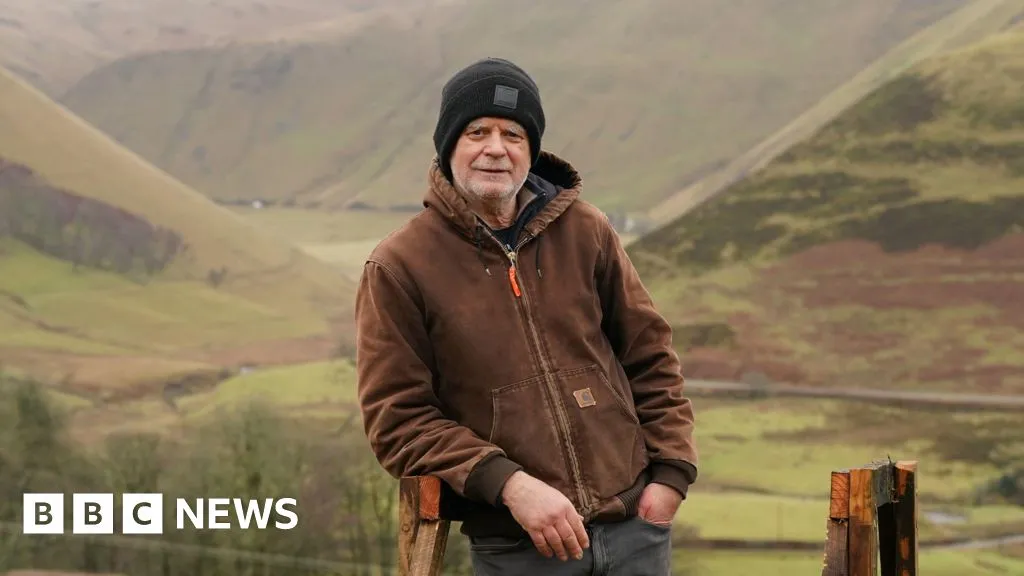
I'm standing in a graveyard in Kirkconnel, Dumfriesshire, with the artist Andy Goldsworthy. He is examining a pile of rich red earth, dug up a few hours before by local gravediggers to make space for a coffin.
He picks up some of the clay soil to show me, looking for any stones that might be hidden amongst it. He's beginning to gather them - and thousands of others - for Gravestones, a vast artwork he is creating high up in the local Lowther Hills and the BBC is getting an exclusive first look.
With a permission letter from the council, and every aspect "done with a care and a seriousness and a respectfulness", he is collaborating with gravediggers across 108 cemeteries in Dumfries and Galloway. The eventual artwork, 25 metres by 25 metres and enclosed by a wall, will be filled with stones from these graveyards. He hopes it will become a place for anyone looking "to mourn but also to celebrate" loved ones they have lost.
"Burial by its very nature is a tough, tough experience and I think everybody goes away feeling they want to do something positive about that".
Going up a hill "up to the sky" surrounded by beautiful views will be a good contrast to the pain of a burial, he believes, giving "that sense of spiritual uplift".
Local gravedigger Toby Howat, 25, is working with Goldsworthy. He told me he takes "pride" in his work to ensure "thehighest respect possible because at the end of the day it's somebody's loved one and you can't be too hard digging".
He describes the planned artwork as "a bit of everybody's grave combined together", a repurposing of stones that would otherwise never be used.
Goldsworthy tells me his enclosure will be filled with gravestones on top of ordinary stones, more than half a metre deep, "which hopefully things will not grow through. So it remains very stark, very simple. It's a sea of stones that have been displaced by burials. A sea of humanity."
For now, all there is to see is a staked out area, with posts connected by twine.
Goldsworthy has received £200,000, which is all going to the construction of the work, from a new art prize, being revealed exclusively by BBC News.
Called 'Dent in the Universe', every year a six figure sum will be offered to an artist to create a work somewhere in the UK that is free for the public to visit.
The money comes from the Hugo Burge Foundation and is, according to its CEO Lucy Brown, the biggest single source for public artwork now available in the UK.
Brown told me commissioning beautiful works of art for the public to enjoy used to be part of civic life.
"That's really fallen away and we wanted to do something with this prize to make a positive difference to people's experience of art... We want really bold works. We want things that will endure so that actually it's made a difference to people".
The money was left in perpetuity by the art philanthropist and founder of the travel search engine Cheap Flights, Hugo Burge, who died in 2023 aged just 51.
For this first award, Goldsworthy was approached directly. He knew exactly what he wanted to create, as the idea had been forming slowly ever since his ex-wife and mother of his children died in 2008. When he visited her grave, he saw a pile of stones and had an epiphany as he realised that, when gravediggers make space for a coffin, they don't return the stones they have displaced.
Where many of us might have left it at that, Goldsworthy saw the artistic potential.
"It changed completely, that stone for me. It turned it into something incredibly powerful... the connection between the body and the stone; the displacement but also the connection; a reminder of where we come from and where we end up; and I could hardly touch the stone".
Goldsworthy is a phenomenon. For more than 50 years, he has been creating deceptively simple but often back-breaking works in nature through freezing winters, boiling summers and the seasons in between.
Many are ephemeral; fleeting leaf sculptures that blow away into the forest or giant snowballs placed in the city of London which melted to disclose sticks and stones.
His Hanging Stones, a six-mile trail in Northdale, North Yorkshire, is more permanent. Goldsworthy restored farm buildings under the patronage of David Ross, co-founder of Carphone Warehouse, and has turned them into works of art.
He has amassed a large and loyal following. Hanging Stones is sold out until September, with tickets after that being made available - and likely snapped up fast - later this month.
His retrospective, Andy Goldsworthy: Fifty Years, at Edinburgh's National Galleries Scotland last year, was one of the top five paid exhibitions in its history.
But for many years, Goldsworthy was overlooked - even shunned - by the often urban-oriented art world.
"Nature as a subject matter was not seen as the right thing for art to be engaging with. Now, obviously it's changed. It's the only subject."
The artist, who trained (like David Hockney before him) at Bradford College of Art and also Preston Polytechnic in Lancaster but was inspired by the labouring he did on farms near his home in West Yorkshire from his early teens, appears not to hold a grudge.
"I've been outside in every respect of the word and quite happy to be there, you know, to be honest. Because whilst the art world is fantastic and just great, it's a very small world. And I have the privilege to be working in the world. And that's an amazing thing to be doing."
I'm getting an early preview of his plans for the new artwork - and, as we begin the rainy - but stunning - 20 minute climb, he tells me he is "obsessed".
"All artists and architects feel their building is the best thing they'll ever make. I think in this instance it's probably true".
Goldsworthy's other artworks:
Before visitors head to the top, they will start at a farm building. At the moment it's derelict, but Goldsworthy explained his plans to create a rammed earth wall with a deep cavity in the middle, the size of a grave.
He says that looking into an open grave, particularly one that is deep enough to hold three coffins, is "like looking into another world. It is quite beautiful. It really is. And you see the layers of earth and time."
As we walk uphill, I ask him whether creating this new artwork has made him think more about his own longevity.
"I think it makes it less intimidating. When we're looking into the graves when they dig them, they are quite comforting, in a very strange way. They're very inviting."
The logistics of collecting the stones and creating the work are "massive and wonderfully so". He's grateful to the Hugo Burge Foundation and also the Duke of Buccleugh, another patron, who is supporting him with machinery, renovation work and the land where Gravestones will be located.
He's currently working on three works; one in Sweden and another in Massachusetts; America. He's having his moment. "It's so falling into place. This is almost too good; it makes me nervous. So I've just got to get on with it; get them done."
He hopes Gravestones will be finished in the next two to three years.