You'll never catch me owning a glass dining table now I've moved so many. But it was the people I worked alongside who made the job what it was.
My "wilderness years" began when I lost a job I loved hosting a daily radio show in Melbourne, then spent a decade slowly rebuilding my broadcasting career. That meant most of my on-air appearances went back to being unpaid, and the rent wasn't going to cover itself.
To survive financially, I spent 10 years saying yes to almost every job I stumbled across: pub trivia host, wedding DJ, babysitter, copywriter, documentary reviewer, arts event moderator. But the gig that changed my life was the years I spent as a furniture removalist.
I decided to work as a removalist because I thought it might be a cheaper alternative to hiring a personal trainer. Better than that, because I'd be the one getting paid to get ripped. Then the pandemic hit, all my entertainment and event-based work disappeared overnight, and suddenly I was a 39-year-old woman spending her days hauling other people's lives around.
Some of what I learned was about the furniture itself. For example, you'll never catch me owning a glass dining table. They are so heavy and difficult to move, I eventually started fantasising about outlawing them. To justify this I came up with a secondary argument: what kind of sick pervert demands to be able to peer at the crotches and feet of their guests during a dinner party? Let people scratch themselves subtly in peace.
All mattresses are kind of stained. We've seen it all. It's fine. Some might be worse than others, but we never really cared, we just wanted to get them on to the truck as quickly as possible. It was only awkward when people tried to stop us to offer unnecessary explanations: "Oh we dropped a coffee on the bed last week, haha!"
I also learned people have far more faith in the structural integrity of cardboard boxes and cheap plastic tubs than is warranted. I once turned up to a job to find someone had taken the box their washing machine came in - a box designed to protect white goods from scratches rather than actually contain their weight - and filled it like a skip bin with a variety of items including crockery and glassware, bedding, books and lamps. They were visibly pleased to have reduced their entire inventory to technically one box, and seemed surprised when we explained it was not only unliftable, but would collapse the second we tried to move it.
Another time a personal trainer had filled a plastic tub with his entire weights collection. It was so heavy, we couldn't even slide it across the floor. He looked at us expectantly, convinced that because it was in a container, as removalists we had a legal obligation to carry it. The answer to: "Do you even lift, bro?" was a polite but firm no that day.
It's essential to empty your furniture before people turn up to move it. Not just to be considerate, but because drawers slide out, cupboard doors fly open and things fall everywhere. This is especially important when it comes to bedside tables. Ladies, we salute you in your journey to explore and wish you well, but you do not want anything from the "personal use" category tumbling on to the truck floor. With men we discovered accoutrement of a similar vein, only in their case it was more often in an office desk drawer than the bedside table, which tells its own interesting story.
For many people, especially in the early days when I was the only woman at the company, having a female removalist turn up was a bit like opening the door and seeing a dog riding a bicycle. Some were delighted. Some were unsure. Some simply refused to accept what they were seeing, even as the dog was fully dressed in Lycra and pedalling.
I'd call ahead to let customers know we were on our way to their job and they'd say something like, “Tell the boys to park to the left of the driveway”, and I’d try to respond chirpily, “Well I’m actually your removalist today, so I’ll keep that in mind.” Sometimes I’d hear surprise, sometimes uncertainty, very occasionally concern. One man became insistent this simply wouldn’t work for him, as he’d “done his back in” and wouldn’t be able to help me lift all the heavy things I’d no doubt struggle with. I assured him that carrying heavy things was, in fact, my day job, and that this was not a Make A Wish activity organised on my behalf. I took particular joy that day in whistling merrily as my colleague and I carried his massive fridge through his apartment, down the stairs and on to the truck.
At the other end of the spectrum was the time a client's elderly mother was waiting at the pickup address. She was so delighted to see a woman doing the job, she spent the entire move following me around like paparazzi, snapping photographs on her phone and offering a running commentary of encouragement. Every time we angled a piece of furniture around a doorway or negotiated something in a stairwell, I’d hear her loudly exclaim, “You’re so STRONG!” and “Oh aren’t you GOOD!”
I cannot stress enough how much her words of affirmation made me work harder. I have never moved furniture so efficiently in my life.
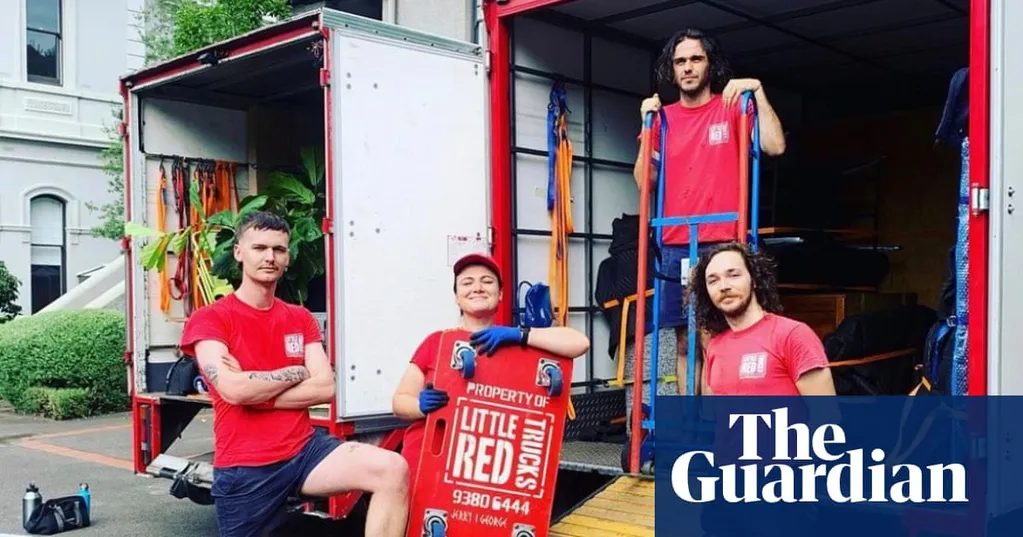
What made the job what it was, more than anything, was the people I worked alongside. When I started, the truckers were all men; mostly straight; but over time I watched the company change - more women; more queer people; all there on merit because there was no faking it. You could either do the job or you couldn't; and the furniture didn't care either way.
From time to time we'd encounter customers who seemed to assume that because we were doing physical labour for a living we weren't particularly bright; but I worked with people who were completing degrees in physics or literature. One had recently returned from playing in front of an audience of 90,000 with their band at Coachella. There were actors; comedians; writers; chefs and painters - creative and brilliant folk - who turned up every morning in their red shirts ready to lift heavy things with me.
In an era when we're constantly told that toxic masculinity is everywhere; the men I worked with were nothing like that. They expressed affection for each other openly. They respected women. They talked about mental health and how they were feeling; and it was a beautiful thing to be around.
Despite my gratitude for paid employment during a pandemic and my love of my colleagues; during the early days I found the shifts long and brutal on my unfit late-30s body. I was also unhappy with where my life was at. I felt no closer to my dream of returning to paid broadcasting than I had been on the day I’d lost the job; and I was acutely aware of being one physical injury away from financial precarity. What I needed more than anything was an attitude adjustment. The removalist job was more than happy to provide one.
Some days were small jobs with long drives to the beach or the countryside. Others might be brutal back-to-back moves between third-floor apartments with a tonne of boxes and large white goods. I didn’t have any control over the jobs I was given; but I started to understand that I could control how I showed up to them.
If you turned up in a foul mood, the hard shifts were unbearable. But when you’re ready to get on with it and make the best of things, even the tough days had moments of laughter and joy, and a sense that you were all in it together.
No matter how big or small a job, they all start the same way. Box by box, piece by piece. You pick something up and deal with it, then do it again. And again. And eventually, you’re done.
If I'd sailed through my 30s from one radio job to the next, I would have arrived at this point in my life with an insufferable lack of real-life experience. I'd be a poorer broadcaster because the truth is: the wilderness years that I thought nearly broke me actually made me. And I reckon I could still lift a fridge.