Thirty years ago, Congress passed the Telecommunications Act of 1996 based on a straightforward principle: The benefits of modern communications networks should reach every community, not just the well-resourced ones.
Back then, the "world wide web" was growing and increasingly necessary for daily life, but fewer than a quarter of U.S. adults had internet access. To address that gap efficiently, Congress created E-Rate, a discount matching program that enabled public libraries and schools across the country to obtain high-speed internet access at significantly reduced cost.
As the program hits its 30th anniversary this month, we should celebrate E-Rate for what it is: a quiet powerhouse that has given nearly every American access to high-speed internet through public libraries and schools.
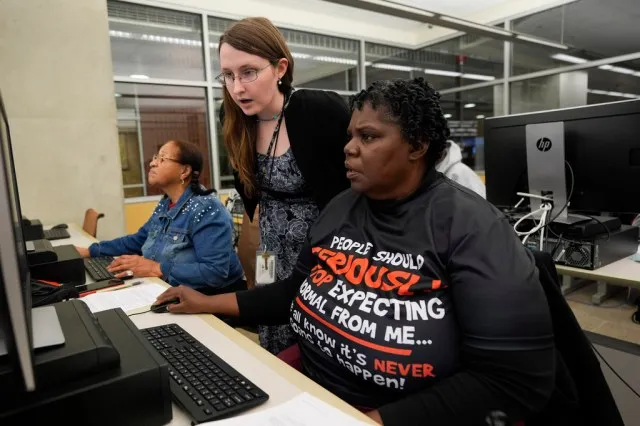
For public libraries, the impact of E-Rate has a human face: a job seeker applying for a new position; workers filing taxes on time; a family accessing student homework portals, remote learning and telehealth appointments; and communities using library technology to keep in touch with loved ones during natural disasters. In many towns and neighborhoods, the public library remains the only reliable place to get broadband speeds that make modern life possible. When home connectivity is unavailable, unreliable or unaffordable, the library is where people come to get online.
The internet also powers the practical, behind-the-scenes functions that keep libraries running. The full range of library services requires high-speed internet: building and managing collections, checking materials in and out, supporting research, and helping patrons find credible information efficiently. Today's card catalogs do not work without internet access.
Beyond powering countless library services, the E-Rate program provides broadband that entire communities rely on. Six tribal libraries and two schools in New Mexico, for example, leveraged their access to E-Rate funding and built two tribally owned and operated modern fiber networks. Covering 120 miles and six sovereign nations, the networks dramatically increased internet access speeds and decreased costs, and it would not have been built without federal E-Rate funding.
Not only has E-Rate made broadband more accessible for communities over its 30-year history, it is now considered a model for other federal programs in terms of oversight for federal awards and grants. Of five programs reviewed by the Government Accountability Office in 2025 for compliance with requirements for preventing waste, fraud and abuse, E-Rate was the only one to receive a perfect score.
Despite the success of E-Rate in filling connectivity gaps over the years, the program is not perfect. Only about half of public libraries participate in E-Rate. The complexity of the application process continues to be a key barrier. Many libraries, especially small, rural and tribal, operate with limited administrative capacity. When a single person is the director, technology lead and grant writer, complicated forms, procurement requirements and compliance rules can turn a valuable benefit into an unrealistic burden. For a large system with specialized staff, complexity is inconvenient. For a small library, it can be disqualifying.
Over the last 30 years, ALA has continually worked with the FCC to improve the program, remove barriers, and increase access to this vital program for library applicants. The FCC can simplify applications and procurement steps and preserve E-Rate's already strong program integrity safeguards. These streamlining measures mean less time spent navigating paperwork and more time spent delivering public value—and more libraries across the country with high-speed broadband.
Congress, which has long recognized that E-Rate is as important today as it was in 1996, has its own part to play in ensuring the program remains a critical part of the Universal Service Fund. Today, a bipartisan, bicameral working group is considering reforms to ensure the Universal Service Fund, including the E-Rate discount, continues well into the future. As Congress moves toward contribution reform, they should prioritize reliable funding that is not dependent on annual appropriations.
Congress should also keep its eye on the courts. The Supreme Court upheld the constitutionality of the Universal Service Fund in 2025, but recent renewed attacks claim that E-Rate specifically is unconstitutional. Threats to a program with such results—and fiscal integrity that exceeds many government programs—are short-sighted and jeopardize efforts to bridge the digital divide for the nearly one in ten Americans that have no high-speed internet access.
Anniversaries are a time to take stock. Thirty years after the Telecommunications Act of 1996, the country is more connected, but many people still rely on public institutions to reach the digital world. E-Rate is one of the most effective, accountable tools the nation has for making sure that geography and income do not determine who can learn, work and participate in our connected world. We should celebrate E-Rate and—until broadband is universally accessible and affordable—strengthen it.
Sam Helmick is president of the American Library Association and serves as community and access services coordinator for Iowa City Public Library.