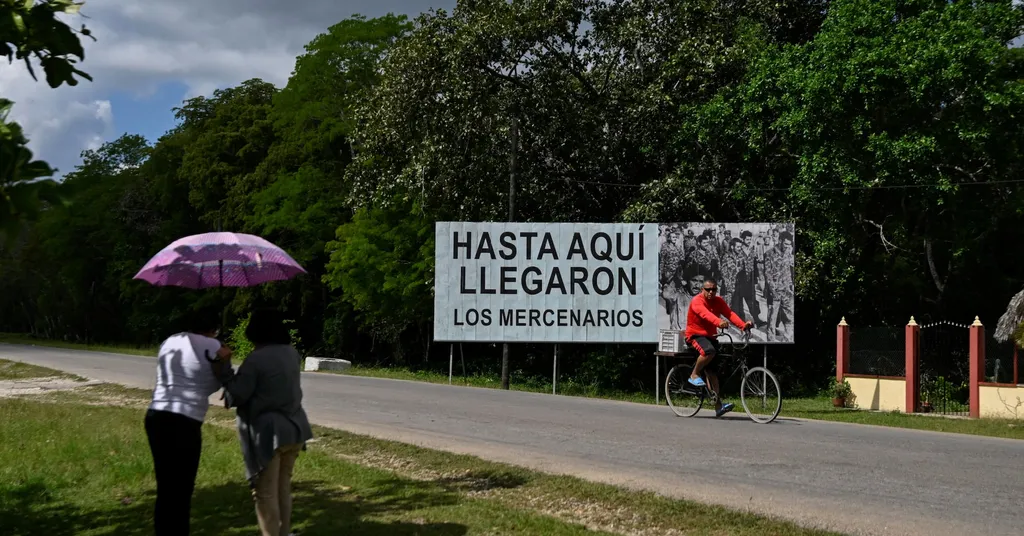
BAY OF PIGS, Cuba, April 17 (Reuters) - Orestes Chamizo points at a scrubby patch of sand on Cuba's Bay of Pigs, showing the spot where a brigade of U.S.-trained Cuban exiles landed on the island's southern coast on April 17, 1961.
"The mercenaries came in right there," Chamizo says, recalling their dramatic defeat and his own role tracking down survivors scattered in the nearby swamp.
He said the U.S. under President Donald Trump, who has repeatedly threatened Cuba since imposing a de facto oil blockade on the island, risks the same outcome if he chooses to invade.
"I'm 90 years old but if I have to pick up a gun again, I'll do it without fear," the still spry Chamizo told Reuters. "The last invasion failed ... and the next one will too."
The prospect of communist-run Cuba resisting a military invasion by the global superpower to the north appears as improbable today as it did 65 years ago.
Reuters spoke with upwards of two dozen residents, young and old, around the Bay of Pigs, long a bastion of national pride after Fidel Castro's victory against the exiles - one of the Cuban Revolution's proudest moments.
The interviews underscore a gulf between the fiery rhetoric of those who lived those early years of the revolution and the island's downtrodden youth who struggle to survive in a Cuba brought to its knees by an inefficient state-run economy and U.S. sanctions.
"Young people here don't have the same spirit they used to," says Miguel Piloto Garcia, a 22-year-old barber who spoke with Reuters from his porch just a few miles from the site of the 1961 U.S. invasion. "We want to improve our lives, but right now there's no future for us."
FIERY RHETORIC
Cuba and the United States, separated by just 90 miles across the Straits of Florida, are talking, both sides have said. But Trump has also repeatedly hinted at the possibility of military action against Cuba, telling reporters as recently as March he might be "taking" the island.
"I mean, whether I free it, take it. Think I can do anything I want with it," Trump said.
Cuban President Miguel Diaz-Canel last week told NBC that Cuba does not want war. But he warned Cuba would nonetheless defend itself, if attacked, using "irregular warfare" that would make any incursion by the United States "untenable."
Cuba's constitution requires the country's youth to undergo military training. Recruitment begins at 18 years old. The service, typically one to two years, includes firearm training, part of a broader "War of All the People" doctrine enshrined in Cuba's National Defense Law and touted by Diaz-Canel in last week's interview.
"Every Cuban man or woman has a mission, a purpose, a place to defend, and they will have their own place to take in the defense," Diaz-Canel said. "So this is all based on people's participation, voluntary participation."
Cuba has held nationwide military drills every Friday - called "National Defense Days" - since the United States in early January invaded Venezuela and deposed former leader Nicolas Maduro.
The training, often aired on Cuba's daily television news programs, shows men and women in urban and rural environments taking aim with rifles, driving Soviet Union-era tanks, flying drones and tossing grenades.
Despite its increasing visibility, Cuba's military remains a black box to much of the outside world, with no public accounting of its readiness, financing, weaponry or capacity.
In a country with no public opinion polls, it remains difficult to gauge support for the country's armed forces.
SHIFTING IDEALS
The rhetoric from both Washington and Havana takes time to reach the Bay of Pigs, a distant backwater surrounded by the Zapata Swamp that now suffers 22 hours of blackouts a day. Residents have learned to live largely without public transport or modern communications like cell phones and internet.
Yudel Ramos, 30, a young fisherman and crab hunter, is too busy making ends meet to worry much about war. He says his salary is not even enough to buy him a sack of charcoal, so his time is occupied scavenging for firewood.
"If the time came to give my life for Cuba, I would, but sometimes I don't know what to think," he told Reuters outside his home in Palpite. "We are going through a very difficult time."
Immigration has also sapped the ranks of potential military recruits.
Between 2020 and 2024, the country registered a population decline of more than 1.4 million people, more than 10% of its population, due largely to migration in which young people between 18 and 30 years old predominate, according to recent data from Cuba's ONEI statistics agency.
The changing face of Cuba saddens Jesus Bernardino Alonso, 87, one of the few remaining Bay of Pigs veterans still living in Palpite, a town whose entrance is adorned by a sign marking the defeat of the U.S.-trained invaders.
He recalls how the entire town rallied in response to the invasion 65 years ago.
"It's true times have changed," Alonso said. "But there are still many of us who defend this even though we know we are facing a superpower."