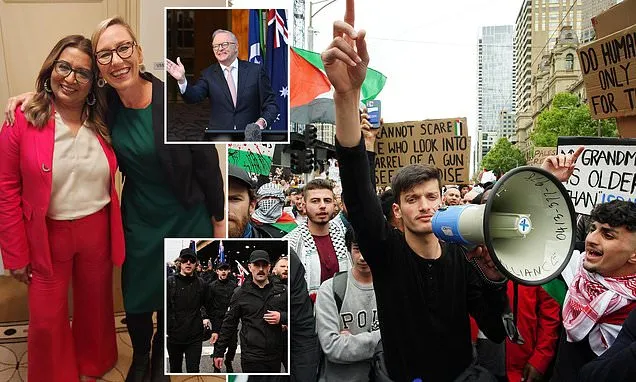
Labor's hate speech package is fast turning into a sprawling mess - in design, process, and now in terms of politics too, because the one thing it needs most is support from the Opposition - and that appears lost, with Sussan Ley branding it 'unsalvageable'.
The Bondi Beach terror attack exposed something Australians have been watching build for too long: antisemitism hardening into a cultural norm in parts of the community.
It was cloaked as anti-Zionism, laundered through activism and ended in extreme violence, with 15 Australians ruthlessly gunned down on the shores of Bondi Beach. Labor has been forced to respond.
But making sweeping changes to the rights of all Australians requires deeper thinking than media stunts, and the Prime Minister's rush to craft new hate speech laws appears to have created all manner of unintended consequences that may impinge on freedom of speech.
The laws of the land are supposed to be the cleanest, most disciplined expression of state power. They are supposed to have clear definitions, predictable thresholds, tight defences and be forged by a parliamentary process that gives the community confidence in what's crafted.
Instead, Labor is rushing Parliament back on January 19 - it is exceptionally rare for Parliament to sit before Australia Day - and plans to ram through an omnibus bill.
The design problems in the draft new laws aren't simply lawyerly quibbles. They go to whether this bill can do what it claims without creating new grievances, new loopholes and new legal uncertainty.
The centrepiece of the bill, a new criminal vilification offence, carries up to five years' jail and hinges on whether conduct would cause a 'reasonable person who is the target, or a member of the target group' to feel intimidated, fear harassment or violence, or fear for their safety.
The Prime Minister is rushing through new hate speech laws in response to the Bondi terrorist attack - and may have to do a deal with the Greens in order to get in done, with the Opposition branding it 'unsalvageable'
That sounds sensible enough until you consider how it shifts the criminal test towards the perspective of the targeted group, rather than anchoring it in broader community standards.
In civil law that might be one thing. In criminal law, however, where the penalty is prison and the stigma is permanent, it opens the door to arguments about subjectivity and inconsistency.
What leads one group to feel intimidated or fear harassment may not be the same as another. The government can insist its new draft laws are balanced all that it likes, but it is still choosing a standard that has uncertainty right at the core.
Then there is the religious text carve out, which Labor insists is narrow and officials say only applies where conduct consists solely of quoting or paraphrasing religious texts for teaching or discussion purposes, and is therefore not contrary to the public interest.
Yet the very reason the carve out exists is because religious texts can contain archaic exhortations. That is exactly why a carve-out might be dangerous. Extremists do not need permission to weaponise scriptures.
A defence framed around quotation risks becoming the playbook for getting around the new laws, for anyone determined to keep preaching hatred while staying just inside the technical boundary.
Albo dismisses this concern by pointing out some of the extreme content in the Old Testament. But can he point out ways that it is being used by radicals here in Australia to justify violence? It's a deeply false equivalence.
Even the Australian Human Rights Commission has cautioned that criminalising the 'promotion of hatred' is an exceptional step that needs careful justification and safeguards.
And this is where the design mess becomes a political mess. If Labor had produced a tight bill, with clear thresholds, it might have built support on both sides of the aisle.
Instead, the government has taken on inherently sensitive areas: free speech, religious freedom and public safety, and turned them into a bundle of contested drafting choices, layered on top of a rushed process.
That is not how you keep the Coalition in the tent - or how good laws are made.
And right on cue, the Coalition is now signalling it will oppose the new laws. Whether that is about party politics rather than on principle is almost beside the point.
Potential laws like this need legitimacy - the legitimacy that comes from the broader parliament buying in on a solution. Lose bipartisanship, and you lose the strongest argument that this is a measured recalibration rather than a panicked overreach.
So Labor's pathway now runs straight through the Senate, and that is where the mess risks becoming a farce.
The Greens have already indicated that they will not support reforms that, in their view at least, unreasonably restrict political speech and protesting. Especially in and around universities.
If Labor can't get the Coalition or the Greens to support its new legislation, it's dead on arrival. If Labor finds a way to get the Greens on board, the amendments will likely lose the mainstream, leaving Labor to respond to Bondi in coalition with the Greens. That's certainly an odd look.
Teaming up with the Greens to pass a complex hate speech regime that experts and community voices have already flagged as poorly designed is not a legacy Albo would be thrilled about.
It looks like desperation, passing whatever can pass, rather than what should.
Labor can still salvage this, but only by admitting what its current plan denies: that haste has made the drafting weaker, not stronger, creating mistrust instead of unity.
If the government wants to fight antisemitism and blunt radicalisation, it should do what serious governments do and take the time necessary to get new laws that curtail freedoms right.
Ironically, Albo used the excuse of not rushing into announcing a royal commission to justify his weeks-long attempts to avoid even holding one. And the announcement was the easy part - the commission itself will rightly take its time sifting over the evidence.
New laws can't be rushed because once legislated they affect people's lives and curtail their rights.
Yet Albo's rush to appear active in response to Bondi - legislatively if not in other ways - has precipitated a fresh crisis.