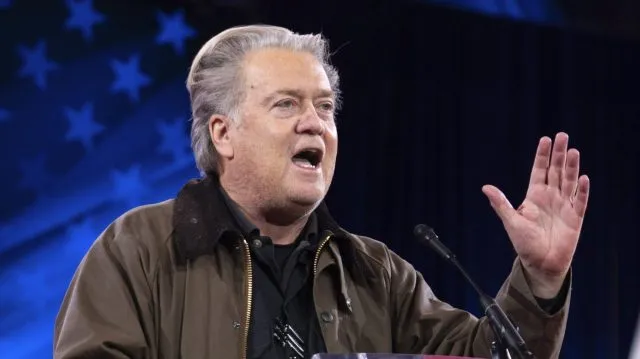
Former White House strategist and podcaster Steve Bannon on Friday said at Conservative Political Action Conference (CPAC) that the U.S.-Israeli conflict with Iran could result in U.S. service members fighting on the ground at Kharg Island.
Bannon told CPAC attendees in Grapevine, Texas, that the U.S. is "probably [at] the start of a war," but added that "decision in going forward is obviously" President Trump's decision.
"You have to be convinced that this is the right thing to do, particularly now that we're on the eve of potentially the insertion of American combat troops," Bannon continued. "Your sons, daughters, granddaughters, grandsons could be on Kharg Island or be holding a beachhead down by the Strait of Hormuz."
Trump has considered taking Kharg Island, Iran's economic lifeline where it holds 90 percent of its crude exports. Taking over the island would require ground troops, something experts have said would be risky and likely result in more casualties, leaving the option of negotiating with Iran unlikely.
Blackrock founder Erik Prince spoke not long after Bannon and emphasized that Iran's supreme leader Mojtaba Khamenei will be the sole person who decides that the conflict is over. He added, however, that the U.S.-Israeli strikes on Iran left Khamenei's wife, several other family members and his father, the former supreme leader Ayatollah Ali Khamenei, dead.
The CPAC audience applauded this, but Prince said he does not "share the optimism of the administration that there's going to be a peaceful stop to this."
"They will burn it down," he continued. "And my real concern is that if they try to put boots on the ground, force [open] the Strait of Hormuz, you're going to see imagery of burning American warships in the next couple of weeks. And I don't think people are really prepared for that."
Prince also downplayed calls for regime change from an "armed opposition" within Iran, something Trump and Israeli Prime Minister Benjamin Netanyahu have given support to at separate times before and during the conflict.
"There's never been a real preparation of an armed opposition inside the country, and a lot of ways to do that from the periphery that does not require U.S. boots," he added.
Trump and his Cabinet members have touted the U.S. firepower raining down on Iran. The president has said that strikes have "decimated" Iran's naval, air and missile capabilities, and has also suggested the conflict could be "winding down."
Secretary of State Marco Rubio told the foreign ministers of Group of 7 nations in France that the conflict would conclude in two to four weeks, Axios reported. He later told The Guardian that the conflict will end in "weeks, not months."
"When we are done with them here in the next couple weeks, they will be weaker than they've been in recent history," Rubio told The Guardian.
Rubio said the U.S. was still working with mediators to negotiate an end to the military operation with Iran, sources told Axios. He added that it was unclear who was actually making decisions in Tehran and that mediators were having difficulty communicating with Iranian officials who feared they would be located and killed by airstrikes.