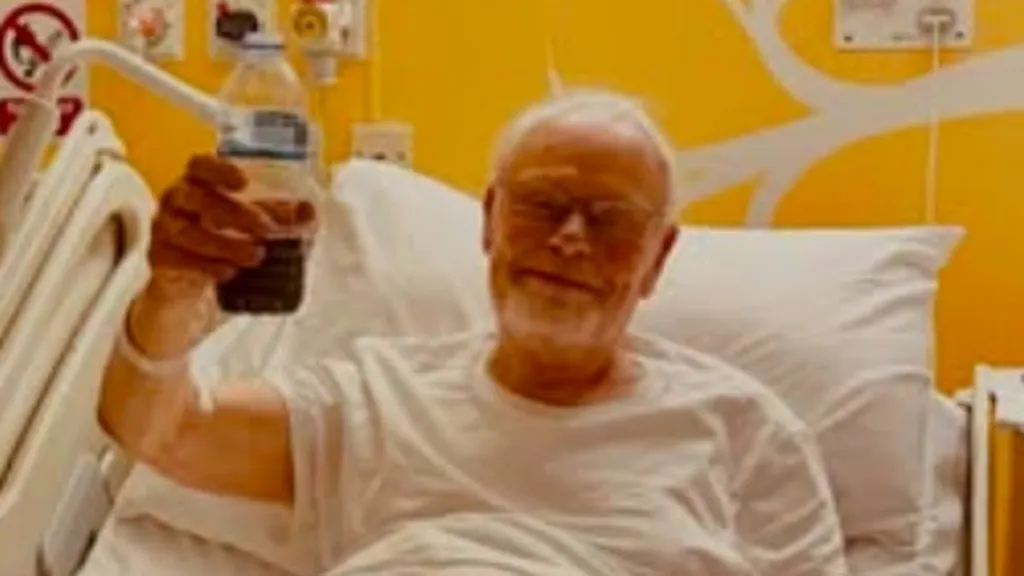
BBC Radio 2 star Bob Harris has been hospitalised amid his prostate cancer battle.
The legendary radio DJ, 79, known as 'Whispering' Bob Harris was diagnosed in 2007 and still lives with the disease today, though it is managed thanks to advances in technology.
On Thursday he took to Instagram with an update as he smiled from his hospital bed and thanked his family for supporting him through the 'unexpectedly testing time'.
Bob explained that he was receiving treatment for an 'issue that had been building up' related to his cancer but didn't elaborate any further.
He wrote: 'HEALTH UPDATE Here I am in hospital taking short time away from my programmes on @bbcradio2 for treatment of an issue that has been building for the past few weeks.
'As many of you know, I suffer from prostate cancer, and every now and again I experience setbacks that need attention. Now is one of these moments.
'This weeks Country Show is all ready to go and Sounds of the 70's on 12th April will be an 80th birthday celebration special, which I recorded just before @c2cfestival with my beautiful friend @zoetheball
'After that @dariusrucker will be sitting in on Country and @shaunkeaveny_ will be looking after Sounds of the 70's for a few weeks.
'Although I can't at the moment give an exact date for my return, I know that I will come back... and come back stronger. I hate missing programmes and I am keen to get back into the studio as soon as I can. Meanwhile, the @bbcradio2 family is supporting me every step of the way.
'I am so blessed to have the love of my family and the support of my friends who have rallied round me at what has proved to be an unexpectedly testing time. My manager Nick Canham at @cloreclients has also been absolutely amazing.
'Thank you with all my heart to them and to all my listeners whose words and messages here mean so much. Sending you all my fondest love ❤️ I will be back... #health #cancer #radio2 #country #soundsofthe70s.'
Last October Bob was flooded with support from his colleagues including Zoe Ball as he shared an emotional cancer update.
He took to social media as he told followers how he was 'feeling very low'.
Alongside a selfie as he rested, Bob penned: 'I am so grateful for my cancer treatment but there are times when the side effects are really tough.
'Feeling very low tonight. Tomorrow I go again...'
Bob was inundated with messages of support, including from his BBC Radio 2 colleagues who replied in the comments.
Zoe Ball said: 'Darling chap. sorry to hear today hasn't been so good. all the love to you. you're very brave and loved xxxx.'
Weekend presenter Paddy McGuinness wrote: 'I need you up and at um Bob! You're the Governor!!!'
Dermot O'Leary replied: 'You're the best champ! X.'
Sara Cox added: 'Bob I'm sending you an inappropriately long hug xxxxx.'
Two years ago Bob opened up about his cancer treatment to fans as he said he counts 'every day as a blessing'.
He penned: 'I occasionally have to go through moments of intensive top-up treatments, and I have to take some pretty hefty daily medication to keep my cancer under control, the difficult side-effects of which can often bring my emotions far too close to the surface!'
'But my cancer was detected early and I count every day as a blessing.'
He added: 'My massive advice to any male over 50 reading this is GET YOURSELF CHECKED if you haven't already. The blood test only takes seconds and it could save your life!'
The legendary radio DJ, 79, known as 'Whispering' Bob Harris was diagnosed with prostate cancer in 2007 and still lives with the disease today.
On Thursday he took to Instagram with an update as he smiled from his hospital bed and thanked his family for supporting him through the 'unexpectedly testing time'.
Bob has been broadcasting with the BBC for more than 50 years and received an OBE for services to broadcasting in 2011.
He currently presents Bob Harris Country on Thursday evenings from 7pm as well as Bob Harris Sunday.
In 2019 Bob was forced to take a break from his shows after rupturing his aorta while out walking.
He said at the time: 'Ten days ago, while out walking, I suffered a tear to my aorta known as an aortic dissection.'
'The aorta is basically the M1 of the body and any damage is regarded as extremely serious.'
'For the past few years I have been walking an average of five miles a day and I am convinced that the level of fitness I have achieved during that time helped save my life.'
He added: 'It was an incredibly scary moment and I am massively indebted to the ambulance crew who attended so promptly, the intensive care team and the consultants at the John Radcliffe Hospital in Oxford, and to my wife Trudie and my wonderful family who have rallied round me with huge love and support.'
'I am not exactly sure when I will be on air again but I am on the road to recovery now and will be back playing music for you on Radio 2 as soon as possible.'
'Thank you for everything.'
WHAT IS PROSTATE CANCER?
How many people does it kill?
More than 11,800 men a year - or one every 45 minutes - are killed by the disease in Britain, compared with about 11,400 women dying of breast cancer.
It means prostate cancer is behind only lung and bowel in terms of how many people it kills in Britain.
In the US, the disease kills 26,000 men each year.
How many men are diagnosed annually?
Every year, upwards of 52,300 men are diagnosed with prostate cancer in the UK - more than 140 every day.
How quickly does it develop?
Prostate cancer usually develops slowly, so there may be no signs someone has it for many years, according to the NHS.
If the cancer is at an early stage and not causing symptoms, a policy of 'watchful waiting' or 'active surveillance' may be adopted.
Some patients can be cured if the disease is treated in the early stages.
But if it is diagnosed at a later stage, when it has spread, then it becomes terminal and treatment revolves around relieving symptoms.
Thousands of men are put off seeking a diagnosis because of the known side effects from treatment, including erectile dysfunction.
Tests and treatment
Tests for prostate cancer are haphazard, with accurate tools only just beginning to emerge.
There is no national prostate screening programme as for years the tests have been too inaccurate.
Doctors struggle to distinguish between aggressive and less serious tumours, making it hard to decide on treatment.
Men over 50 are eligible for a 'PSA' blood test which gives doctors a rough idea of whether a patient is at risk.
But it is unreliable. Patients who get a positive result are usually given a biopsy which is also not fool-proof.
Scientists are unsure as to what causes prostate cancer, but age, obesity and a lack of exercise are known risks.
Anyone with any concerns can speak to Prostate Cancer UK's specialist nurses on 0800 074 8383 or visit prostatecanceruk.org