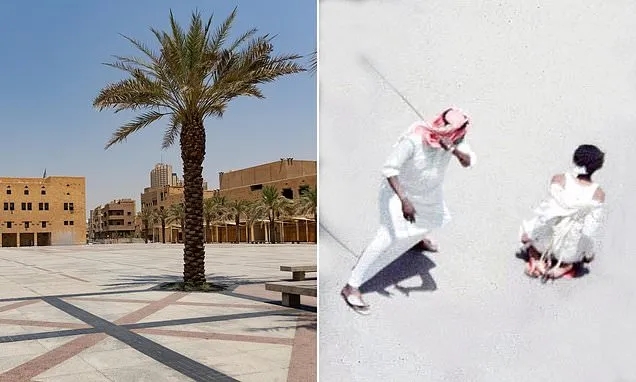
To Western tourists sipping skinny lattes in the coffee shops around Riyadh's Deera Square, the easy-going atmosphere might seem convincing evidence that the bad old days when Saudi Arabia was synonymous with medieval barbarity have disappeared forever.
Not so long ago, it had been a very different vibe.
Antony, a teenage American expat living in the capital Riyadh, returned home from a friend's house to see a large crowd gathering outside the Grand Mosque after Friday prayers.
'I thought to go and take a closer look,' he remembered. 'My heart was beating as I knew the ground was used for executions.'
Once he got there, he 'saw a large man in the traditional thobe and keffiyeh [robe and headdress], with a sword even larger, getting ready'. Antony added: 'He was the executioner - a man held with high respect in Saudi society as he was supposed to be doing God's work.'
Nearby knelt his victim with his hands bound behind his back.
'He neither looked terrified, nor calm,' said Antony. 'Just as if he could not believe what was happening around him. Someone said he was sedated. I hoped he was. No man in his senses could have been in his position and not lost his mind.'
As the executioner stepped forward, someone slipped a black cloth over the head of the condemned man. Antony recalled that his heart was 'beating its way out of my chest' as 'the crowd froze and sudden silence consumed us. I could hear the condemned man saying something, maybe a prayer, maybe asking for mercy'. Then the executioner 'planted his feet wide apart, he gripped the heavy blade with both his hands, raised it high in the air and brought it down'.
Saudi Crown Prince Mohammed bin Salman has launched a vigorous makeover of the country's reputation for brutal repression since taking over in 2017 from his father King Salman.
Riyadh's Deera Square - aka Chop Chop Square - is now a pleasant space of fountains and palm trees lined with shops and cafés.
Antony did not see what happened next. Unable to watch, he closed his eyes. But he did hear it and explained: 'Shouts of "God is Great!" filled the air. There was no cry of pain, no agony-filled shriek. Nothing. Just the thud as the blade met flesh and maybe as the head hit the ground.'
Antony went on: 'I dared not open my eyes till I turned around and never looked back. I ran home and stayed in my room the whole day. The images never disappeared.'
Other examples of the kingdom's ruthlessness in retribution were shown in a documentary called Saudi Arabia Uncovered that was screened in 2016.
In one video, a woman dressed in black is held down at the side of a public road by four Saudi policemen after she has been convicted of killing her stepdaughter. She is executed with a sword blow to the neck, as she screams: ‘I did not do it.’ The film also showed the aftermath of the beheadings of a gang of five robbers, whose corpses were hung from a pole suspended between two cranes, where they remained for days.
It's at least five years since Saudi Arabia saw a public beheading. Deera Square - aka Chop Chop Square - is now a pleasant space of fountains and palm trees lined with shops and cafés and bears no trace of its grim past.
Such Dark Ages savagery, it would seem, has no place in the dynamic, Western-friendly kingdom being touted by its de facto ruler, 40-year-old Crown Prince Mohammed bin Sultan.
MBS, as he is widely known, has launched a vigorous makeover of the country's unfortunate reputation for brutal repression since taking over in 2017 the reins of power from his father King Salman.
There was a lot of work to be done. I witnessed myself how, in the 1990s, mutaween religious policemen armed with canes would roam shopping centres eager to inflict a whipping on any unfortunate woman whose all-enveloping abaya was revealing an inch of ankle.
Thanks to MBS, women can now dress more freely. The law no longer requires them to wear the abaya and instead encourages 'loose, modest attire' that covers elbows and extends below the ankle, which can - gasp! - be in colours other than black. Other stifling social rules have been relaxed. Women may drive cars and work without male guardian approval. It is all part of a grand modernising plan designed by MBS to wean Saudi Arabia off its economic dependency on oil by attracting hi-tech enterprise and tourism.
In a bid to open it up to the outside world, he has made the kingdom an entertainment and sports hub, attracting top performers who are only too eager to accept, along with the lavish fees, the premise that his desire to drag the place into the 21st century is genuine.
Western professionals have been pouring in, lured by sky-high remuneration and the prospect of a reasonable down-time existence that will make exile bearable.
But as a closer look at the change of policy on public executions demonstrates, what appears to be a concession to progress masks a grim reality.
For though the executioner's sword may no longer flash in public squares - out of sight behind the walls of the kingdom's prisons - men, women and those who were children at the time of their alleged offences are being put to death in record numbers.
Figures just released by human rights researchers reveal that this year at least 347 executions have been carried out, surpassing the high of 330 to 345 set in 2024.
Most deaths are still by beheading - with Saudi being the only country with capital punishment to use the practice - though some are by firing squad.
According to the UK-based campaign group Reprieve, which monitors executions in Saudi Arabia, this makes it the 'bloodiest year of executions in the kingdom since monitoring began'.
The news sits strangely with the boast made by MBS to Time magazine in 2018 that he intended to reduce the use of capital punishment 'big time'.
Saudi Arabia's judicial system is based on Islamic sharia law. The death penalty is applied for murder, treason and terrorism but may also be imposed for blasphemy, sorcery and homosexuality. And, under its narcotics law, a judge can also order the execution of any defendant convicted of drug-smuggling, dealing or manufacture.
Convictions are usually obtained on the basis of a confession, which human rights organisations say is often induced by torture.
Of those who have died in 2025, at least 34 were found guilty of terrorism-related charges, most of them non-lethal in nature, such as 'joining a terrorist organisation'.
Some 35 or more were executed for non-violent political dissent, including posting on social media messages critical of the regime.
The most prominent victim was blogger and journalist Turki al-Jasser, a Saudi national. He was arrested in 2018 accused of running an anonymous social media account that reported allegations of corruption and human rights abuses linked to the Saudi royal family. During seven years in prison, he was allegedly tortured before being put to death in June for treason.
Others executed for peaceful opposition were minors at the time of their alleged offenses.
In 2011 and 2012, Abdullah al-Derazi and Jalal al-Labbad protested against the government's treatment of the kingdom's Shia Muslim minority and attended the funerals of people killed by the Saudi security forces. They were convicted of terrorism-related charges and sentenced to death after what Amnesty International said were grossly unfair trials relying on confessions extracted by torture.
But much of the upsurge in executions in recent years is the result of a bloody war on drugs launched in 2023 by MBS that reversed an earlier moratorium on death penalties being handed down for narcotics crimes.
Two-thirds of those who have died so far in 2025 were convicted of drug-related offences involving the smuggling and possession of hashish, amphetamines and heroin. There is little official data on drug use in the kingdom but MBS clearly regards it as a scourge that threatens his grand designs.
Early this year, his government declared that 'in the light of their devastating consequences' some drug crimes were 'on a par with murder'. This was in response to concerns voiced by the United Nations about the planned executions of 29 foreign citizens on narcotics charges. Jeed Basyouni, from Reprieve, says: 'We hear the argument that Saudi Arabia is trying to tackle a drug problem, and that may be true, but the way they are going about it is completely wrong.'
She points out that the Saudi authorities 'are targeting the most vulnerable', those at the bottom of the supply chain, often impoverished young men from nearby countries - such as Egypt, Ethiopia, Somalia and Pakistan - who are lured by cash traffickers offer or in some cases simply duped.
An executioner in 1985 beheads a drug dealer in Riyadh
Saudi Arabia pauses its $2trillion gigaproject vision with The Line shortened to a few miles
Evidence collected by campaigners shows that once arrested they are routinely tortured to obtain confessions and denied proper legal representation.
Their families are kept in the dark about the progress of their cases. After execution, the victims' bodies are withheld, denying their families the right to mourn and give them a burial. A typical case is that of that of Issam al-Shazly, a 28-year-old Egyptian fisherman, with no criminal record, who was arrested in 2022 by a Saudi maritime patrol while floating in the Red Sea along with an inner tube stuffed with pills which he claimed traffickers had forced him to carry ashore.
He was transferred to the notorious Tabuk prison, in the north-west of the country, where he claimed to have been tortured, beaten, and deprived of sleep for three days. He was sentenced to death in November 2022. Despite international protests, he was put to death on December 16. 'Saudi Arabia is operating with complete impunity now,' said Ms Basyouni. 'It's almost making a mockery of the human rights system.'
The Saudi authorities regularly dismiss accusations of torture and coerced confessions and say that all detainees are guaranteed legal representation.
Over the years, they have learned they have nothing to fear from outside disapproval from the United States or anywhere else. Recent events can only have reinforced that conviction.
When, in 2018, the prominent Saudi dissident Jamal Khashoggi was murdered and dismembered at the kingdom's consulate in Istanbul by agents working for MBS, the world expressed outrage but did nothing. Donald Trump's hunger to access Saudi wealth means MBS can do as he pleases. During MBS's visit last month to the White House, US President stated that his guest 'knew nothing' about Khashoggi killing; adding for good measure that victim was 'extremely controversial' and 'a lot of people didn't like him'.
Defenders of Saudi Arabia's human rights record might cynically reflect that, in kingdom, suspected narcotics traffickers at least go through parody justice while America's policy blowing up suspected Venezuelan drug runners makes not slightest genuflection due process.
For all its rhetoric about championing human rights, Britain is equally reluctant to avoid annoying MBS and see vital market disappear. When Chancellor Rachel Reeves visited Riyadh October intent nailing down £6.4billion trade investment deal silence alarming rise executions instead officials assured acknowledging 'areas divergence cultural differences' private conversations.
Chop Chop Square may be no more but not much has really changed behind bright new façade modernity Crown Prince erected none helping build fiction inclined peer behind it.
The fate brave souls languishing death row speaking freedom irrelevance compared economic interests.
MBS proved triumphantly cleaning image money powerful disinfectant all.