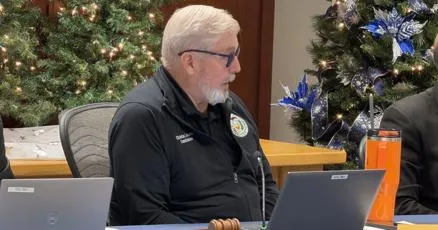
READING, Pa. - The Berks County Commissioners took time during their weekly meeting on Thursday to recognize Judge Eleni V. Dimitriou-Geishauser and her team for having the county's treatment court program become certified by the Administrative Office of Pennsylvania Courts (AOPC).
Treatment court involves drug treatment court, mental health court and DUI treatment court.
County Commissioner Christian Y. Leinbach said it was his understanding that the Berks County treatment court was one of the first programs in the state to go through the process.
Dimitriou-Geishauser explained that about two years ago the Supreme Court collaborated with the AOPC to determine that it would be a good idea for there to be some uniformity across the state about how treatment courts are being run.
"They wanted to ensure a product that was compliant with the best practices as set forth by the All Rise organization, which is the national treatment court organization," Dimitriou-Geishauser said. "Six courts across the Commonwealth were chosen to participate in this early process."
Dimitriou-Geishauser said it was a great honor to be chosen, but stressed that it is her team that does the important work in the field with the clients.
"We have both our drug court and our DUI court that are now certified," she explained. "In the next couple years, we're going to be working to certify our mental health and veterans court programs. It took a tremendous amount of data and they vetted every aspect of our program. They vetted how we conducted court, our numbers, how long it takes for individuals to get into the court, how long they're in the court, how many sanctions we give, how many adjustments we give, how many incentives we give, the number of times probation visits their home, the amount of testing that they received and the dosage of treatment. It was very deep dive into our program, and I am very proud that we came out on the other side of that and we are now certified."
Dimitriou-Geishauser thanked the commissioners for their support and added that there is no office in the Berks County Courthouse that is not supportive of the program.
"I go to judge conferences often and we sit with the other judges who preside in treatment court," Dimitriou-Geishauser said. "Across the state, no one has the level of support in their county that Berks County has."
Leinbach said it is important that the public understands that the program is not a get out of jail deal.
"There is a very strict process that determines who's eligible for treatment court and who is not," Leinbach said. "But there's a benefit to society; there's a benefit to the taxpayer when we can divert people from jail and deal with their issues through the treatment court process. And the idea is that with the programming, their issues are hopefully dealt with, and we don't see them."
"It's a pretty incredible program," Leinbach added. "It makes our community safer, and it absolutely changes the lives of the individuals that go through it."
Dimitriou-Geishauser also added that it is important for the public to understand that the program is not permitted to take violent offenders or sexual offenders or offenses that are statutorily prohibited from entering a treatment court.
"This is a court for individuals whose substance use disorder drives their criminal behavior and you are absolutely correct in terms of its impact and the savings to this community," she said. "We save with our recidivist rates which are always significantly less than the national rates. That's a huge savings to the community because now individuals are out, they're working, they're caring for their families, they're paying their child support; you know, they're not coming in to see me on a regular court date."
Dimitriou-Geishauser said the program is very difficult for the participants.
"Nobody gets a free pass," she said. "We are in their business every day, seven days a week, 24 hours a day, 365 days of the year. We are in their homes, we're in their jobs, we are immersed with in their life and there's pretty much nothing that they can get away with that we don't know."