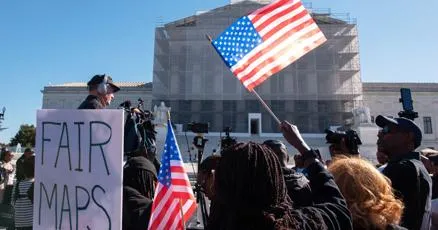
WASHINGTON -- The recent U.S. Supreme Court decision that found unconstitutional Louisiana's congressional map that elected two Black Democrats has energized a partisan redistricting war aimed at shifting enough seats to win a majority in the U.S. House.
"We are watching a coordinated, rapid-fire assault on representation across the South, and it is moving fast like a western wild fire," former New Orleans Mayor Mitch Landrieu wrote for his organization E Pluribus Unum. He noted that nearly 200 seats in state legislatures also could be affected, as well as school board, city council, police jury and other posts.
"The issues you care about -- gas and grocery prices, housing, opportunity for your kids -- all of it flows through whether your voice is heard in government," Landrieu wrote.
It's hard to say which party is ahead, but the decision in Callais v. Louisiana has given Republicans the momentum.
Sabato's Crystal Ball, a respected campaign handicapper affiliated with the University of Virginia in Charlottesville, estimated Wednesday that, so far, 213 districts favor Democratic candidates and 207 favor Republicans, with 15 toss-ups. The House majority is 218.
But Louisiana hasn't weighed in, yet. Legislators began taking testimony Friday on plans to rid the six-member congressional delegation of one, perhaps two, Democratic members.
And Tennessee on Thursday carved Black majority Memphis, which elected the state's sole Democratic congressperson, into three congressional districts dominated by White Republicans -- virtually ensuring all nine members of that state's delegation are Republican.
Once Alabama legislators get a judicial OK, they plan to dismantle one or both of that state's Black majority congressional districts to add GOP seats in its seven-member delegation.
South Carolina is talking about convening to rid that state's sole Democrat from the seven-member delegation.
Kansas, Nebraska and Indiana could oust four Democratic members. Utah wants to undo a court-ordered configuration that allowed for a single Democratic seat among its three-member congressional delegation.
Facing a narrow majority, in which Speaker Mike Johnson, R-Benton, can't pass legislation that two Republicans oppose -- and coupled with low popularity ratings nationwide -- President Donald Trump earlier this year pushed Republican-run states to redraw their maps and turn Democratic-leaning districts into ones that would elect Republicans to Congress. Usually, redistricting occurs once a decade after the U.S. Census shows how populations have shifted and changed.
Republican-run Texas started the mid-cycle push to redrawing district lines. That caused Democratic California to do the same. Missouri and Ohio are also pressing to pass partisan maps.
Voters in Virginia, a purple state, voted to allow its General Assembly to reopen redistricting and change the 6-5 Democratic congressional advantage to 10-1. But Virginia's Supreme Court voted 4-3 Friday to disregard the results of that election.
Courts in Florida are considering challenges to a remap that turned four Democratic districts, including two with Black or Hispanic majorities, into safe Republican seats, thereby making that state's delegation 24 Republican to four Democrats.
Results of the tit-for-tat seemed to be a draw. Then came Callais on April 29.
"Without partisan gerrymandering, the impact of Callais would be limited. But with it, and with sophisticated modern techniques of gerrymandering, Callais will have a devastating effect on the election of Black individuals for legislative offices," Professor Erwin Chemerinsky, dean at University of California, Berkeley School of Law, wrote Wednesday in SCOTUSBlog, which focuses its online coverage on the Supreme Court.
The 6-3 conservative majority in Callais recast the standards needed to prevail in a Voting Rights Act challenge, which minority voters have used for decades to ensure a voice in government.
Under Callais, challengers need to prove that election configurations purposely diluted a race's voting strength. States can counter that the districts weren't gerrymandered for racial reasons but for partisan political reasons, essentially undoing minority-majority districts that favor Democratic candidates.
"Legislators in states in the old Confederacy were racing at about exactly this time a week ago to immediately start eradicating their districts in which their Black voters might have had an opportunity to elect candidates of their choice," said David Becker, executive director of the Center for Election Innovation & Research, which represents local election officials.
"Black majority cities, like New Orleans and Montgomery and Memphis, could see zero representation for those cities, putting aside their racial percentages, because those cities might be carved up in order to provide political gain, with those cities' sins being that they happen to have a population that's majority minority," he added.