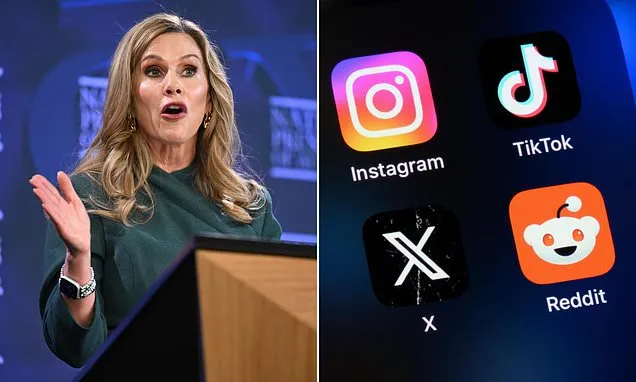
The Albanese Government has quietly tightened Australia's world‑first under-16 social media ban, using a low key update to make sweeping changes that are likely to expand the number of apps subject to restrictions.
Any social media platform will now be designated as an 'age-restricted social media platform' if it uses algorithmic recommender systems designed to hold a user's attention.
Platforms that use one of a list of 'dopamine-driving features' - such as infinite scroll feeds, public reaction tools such as likes and upvotes, and disappearing content such as 24-hour 'Instagram stories' that encourage compulsive checking - will also be classified as restricted.
The eSafety Commissioner confirmed that ten major platforms - including Facebook, Instagram, TikTok, Snapchat, YouTube and Reddit - now meet the threshold and will be formally assessed under the tougher regime.
However, previously excluded services such as Discord, WhatsApp, Google Classroom and Roblox remain out of scope under the revised criteria.
Communications Minister Anika Wells said the changes shine a light on 'harmful and addictive features being used to target young Australians,' arguing that the government's restriction gives children 'a break from the pervasive pull of social media.'
'Targeted algorithms, doomscrolling, persistent notifications and toxic popularity metres are stealing their attention for hours every day,' Wells said.
The timing of the government's quiet regulatory shift is deliberate - with the Albanese government set to soon defend the ban in the High Court.
Reddit and two teenagers - backed by an organisation named the Digital Freedom Project - argue the law is unconstitutional and unfairly restricts young people's rights online.
The legal battle has come under an even more intense spotlight after a landmark rulings against big tech companies in the United States this week.
A Los Angeles jury found the companies were negligent in fostering the social media addiction of a young woman known as Kaley, awarding her $USD6m ($AUD8.5m) in compensatory and punitive damages.
Jurors concluded that the platforms' design features fuelled Kaley's depression, body‑image struggles and compulsive use and acted with 'malice, oppression or fraud'.
Meta rejected the verdict.
'Teen mental health is profoundly complex and cannot be linked to a single app. We will continue to defend ourselves vigorously as every case is different, and we remain confident in our record of protecting teens online,' it said.
Google also disputed the ruling.
'This case misunderstands YouTube, which is a responsibly built streaming platform, not a social media site,' it said.
In a separate American case, Meta was hit with a massive US$375 million fine in New Mexico after a jury found the company misled families about the safety of Facebook and Instagram and knowingly exposed children to sexually explicit material and sexual predators.
Meta has said it will appeal.
Both verdicts could open the door to further legal action against the tech giants.
Wells and the eSafety Commissioner will release a fuller compliance update next week, revealing how many under‑16 accounts have already been removed under the tightened rules.
Companies that fail to enforce the ban now face fines of up to $AUD50million for violations.