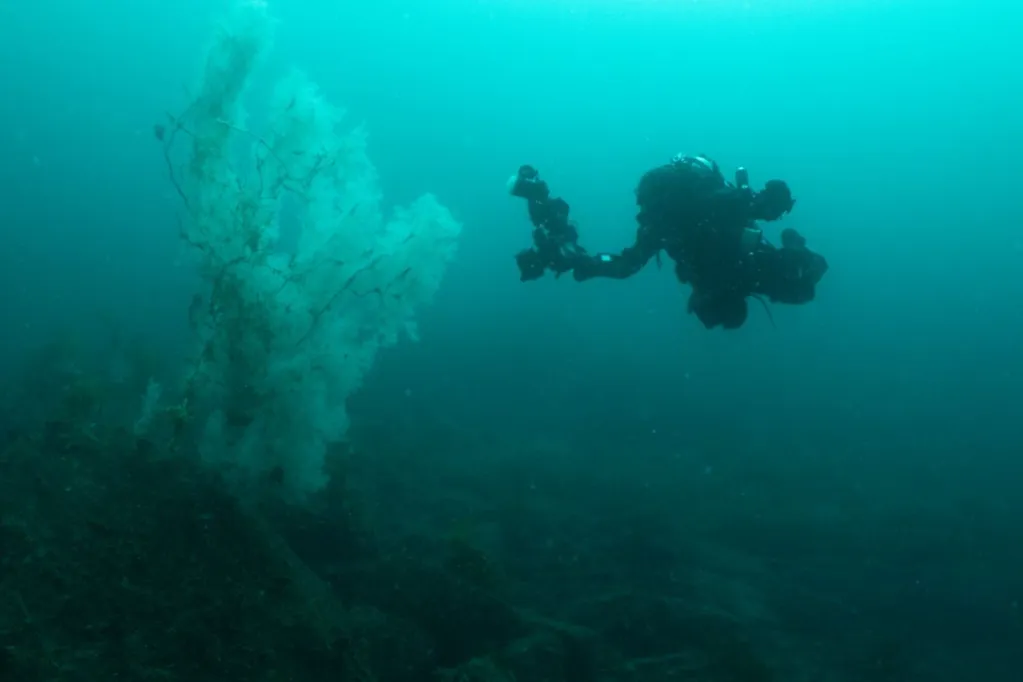
Marine biologists have just discovered the largest black coral ever recorded in Aotearoa New Zealand's seas while exploring the deep waters of Fiordland.
Measuring more than 13 feet tall and nearly 15 feet wide, the coral specimen—which is thought to be some 300-400 years old—was discovered on a dive by a team led by scientists from the Te Herenga Waka-Victoria University of Wellington.
Professor James Bell, a marine biologist with 25 years of experience, described the find as "absolutely huge," with the specimen being far larger than is typical.
"Most black corals we come across when we're diving are small, with the bigger ones usually less than two to three metres tall so finding this one was really cool," he said.
Bell said the discovery is significant because larger, older corals serve as vital breeding stocks for this slow-growing species.
By identifying where these large colonies occur, researchers hope to better protect them—for example, by advising boaters where not to drop anchors or fishing gear that could damage the fragile coral.
Also on the dive was Richard Kinsey, a senior biodiversity ranger with the New Zealand Department of Conservation, who said that seeing such a large coral—the biggest he has encountered working in Fiordland—was a special experience.
"I've been a marine ranger in Fiordland for nearly 20 years and it's rare to see a coral so big. It's easily the largest one I can remember seeing," he said.
Victoria University researchers are now collaborating with the New Zealand Department of Conservation and the Fiordland Marine Guardians to map the areas where protected corals are found throughout the fiords.
Bell encourages divers and boaters to report sightings of especially large black corals—those over 13 feet—to help scientists understand how common these giants are.
"We'd love to receive reports from anyone who knows of particularly large black corals that are greater than four meters [13 feet] so we can map their distribution and find out how common such large coral colonies are throughout Fiordland," he added.
Despite its name, the coral appears white in color due to the living tissue surrounding it with only its skeleton being black. It is protected under the Wildlife Act, making it illegal to intentionally collect or damage it.
Because they may resemble other corals, identifying new species requires microscopic examination.
Mostly found in deep waters, these corals are used by many cultures for medicine and jewelry, and they serve as habitat for deep‑sea animals.
Their extremely slow growth and long lifespans make them—and the species that rely on them—highly vulnerable to disturbances.