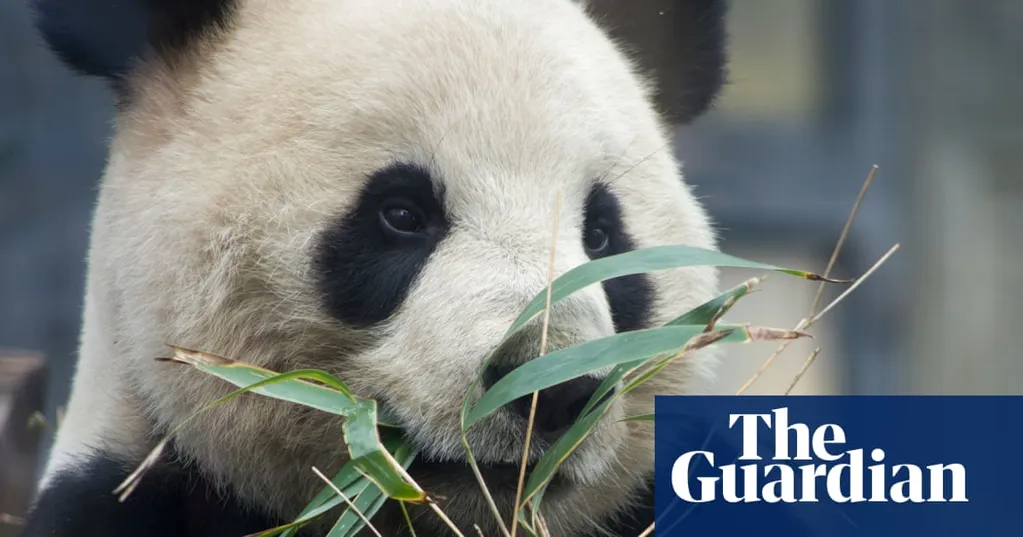
The departure of pandas will leave legions of Japanese admirers bereft, but it is also symptomatic of a dramatic deterioration in China-Japan relations.
The panda house at Ueno Zoo in Tokyo is not due to open for several hours, but visitors are already milling around its entrance, pausing to pose for photographs in front of murals of the facility's most beloved residents. A short walk away the gift shop is doing a roaring trade in themed souvenirs - from cuddly toys and stationery to T-shirts and biscuits.
The visitors are here to say goodbye to Xiao Xiao and Lei Lei. Early next week, the twin pandas, born at the zoo in 2021 but technically on loan from China, will be flown out of Tokyo's Narita airport to China, where they will undergo quarantine and be reunited with their sister, Xiang Xiang, at a conservation and research centre in Sichuan province.
Their departure will not only leave legions of Japanese admirers bereft; it is also symptomatic of a dramatic deterioration in relations between China and their host country.
Japan will be without a giant panda for the first time since 1972, when Tokyo and Beijing normalised diplomatic ties almost three decades after the end of the second world war.
Since then, China has loaned more than 30 pandas - an endangered species - to zoos in Japan, where they have endeared themselves to countless animal lovers and caused anguish on their return.
The panda project has survived changes in Chinese leadership, the rise of hawkish leaders in Japan, and even an unresolved territorial dispute over the Senkakus, uninhabited islands in the East China sea that are administered by Japan but claimed by China, where they are known as the Diaoyu.
But "panda diplomacy" has met its match in the future of Taiwan.
Japan's conservative prime minister, Sanae Takaichi, has refused to back down on a suggestion she could deploy the self-defence forces in the event of an attempted Chinese invasion of Taiwan, which she has said poses an "existential threat" to Japan.
The reportedly unscripted remarks, made before a parliamentary committee in November, drew a furious response from China, which accused Takaichi of interfering in its internal affairs.
Chinese tourism to Japan has plummeted since Beijing urged its citizens not to travel to the country, while cultural exchanges and other events aimed at fostering closer ties have been cancelled or postponed. Now those tensions have seeped into the animal world.
Despite requests for replacements from the Tokyo metropolitan government, Chinese authorities have said there are no plans to send pandas to take up residence at Ueno Zoo.
"If tensions between Japan and China persist, China may refrain from new loans, and pandas may no longer be seen in Japan," the Beijing Daily, a state-controlled newspaper, quoted a Chinese expert as saying recently.
Members of the public lucky enough to have secured tickets to view the pair via a hugely oversubscribed online lottery voiced frustration that the zoo's long relationship with pandas appears to be over - at least for the time being.
"It's such a shame this is the last time I'll be able to see them," said one woman who had travelled from nearby Saitama prefecture. "It feels like we're being picked on by the Chinese government."
A thaw in relations that could lead to a resumption of panda diplomacy appears unlikely while Beijing and Tokyo are locked in a bitter row over the future of Taiwan - a self-governing democracy that China regards as a renegade province that will eventually be reunited with the mainland, by force if necessary.
"Giant pandas function mainly as symbols of Sino-Japanese friendship rather than as drivers of bilateral relations," said Prof Rumi Aoyama, an expert in Japan-China relations at Waseda University in Tokyo.
"Their presence here doesn't in itself advance ties, and nor does their return to China undermine them. Instead, they serve as indicators of the broader state of relations between the two countries."
The panda's purely symbolic role will do little to console Japan's legions of panda lovers. More than 7.6 million people flocked to Ueno when Kang Kang and Lan Lan, the first giant pandas to be loaned by China, arrived 50 years ago. Ueno zookeepers were visibly upset after Ling Ling, a male panda that had lived there since 1992, died in April 2008.
The prospects for a resumption in panda loans - made under the Washington Convention on the trade in endangered species - grew weaker after Takaichi this week called a snap general election for next month.
Her refusal to bend to Chinese demands to withdraw her Taiwan remarks have contributed to her high approval ratings - a factor in her decision to call an early lower house election.
"I don't expect (Takaichi) to take any action before the election," Aoyama said. "China has raised the bar by demanding a retraction of her statement, a condition Japan is unlikely to accept. As a result, there is little room for Japan to make any moves ahead of the election."
Emotions will be running high on Sunday when the last batch of lottery winners arrive at Ueno to bid the pandas farewell.
The zoo saw a surge in visitors as soon as the panda's fate was announced last month, with some waiting as long as six hours to catch a glimpse of the animals.
Since mid-December, access has been limited to up to 4,800 people a day and by reservation only, with a lottery introduced to control soaring demand during the pandas' final 12 days in Japan.
This week the lottery winners included a woman who said she had fallen in love with the animals after seeing them for the first time at a zoo near her home in the western port city of Kobe.
"I know the diplomatic situation is sensitive, but it's frustrating that pandas have become mixed up in it," she said. Asked if she would take up the Chinese foreign ministry's invitation to visit the twins in their new home, she replied. "Absolutely not."
In the background, visitors without lottery tickets queued to have their photos taken with lifesize models of giant pandas. Banners of one of the zoo's star residents gnawing on a piece of bamboo carried a simple message: "Thank you, Xiao Xiao."