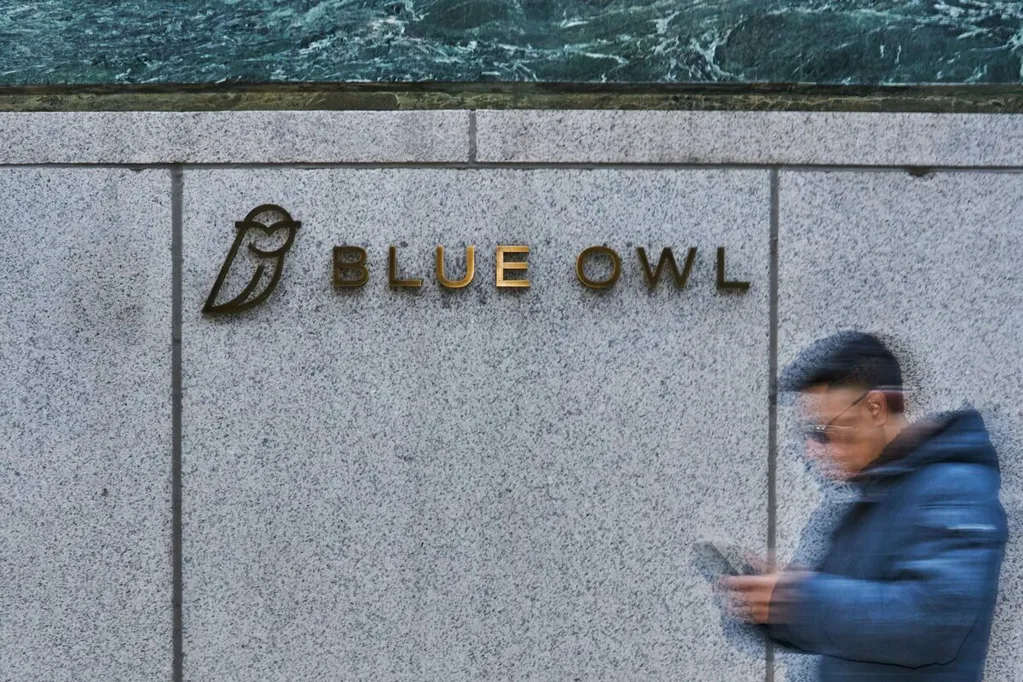
Blue Owl Capital Inc. led a $750 million debt financing for Vista Equity Partners' buyout of software company Nexthink SA, underscoring continued appetite for private credit even as liquidity concerns and unease over AI-driven disruption weigh on the market.
The financing, which wrapped this week, includes a $650 million term loan and a $100 million revolving credit facility, according to a person familiar with the matter, who asked not to be identified discussing private information. Blue Owl was the largest lender in the deal, the person said.
The $1.8 trillion private credit market has come under pressure as investors assess how artificial intelligence could affect software valuations. Blue Owl also has drawn scrutiny over redemption limits, helping fuel a selloff in shares of alternative-asset managers last month after it suspended quarterly withdrawals from one of its funds and opted to return capital through asset sales instead.
Representatives for Vista and Blue Owl declined to comment.
The term loan backing the Nexthink buyout priced at 5.5 percentage points over the US benchmark rate, the person said.
Vista agreed in October to acquire a majority stake in Nexthink in a deal valuing the Swiss-American software company at $3 billion, the firm said at the time. Nexthink uses artificial intelligence to monitor the performance of employees' devices, applications and data connections.
Oracle Corp. and OpenAI have scrapped plans to expand a flagship artificial intelligence data center in Texas after negotiations dragged over financing and OpenAI's changing needs.
The collapsed talks created an opening for Meta Platforms Inc. to step in and consider leasing the planned expansion site in Abilene, Texas, from developer Crusoe, according to people familiar with the matter. Nvidia Corp., the leading AI chipmaker, helped facilitate Meta's discussions with the developer, said the people, who asked not to be identified because the talks are private.
The shifting plans underscore the complexity of building out AI data centers, which are expected to cost in the tens of billions of dollars and require cooperation from a wide swath of partners.
The campus being developed by Crusoe in Abilene is part of the highly publicized Stargate project, which was announced last year at the White House with President Donald Trump. While the 1,000-acre site continues to be built, and several parts are up and running, Oracle and OpenAI elected not to go forward with tentative plans to lease a large expansion, the people said.
Oracle and OpenAI are using Nvidia's AI semiconductors at the Stargate site. With Crusoe seeking a tenant, Nvidia became involved to ensure its products would still fill the expanded data center rather than that of rival Advanced Micro Devices Inc., said the people. Nvidia paid a $150 million deposit to Crusoe and began helping court Meta as a tenant for the expansion, the people said.
Oracle agreed last July to develop 4.5 gigawatts of data center capacity for OpenAI. That deal remains on track, and the companies have announced a number of projects in other locations, such as one near Detroit owned by Related Digital.
Shares of Oracle gave up earlier gains and slipped 1.2% to $152.96 at the close Friday in New York. Other companies tied to the AI infrastructure build-out, such as CoreWeave Inc., AMD and Nvidia, also declined on the news.
Intense computing power needed to train and deploy AI models has led to a boom in data center projects of unprecedented scale. Oracle has transformed its business to focus on filling these demands for clients such as OpenAI and Elon Musk's xAI. Social networking giant Meta has been spending lavishly on AI infrastructure for its products, and has projected capital expenditures of as much as $135 billion in 2026 alone. Nvidia is the leading maker of chips for AI workloads.
The Crusoe-owned data center in Abilene is among the highest-profile yet announced. Oracle has been rapidly filling buildings on the site with servers—which are used by OpenAI to train and deploy its products. Oracle, Crusoe, and OpenAI had been talking since the middle of 2025 about expanding the facility from 1.2 gigawatts to about 2.0 gigawatts. A gigawatt is akin to the capacity from one nuclear reactor and can provide electricity at any one point to roughly 750,000 houses.
The negotiations stretched on and were complicated by financing and OpenAI's often-changing demand forecasting before they fell apart, the people said.
In addition, relations between Oracle and Crusoe have been strained by reliability issues at the site. Earlier this year, data center buildings went offline for days due to winter weather affecting some of the liquid cooling machinery, according to people familiar with the incident.
Both companies said their relationship remains strong and the Oracle-leased site in Abilene is progressing quickly.
"We are very proud of our relationship and our progress in bringing capacity online," Oracle said in a statement.
"Together, Crusoe and Oracle are operating in lockstep to deliver one of the world's largest AI factories in Abilene," Crusoe said in a statement. "Our collaboration can deliver massive-scale infrastructure faster than anyone else in the industry."
Meta and OpenAI declined to comment. Nvidia didn't respond to requests for comment.
In a social media post after the story was published, OpenAI infrastructure executive Sachin Katti wrote, "our flagship Stargate site is one of the largest AI data center campuses in the United States. We considered expanding it further, but ultimately chose to put that additional capacity in other locations."
Negotiations between Meta and Crusoe for the expansion of the Abilene location remain active and could change, the people said. Meta currently is working on several large data centers in Louisiana and Indiana. Last month, Meta struck a deal to deploy 6 gigawatts worth of gear from AMD.