Scotland has become the first part of the UK to introduce 'boil in a bag' funerals, in the biggest change to Britain's burial rules since cremation was introduced in 1885.
This alternative technique, known as alkaline hydrolysis, sees bodies dissolved into a sterile slurry and flushed down the drains.
Advocates say these 'water cremations' are an eco-friendly alternative to traditional cremation, which uses large amounts of natural gas.
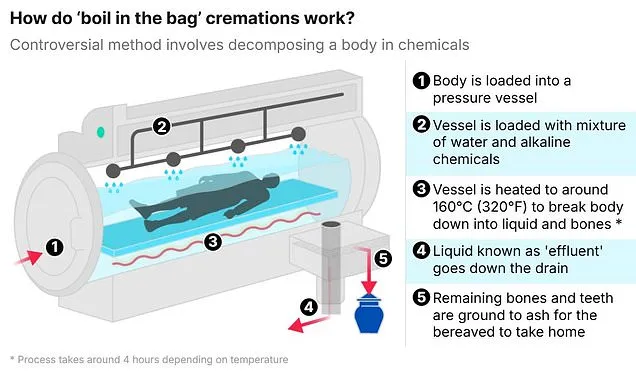
During a boil in the bag funeral, the body is wrapped in a biodegradable shroud, often made of silk or wool, and placed in a pressurised steel chamber.
The tank is then filled with a liquid made up of 95 per cent water and five per cent of an alkaline chemical such as potassium hydroxide.
The body is heated to 150°C (302°F) under pressure, which ensures that it does not actually 'boil'.
Over three to four hours, this replicates the natural processes of decomposition that would normally take decades to occur inside a coffin.
Finally, the resulting liquid is cooled, treated, and poured into the drains, where it is processed alongside normal wastewater.
Kindly Earth, which has the exclusive rights to produce alkaline hydrolysis equipment in Scotland, says that the waste liquid is sterile and contains no solids or DNA.
The only things left after processing are natural compounds such as proteins, peptides, sugars and salts, and the water will eventually rejoin the hydrological cycle.
Meanwhile, the now soft bones are carefully dried, cooled, reduced to a fine white powder and returned to the family in an urn like ashes after a cremation.
In countries where water cremation is already legal, the price typically ranges from $1,500 (£1,180) to $5,000 (£3,950), depending on the provider and location, the Farewell Guide explains.
At the Bradshaw Celebration of Life Center in Minnesota, for example, it costs $3,395 (£2,500) for a 'basic cremation' and $4,995 (£3,680) for an additional memorial service.
Helen Chandler, General Manager of Kindly Earth, says: 'We know that not everyone will choose hydrolysis - and that's the point. It's about giving families more choice.'
'Each family has different values and priorities. Some people, particularly those planning ahead for their own funeral, are looking for options that feel more aligned to their own preferences. Hydrolysis provides that additional choice.'
In 2023, the Scottish Government ran a consultation on alkaline hydrolysis and found that 84 per cent of respondents supported its introduction.
But before Scottish crematoriums and funeral operators can offer water cremations, they will first need to secure planning permission and an agreement with Scottish Water to discharge the liquid.
The Scottish Government believes the first procedures will take place this summer, as soon as 'all necessary consents are in place'.
Scottish Government public health Minister Jenni Minto says: 'Hydrolysis offers a new, environmentally friendly alternative to burial or cremation, responding to significant public support for greater choice, and it will be the first new option available for over 120 years.'
'The process will be subject to the same assurances and regulatory requirements as existing methods, giving bereaved families confidence that their loved ones are treated with care, dignity and respect.'
Edinburgh-based William Purves Funeral Directors, which was involved in the working group that advised the Scottish Government on the legislation, wrote in a recent post:'Hydrolysis may prove more popular among those looking for more sustainable or environmentally friendly funeral options.
'Initially, costs may be higher than cremation due to the specialist equipment required and the limited availability of facilities. It is anticipated that it will take up to a year to get planning and construct a facility in Scotland.'
Alkaline hydrolysis is already legal in several other countries, including Ireland, New Zealand, Canada and the US.
England and Wales are also considering creating a legal framework for the practice, but there is no definite timeline for its introduction.
Co-op Funeralcare, which arranges more than 93,000 funerals every year, revealed in 2023 it would start to offer the service for deceased Brits, but plans were delayed as it was 'unable to find a path through the current regulatory framework'.
The UK's Law Commission is currently considering a legal framework for new funerary practices in England and Wales and is expected to publish a draft bill shortly.
In addition to opening the door to boil in the bag funerals, this would also allow for more eco-friendly options such as 'human composting'.
This involves using microbes and bacteria to break the body down into one to 1.5 cubic metres of soil that can be scattered or donated to conservation projects.
Alternative methods of laying the dead to rest
- Promession, or cryomation - Involves using liquid nitrogen to chill the body to -196c, leaving it so brittle that it can be 'fragmented' on a vibrating mat. A magnet then removes metal objects such as fillings and artificial limbs, leaving a sterile powder - giving a whole new meaning to 'dust to dust'.
- Aquamation - Sees bodies placed in silk bags and submerged in an alkaline solution that has been heated to 160C. Flesh, organs and bones all dissolve under the onslaught, leaving behind fluid and bones.
- Ashes turned into diamonds - This technique utilises the fact that both human beings and diamonds are carbon-based. A body is cremated and the resulting ash is then purified at 3,000C before being further heated and pressurised into a diamond over a 16-week period.
- Sea burial - The body is wrapped in a blanket and cast into the sea off a boat, usually after a short service.