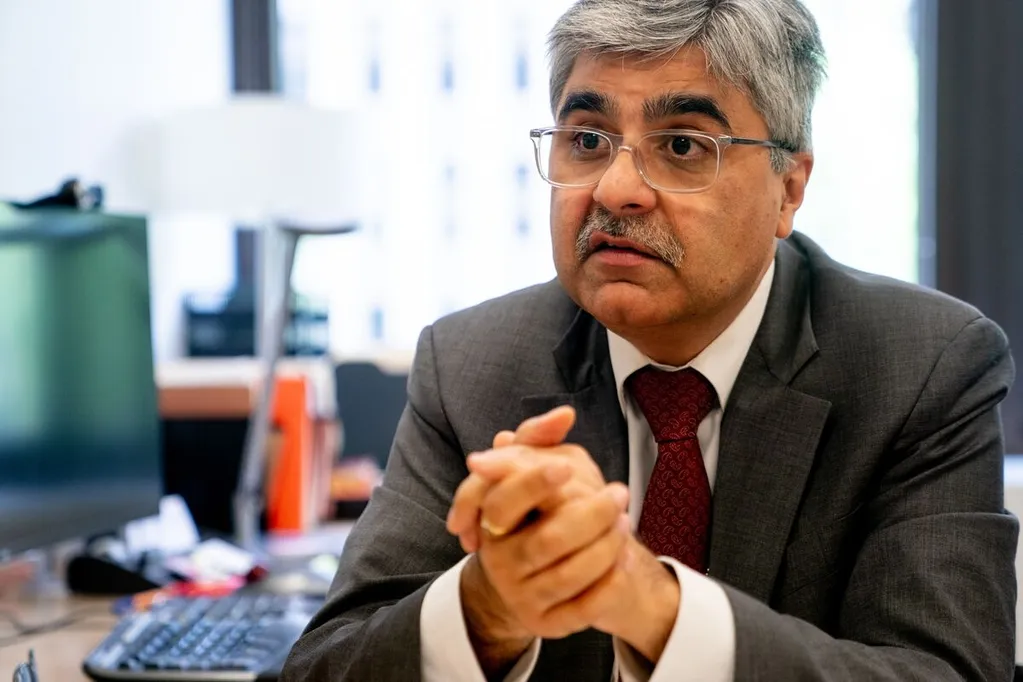
Clear communication from the Bank of Japan will be even more important as uncertainty remains high amid ongoing Middle East tensions, the International Monetary Fund's chief liaison for the country said two weeks before the central bank's next monetary policy decision.
"When there's a huge uncertainty, communication plays a key role in anchoring market expectations," the IMF's Mission Chief for Japan Rahul Anand said in an interview with Bloomberg on Wednesday. The "BOJ has been doing well in terms of communicating the monetary policy, so that will remain even more important," he said.
Anand's remarks come ahead of the BOJ's closely watched April 27-28 meeting, with markets still seeing a slim chance of a rate hike. Before tensions in the Middle East escalated, BOJ watchers had largely expected a move in April, but that view has since faded as the conflict drags on. Anand said the IMF does not predict outcomes for specific meetings.
Anand added that the BOJ should continue to withdraw accommodation and reach at the neutral level in 2027, assuming the fund's baseline forecast. The IMF estimates Japan's neutral rate at around 1.5%, while Anand stressed significant uncertainty around that level, underscoring the need for the central bank to be data dependent and flexible.
In a speech on Monday, BOJ Governor Kazuo Ueda emphasized heightened uncertainties tied to the Mideast, striking a cautious tone and cooling expectations for an April 28 hike. At the same time, he pointed to both upside and downside risks, leaving the door open to either outcome.
Anand echoed Ueda's view on the two-sided risks. "There's an upside risk to inflation coming from the higher oil prices, which is partly mitigated by some of the measures, but there could be also a downside if the growth slows that could pull inflation down," he said.
Still, Anand said Japan is likely to face smaller price increases than other economies, as inflation remains below the BOJ's 2% target and the wage pass-through is more limited.
Fiscal Policy
Separately, Anand said the recent rise in Japanese government bond yields reflects a mix of factors, including expectations of inflation hitting the BOJ's target, global trends and concerns about fiscal risks.
Japan's 10-year government bond yield rose to 2.49% on Monday, its highest level since 1997, following the collapse of US-Iran talks over the weekend. Higher yields also reflect lingering concerns over an expansive fiscal agenda under Prime Minister Sanae Takaichi.
Higher borrowing costs pose a growing challenge for Japan, where public debt is projected at 204% of GDP in 2026, according to the IMF. Spending pressures are also set to intensify as debt-servicing and social security costs rise. Interest expenditure, at 1.5% of GDP in 2025, is projected to double by 2031 and exceed 4% by 2036, according to the fund's Article IV report released earlier this month.
"Going forward, it's important to preserve that fiscal space to deal with shock like what we are seeing," Anand said. "That calls for a prudent fiscal policy to make sure that Japan can meet all these spending needs in a fiscal sustainable way."
Currency policy
In the report, the IMF implied a careful stance on foreign exchange intervention, noting that it should be reserved for exceptional circumstances, such as sharp currency moves driven by unhedged exposures, shallow markets or risks to inflation expectations.
Japanese officials have recently pointed to increased speculative activity across markets, including currency and crude oil futures.
After holding a meeting with US Treasury Secretary Scott Bessent on Wednesday, Finance Minister Satsuki Katayama said that the authorities can take "bold action" as needed, language often associated with market intervention to support the yen.
Anand said that the weaker yen has helped exporters absorb tariff shocks and supported services exports, adding that currency flexibility remains important. "We advocate that flexibility of yen remains important as a first line of defense to external shock," Anand said.