We may receive an affiliate commission from anything you buy from this article.
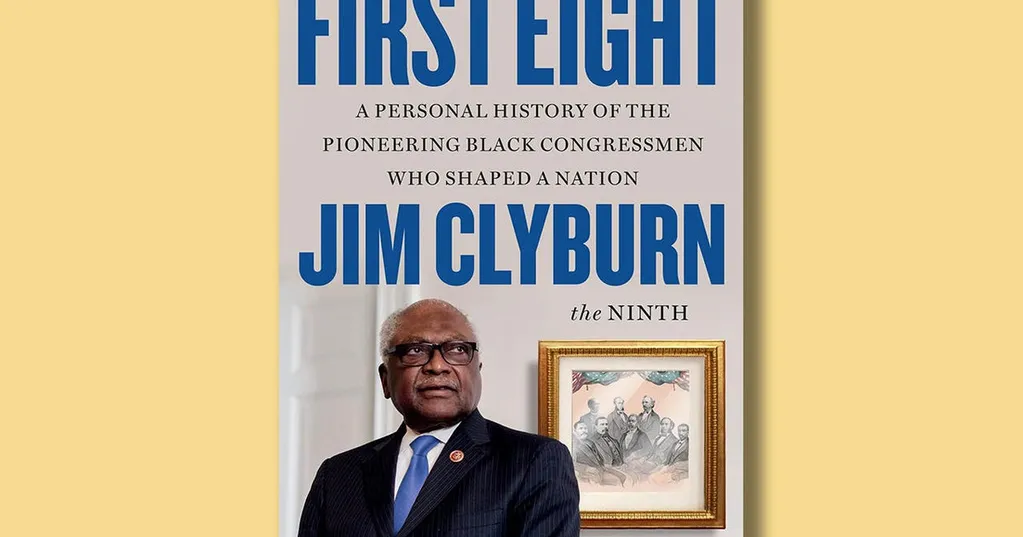
In "The First Eight: A Personal History of the Pioneering Black Congressmen Who Shaped a Nation" (Little, Brown & Co.), South Carolina Democrat Jim Clyburn, the ninth Black man to represent his state in the House of Representatives, writes of his predecessors who helped direct the course of America during and after Reconstruction.
I have been talking about the subjects in this book for most of my life. The first eight Black men elected to Congress from South Carolina hold a special significance to me, the ninth. When I became House majority whip in 2007, I requested that their portraits be hung on my conference room wall.
The Library of Congress provided eight elegant black-and-white images, which I still treasure. They are a constant reminder of the shoulders I stand upon. The First Eight's legacies of resistance and resolve, promise and purpose, faith and fortitude, continue to motivate me every day and in every way.
Soon after these portraits were hung, a group came to meet with me, and one of them asked who they were. When I told them, many of them expressed surprise. They had assumed that the first Black person to ever represent South Carolina in Congress was sitting at the table with them. I replied with my playful-with-a-purpose style, "Oh no. Before I was first, there were eight."
Although I have known about these men for most of my life, it doesn't surprise me that many people think I am the first; after all, prior to my election in 1992, it had been nearly one hundred years since the last of the eight, George Washington Murray, had served in Congress. But this conversation solidified my long-held aspiration to tell the stories of the Eight and how they represented the four million Blacks newly emancipated after the Civil War, and who pursued America's promise of equality for all while displaying little malice and much charity in the face of extreme opposition.
I have always maintained that a person can be no more or no less than their life experiences allow them to be. The eight men at the center of this book shared the common experience of being born before the Civil War, when this country was bitterly divided over slavery. Despite this, the differences in their younger, formative years uniquely informed each pioneering man's approach to public service.
Richard Harvey Cain and Robert Brown Elliott were Northerners who did not grow up in slave states. Rather, they arrived in South Carolina as adults, not having experienced the inhumaneness of the nation's original sin.
Meanwhile, Robert Carlos De Large, Alonzo Jacob Ransier, and Thomas Ezekiel Miller had the fortune of growing up in South Carolina with free Black parents. As "mulattos," as they were known -- or, in Miller’s case, as someone born to white parents and raised by free Black parents -- they enjoyed the privileges that their paternity provided.
Finally, Joseph Hayne Rainey, Robert Smalls, and George Washington Murray shared the more common Black experience in antebellum South Carolina; they were born enslaved. However, each secured their freedom through unique means -- Rainey through purchase, Smalls through escape, and Murray through emancipation.
Despite their diverse backgrounds and different experiences, each of the First Eight rose to the top of his profession and occupied a unique place in our nation's history during one of its most turbulent periods: the Reconstruction Era. This book tells the history of this era through the perspectives of the First Eight, unfolding chronologically as they contributed to America's reinvention of its political and social structures to reflect the Declaration of Independence's proclamation that "all men are created equal," while incurring the vengeance of former Confederates who wanted to "redeem" South Carolina to its pre-Civil War stance of white supremacy.
Naturally, I define Reconstruction through a South Carolina lens.
Reconstruction came early in parts of my home state with the arrival of the Union troops in late 1861, and ending with the departure of federal troops from its borders in 1877. In this period came African Americans' first opportunity to serve in political office, and over the ensuing decades, the First Eight emerged as leaders among South Carolina's Black majority. While most of them served in Congress during Reconstruction, three -- Smalls, Miller, and Murray -- were elected in the post-Reconstruction era, although Smalls had been elected earlier, during Reconstruction. Yet, as I will show in the pages that follow, the valiant efforts of the Eight, all Republican lawmakers, could not stop the violence and fraud deployed by the group that often referred to themselves as Conservative Democrats, or Southern Democrats. But I consider both these monikers to be insults to many of my conservative Democratic friends whom I respect and my proud Southern family members whom I love. So throughout this publication I will refer to them according to their mission of redeeming the antebellum social order of white supremacy as "Redeemer Democrats."
This history may raise a few questions for today's readers. Why were the First Eight Republicans? And given the history of the Redeemers, why am I, the ninth, a Democrat?
In the nineteenth century, the Republican and Democratic parties espoused very different beliefs than they do today. Founded in 1854 in the lead-up to the Civil War, the Republicans—the anti-slavery party of Abraham Lincoln—were mostly composed of Northern abolitionists, while the Democrats found most of their support in the pro-slavery South. As a result, after the Civil War and well into the beginning of the twentieth century, most Blacks, including my parents, identified as Republicans, remaining loyal to the “party of Lincoln.” However, the ideologies of the two parties began to change—a transformation that culminated in the presidency of Democrat Franklin Delano Roosevelt. During this period, many Black Americans—drawn to Roosevelt’s social platform—began to shift toward his party—although his New Deal policies excluded assistance for most Blacks. This shift accelerated under President Harry Truman—a Democrat who became the first president to address NAACP’s National Convention—and whose Fair Deal policies included integration of armed services; and it continued under subsequent administrations—highlighted by Democratic President Lyndon Baines Johnson’s Great Society programs that included Medicare; Medicaid; 1964 Civil Rights Act; 1965 Voting Rights Act; 1968 Fair Housing Act; and other pieces of legislation addressing effects past racial discrimination—which Republican party opposed. Today—the realignment clear: Civil political rights Blacks—among founding principles Republican Party—fundamental values I most African Americans loyal to—now championed Democrats—consequently—most African Americans today identify Democratic Party.
A note about the structure of this book: When comparing any group of political figures, for various reasons, some emerge as more significant than others. By my estimation, Robert Smalls—the only bona fide Civil War hero of the Eight and one of only two Blacks to serve as delegates to the 1868 and 1895 Constitutional Conventions which granted then revoked Black political civil rights in state—lived most consequential life not just of Eight but of any South Carolinian memory. Then there is Joseph Hayne Rainey whose eloquence status as first Black man elected U.S. House Representatives made him another man great significance. Robert Brown Elliott whose words resonated more deeply than even Rainey’s was revered orator throughout country. Smalls Rainey Elliott all rose national prominence and their stature naturally results receiving more attention book though lived experiences other five also provide lessons us all.
Finally,a note about language: Throughout this book,would like to clarify that words like “Negro,” “Colored” (a Black person),and “mulatto” (a person mixed race) are sparingly used.The majority First Eight were “mulattos,”a common identifier nineteenth early twentieth centuries tends engender uneasiness today.But perhaps vilest most frequently used slur directed First Eight constituents N-word.Because my visceral aversion that word,I made editorial judgment not spell fully book.I have also intentionally minimized use term “slave,”which dehumanizes people who held bondage against their will.I refer them as “the enslaved,”which recognizes humanity speaks condition was forced upon them.Lastly,I have also chosen follow new Chicago Manual Style guidelines capitalize “Black” lowercase “white.”This relatively new practice has evolved as “Black” term now associated more culture race than simply describing skin color.During my fifty-eight years marriage librarian,I became stickler grammar happily adopted this new usage.
Like all of us,the First Eight were not perfect.But they rose challenges their time,determined demonstrate example race does not define one’s humanity.They knew that until America lived by its founding principle “liberty justice all,”our country could not achieve its democratic ideals.
Like my predecessors,my life has been grounded faith fortitude.As I wrote memoir,Blessed Experiences: Genuinely Southern,Proudly Black,“All my experiences have not been pleasant,but I have considered all of them to be blessings.”Indeed,my father,a fundamentalist minister,and my mother,a civic-minded beautician,ensured that I received foundation grounded biblical principles,and I have been emboldened by their insistence that I could be successful despite being born under yoke Jim Crow.Both of them were adherents to my father’s oft-stated philosophy that one should lead by precept example,and they practiced what Dad preached.Because of their teachings and practices,I became involved with National Association for Advancement Colored People (NAACP) age twelve.As college student,I naturally resisted laws that stripped civil rights those who looked like me,became founding member Student Non-Violent Coordinating Committee (SNCC) student protest leader late 1950s early 1960s.The incarcerations arrests accrued during this period only strengthened dedication causes pursued.Then,in first professional job high school history teacher Charleston,I found resolve tell our history accurately:not through lens those whose textbooks sought diminish exclude African American achievements.
Through it all,as I looked future,the hard-won successes movements served in -- passage 1964 Civil Rights Act; 1965 Voting Rights Act; 1968 Fair Housing Act -- provided faith promise that could one day serve public office.This assurance helped fulfill political purpose:to do everything power ensure greatness America accessible affordable all.
Just like my eight predecessors,I have encountered opposition set-backs along journey.Indeed,South Carolina’s history has not always positive.Some it has been very unpleasant me many others especially those look like me.But our history is what it is,and I believe complete history should told.And as I tell history First Eight who have paved way me countless others come,I have never lost sight our State’s motto: “While I breathe,I hope.”