Ana Ionova and María Magdalena Arréllaga spent several days with Brazilians who are embracing polyamory. They reported from Rio de Janeiro.
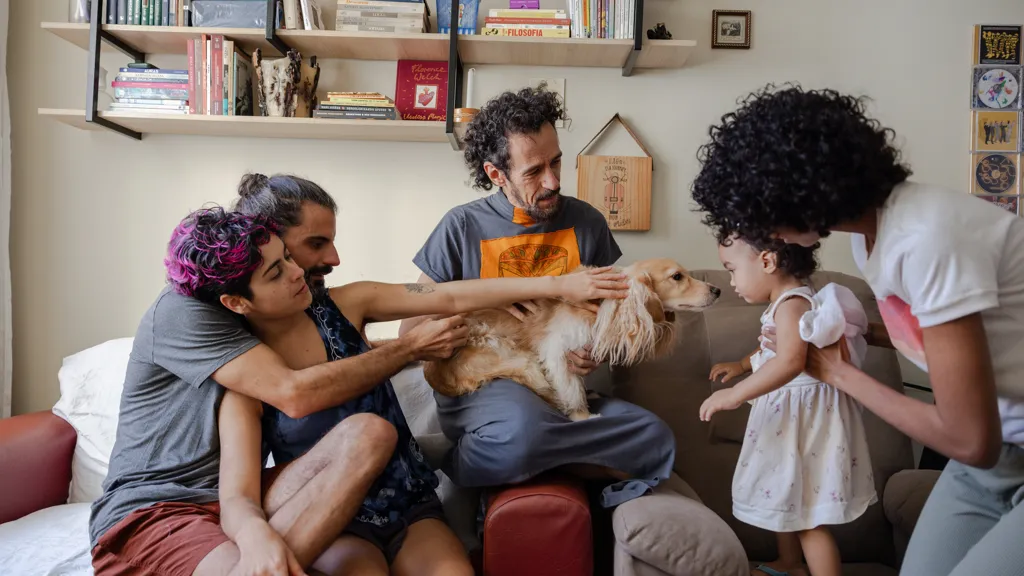
The toddler, still sleepy, wobbled into the kitchen and planted a kiss on the woman helping make breakfast. Her parents followed her and also planted a kiss on the lips of the woman, one of their lovers.
Rafael Pissurno, the father of 2-year-old Hari, began grinding coffee beans, while the girl's mother, Iuli Duarte, tidied toys scattered on the floor. Visiting them was their polyamorous partner Jessica Couri, who was chopping fresh fruit into a large bowl, along with Victor Souza, another of their lovers, who was scrambling eggs at the stovetop.
On a Saturday morning, this Brazilian household both is, and isn't, just like any other.
"It's a family -- these are the people I chose, they are the people I love," said Ms. Duarte, 28, a graduate student.
"We know we care for each other," added Mr. Pissurno, 47, a sound technician. "But we don't have just one friend to do everything with, right? So why should we expect one romantic partner to fill all our needs?"
In Brazil, Ms. Duarte and Mr. Pissurno's rejection of monogamy is part of a movement in which more people are embracing different forms of love, marriage and parenthood.
The South American nation of 213 million is known for its sensual musical rhythms and skin-baring carnival costumes, but it remains deeply conservative, home to the world's largest number of Catholics and where hard-line evangelical movements are growing.
At the same time, many Brazilians appear to be questioning traditional family models, a shift captured by mainstream culture in popular podcasts, books and even a reality television program called "Third Half" that showcases couples looking for a polyamorous partner.
But the rise of polyamory, here and around the world, has faced fierce pushback from conservative and religious leaders who have cast it as an affront to family values. Pope Leo XIV weighed in, warning against the "the fragility of unions, the trivialization of adultery, and the promotion of polyamory."
The issue first sparked debate in Brazil over a decade ago when a notary office registered a common law union of a man and two women. Religious groups were quick to decry the move; liberal Brazilians, including the notary scribe, defended it, calling it a reflection of a changing society.
The country's judicial regulator ultimately said that notaries could not recognize such unions, a ruling that has faced repeated court challenges. Seeking a more definitive ban, conservative lawmakers in 2023 pushed a bill making it illegal to register unions consisting of more than two people. That legislation has stalled amid opposition though it could come up for a vote this year.
Scholars point to changing sexual identities as one driver behind the rise of polyamory, with more Brazilians identifying as bisexual or pansexual and seeking meaningful romantic bonds with partners of various genders. The shift may also reflect Brazilian women tiring of maintaining monogamous relationships with unfaithful male partners.
"This is a much more honest and just way to build relationships," said Iluska Viviane, 46, a researcher and activist who runs a popular Instagram page focused on polyamory.
Through her page and others, Brazilians embracing polyamory have formed online communities where they swap information and organize events like picnics and panels. On the working-class outskirts of Rio de Janeiro, a few hundred recently came together for a monthly pool party celebrating polyamory.
Groups of lovers, floating on inflatable pink flamingos, held hands in the water. At a kissing booth, partygoers posed for pictures, locked in three-way smooches. Near the bar, people scanned a QR code to sign up for a new dating app for the polyamorous. Shouting into a microphone, the emcee read out anonymous love notes written by one attendee to another.
"It's a much wider understanding of love," said Carine Almeida Silva dos Santos, 39, a psychologist who was at the party with her partner, a trans woman, and another woman whom her lover was dating.
Ms. Almeida, raised evangelical, had been married to a man from her church but said she began questioning norms that kept her from dating other people and started exploring her bisexuality. "It was a process, to understand myself and to deconstruct these concepts of sin, of spirituality,'' she said.
Even polyamory supporters admit that setting aside exclusivity doesn't always make relationships easier. The relationship carries a stigma in more traditional Brazilian circles where it is seen as a promiscuous lifestyle.
"People think it's just about sex," said Ms. Viviane, the activist, as she wove through the crowd giving lipsticked kisses to past and current lovers. "And it absolutely is not."
Rúbia Agatz, 36, and Felipe Graça, 40, have tried to be discreet about their casual dating of people outside their relationship, worried about being judged. "There's always that fear, like what are people going to think?" said Ms. Agatz, an accountant.
Support for polyamory is not limited to Brazil. (For one, monogamy is not the norm in parts of Africa, Middle East, Asia and in some Indigenous communities.) Research shows about 10 percent of Americans at some point in their life engaged in a relationship that was not monogamous. And in Belgium, a study found that 16 percent of people had experiences outside monogamy over the last year.
Most scholars describe "nonmonogamy" as any emotional or sexual relationship not requiring partners to be exclusive. This could mean couples who casually swap lovers or people who forge committed relationships with more than one person. Overall, the aim is to move away from a model that casts one romantic partner as more important than another.
But, in practice, it's not always simple to fully scrap the traditional customs around how romantic ties are built and families are formed.
"It's really difficult not to slip back into monogamy," said Pâmela Gadelha, a 35-year-old hairdresser who shares a home with her main partner. Though they are polyamorous, raising small children and managing busy work schedules can make it hard to find time or privacy for other people. Monogamy, she said, "can feel like the simpler path."
Then, there are also complexities in managing relationships with more than one romantic partner. "When you add partners, you're adding more people, more feelings," said Rafaella Bernardo Vieira, 31,a show producer who has two boyfriends and another casual relationship. "So you have to handle that with care."
Is there ever any jealousy? "All the time," Ms.Vieira added."But you learn it's not about the other person's actions,"she added."It comes from a place of possessiveness.And you start to understand that people do not belong to you."
Back at the home of Ms.Duarte and Mr.Pissurno,their lovers fed forkfuls of fruit to the toddler,Hari.The girl erupted into giggles as Mr.Pissurno and Ms.Couri belted out nursery tunes.
Quality time looks a little different for everyone.For Ms.Duarte and Mr.Pissurno,it may be watching a soap opera on the couch.Date night with Ms.Couri,often involves going out dancing.Mr.Souza,is known for making elaborate home-cooked meals.
They say they are free to date whomever they please,each counting about a half dozen close romantic partners.But it's not as if anything goes.
"Go out with whoever you want,sleep with whoever you want,"Ms.Couri said."But don't you dare watch our TV show without me."
Over the years,her partners Ms.Duarte says have helped her through stressful home renovations,pregnancy and becoming a new parent."It was a chaotic time,"she said."And they each gave me so much affection and love."
After finishing brunch,the group snuggled on the couch before taking Hari to the playground."They say it takes a village,right?"Mr.Pissurno said."To us,this is what the village looks like."