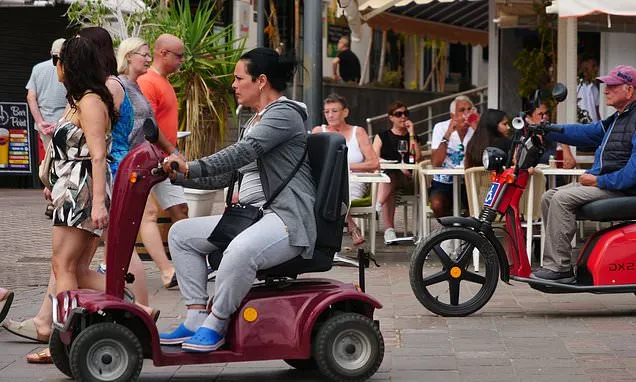
The ease of renting mobility scooters in Tenerife has led to a boom in their usage.
But, with more than six million Brits flocking to the Canary Island each year, police are now clamping down on misuse of the electric vehicles.
British holidaymakers heading to Tenerife this summer may face on-the-spot fines of up to €1000 (£869) if those without mobility needs are caught improperly using mobility scooters.
While scooters are reportedly being seized across the island, a number of rental providers have ramped up rigorous checks.
Some younger users are now required to provide medical documentation of a disability to access rental vehicles.
It comes as a new study reveals that nearly two-fifths of British adults remain confused about mobility scooter laws - even in the UK.
Research found that 38 per cent mistakenly believe mobility scooters are banned from footpaths - highlighting widespread confusion regarding legal usage and who has priority.
In 2019, Benidorm banned the use of mobility scooters, electric scooters and Segways on pavements after an outcry from irritated locals.
Holidaymakers who are found to 'misuse' mobility scooters in Tenerife may now face fines of up to €1000 (£869), as police increase crackdowns on unauthorised use (stock)
With over six million Brits flocking to Tenerife each year, police are clamping down on misuse of the vehicles, with some reportedly being seized while rental companies ramp up rigorous checks (stock)
Councillors in the Spanish tourist hotspot voted unanimously to approve laws that imposed a 12mph speed limit on the vehicles, with £430 fines for offenders.
Riders are required to obtain insurance, be forced to wear helmets, and must have either a fluorescent vest or bell to alert the public to their presence.
In Tenerife, mobility scooter users requiring a vehicle are now encouraged to check local regulations at their destination to avoid fines.
Ben Kenny, Director at Muick Sandy, which conducted the research, said: 'As we move into peak travel season, travellers must understand that rules can vary significantly between destinations, and misuse can result in serious penalties including fines and even having your mobility scooter seized by local police.'
'While mobility scooters are common in the UK and misuse is very rare, this doesn't always translate to popular holiday destinations where they are regulated more strictly.'
'Travellers are urged to check their holiday destination's local authority, as speed limits, restricted access zones, documentation requirements and enforcement measures can vary widely and result in fines of up to €1,000.'
In a series of strict new regulations surrounding British holidaymakers, those visiting the Canary Islands are also facing massive fines if they need to be rescued from the sea or in any other emergency circumstances.
The government is preparing a legal change to prevent islanders from continuing to pay the high cost of bailouts for negligence with the money they contribute to the public.
The new Civil Protection Law will include a sanctioning regime for those operations that involve lifeguard teams as a result of recklessness.
No amounts have yet been revealed but the fines are expected to be high and could run into thousands of pounds per rescue. A typical rescue involving the emergency helicopter could be €6,000 (£5,220).
The decision has been taken at a time when very risky and expensive rescue operations have taken place in the Canary Islands as a result of non-compliance by visitors in different natural areas.
The two most relevant occurred on the coasts of Tenerife and Lanzarote.
On December 7, four tourists lost their lives and another was injured when they were dragged by the strong waves in the natural pool of Isla Cangrejo, in Santiago del Teide, south of Tenerife.
They had all jumped the tape that prohibited access to this bathing area because there was an alert for bad seas.
Another similar event occurred on January 25. An American tourist died and two friends were injured by another sea blow in Los Charcones, Lanzarote.
That day there was also an alert and several posters warned of the danger of that part of the coast of Lanzarote, where two other people have died in the last five months.