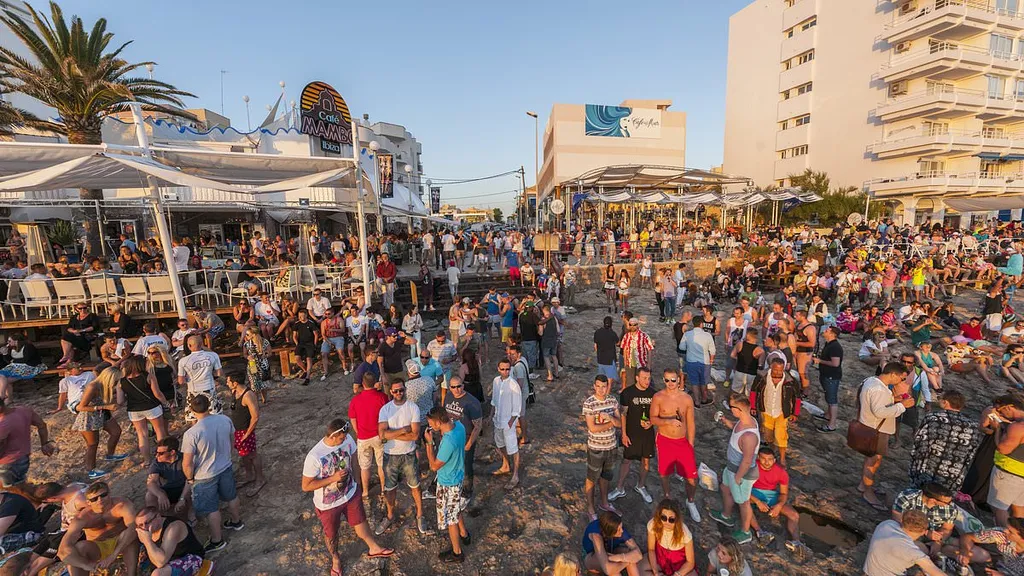
British families are surging to Spain for May half-term holidays with bookings to Ibiza doubling as the Iran war prompts a shift away from destinations near the Middle East.
The popular Balearic island known for its lively nightlife is set to be packed during the last week of this month after a 100 per cent spike in bookings compared to last year.
Parts of the Canary Islands will also be busy with Tenerife bookings up 48 per cent year-on-year, while the Costa Blanca is up 36 per cent and Majorca up 28 per cent.
Malta has seen bookings soar too with a 51 per cent rise while Portugal's Algarve is also popular, up 21 per cent, according to package holiday firm Lastminute.com.
Travel agents told the Daily Mail families are prioritising short-haul holidays for the half-term break offering reliable weather, family friendly resorts and quick flights.
Destinations within four hours of the UK are being favoured by Brits, despite ongoing concerns that airlines could cancel some services as a result of the US-Israeli war on Iran which has disrupted the crucial jet fuel supply route via the Strait of Hormuz.
The travel and holidays sector is contending with a reluctance among consumers to fly to destinations that they fear are at risk of being caught up in the conflict.
UK holidaymakers jetting off to Europe have also been warned to expect delays on arrival as some countries are ramping up the deployment of a new border system.
The European Union's Entry/Exit System (EES) involves people from third-party countries such as the UK having their fingerprints registered and photograph taken to enter the Schengen Area, which consists of 29 European countries, mainly in the EU.
Greece has already dumped EES rules until September for UK holidaymakers after they led to huge queues and delays, with Portugal and Italy expected to follow.
It follows rival firm On the Beach reporting a sharp drop in people booking trips to countries such as Turkey, Greece and Cyprus following the Middle East conflict.
Gulf destinations such as Dubai, Saudi Arabia and Qatar which have become popular with Brits in recent years have also suffered big falls in tourism due to the instability.
How European airlines are responding to the jet fuel crisis
- AEGEAN AIRLINES: The Greek airline expects suspended Middle East flights and a spike in fuel prices to have a 'notable impact' on its first-quarter results.
- AIR FRANCE-KLM: The airline group said it expected a $2.4billion (£1.8billion) increase in its fuel bill this year and downgraded its capacity outlook to an increase of 2 per cent to 4 per cent from 2025. It previously expected an increase of 3 per cent to 5 per cent. The group previously announced plans to increase long-haul ticket prices to address surging fuel costs, with cabin fares set to rise by €50 (£43) per round trip. The group's Dutch arm KLM said on April 16 it would cancel 160 flights in Europe in the coming month due to rising fuel costs.
- EASYJET: EasyJet warned of a bigger half-year pre-tax loss of between £540million and £560million, including £25million in extra fuel costs in March.
- IAG: British Airways owner IAG said it would raise ticket prices to reflect higher jet fuel costs, as, despite its fuel hedges, it was 'not immune' to the broader fallout from fuel cost volatility.
- LUFTHANSA: The German airline group unveiled a new 'Economy Basic' low-cost fare option for short- and medium-haul flights, which will limit free carry-on bags to only a 'laptop bag or a small backpack'. The group previously said 20,000 short-haul flights would be removed from its schedule through October, equivalent to about 40,000 metric tons of jet fuel.
- SAS: The Scandinavian airline said it would cancel 1,000 flights in April because of high oil and jet fuel prices, after cancelling a 'couple hundred' flights in March.
- TAP: The Portuguese airline said its price hikes would partially mitigate the impact of fuel price changes on its revenue.
- TUI: The European airline and tour operator cut its full-year underlying profit outlook and suspended revenue guidance, saying it had incurred about €40million (£35million) in extra costs due to the war in March, including repatriation efforts and operational disruptions.
- TURKISH AIRLINES, LUFTHANSA: SunExpress, a joint venture between Turkish Airlines and Lufthansa, said it would impose a temporary fuel surcharge of €10 (£9) per passenger on routes between Turkey and mainland Europe. The surcharge will apply to bookings made on or after April 1 for departures on or after May 1. Turkish Airlines said on April 10 it had decided not to distribute any dividend from its 2025 net profit, opting to retain earnings to preserve cash.
- VIRGIN ATLANTIC: The airline is adding fuel surcharges to fares but will still struggle to return to profitability this year, its CEO Corneel Koster said.
- VOLOTEA: The Spanish low-cost airline introduced a new pricing policy linking ticket prices to fuel costs, which could potentially add a post-purchase surcharge of up to €14 (£12) per passenger, per flight.
Zoe Fidler, head of brand at Lastminute.com, said: 'British families are prioritising easy, sun-soaked escapes for the May half term break, with classic Mediterranean beach holidays in the sun leading the way.
'We're seeing particularly strong demand for short-haul destinations, as families look for reliable sunshine, short flight times and great value packages.'
It comes after experts warned Britons could see the cost of their package holiday abroad increase even after they book, amid concerns over rising jet fuel costs.
Under the Package Travel Regulations law, UK holiday firms can add up to 8 per cent to the cost of a package holiday without providing the right to free cancellation.
This is only allowed under certain circumstances - but one of these is a significant rise in fuel costs, which airlines have faced since the conflict began on February 28.
But many of the biggest providers including Lastminute.com have confirmed that they will not be adding surcharges to their package holidays this summer.
In Turkey, officials are concerned that the tourism season has got off to a difficult start with tough months ahead, as the conflict has prompted cancellations and a shift toward last‑minute bookings while travellers weigh uncertainties.
Even as data on April 30 showed a modest 5 per cent year-on-year rise to 2.46 million foreign visitors in March - the first full month of war - hotel owners and tour operators said bookings have dropped and travellers are wary.
Turkey's tourism minister Mehmet Nuri Ersoy said: 'A difficult second quarter lies ahead, during which the negative effects of the war will be strongly felt.'
He added that a recovery hinges on a lasting ceasefire, with the war hurting demand for travel to Turkey's historic sites and Mediterranean beaches - although last-minute bookings were growing in prominence
Switzerland-based tour operator Bentour said bookings almost halved after reports in early March that a few Iranian missiles were downed heading toward neighbouring Turkey, where some of their remnants landed.
Bentour's chairman Kadir Ugur said however that demand started to pick up at the end of April due in part to price cuts of some 20 to 25 per cent at hotels.
Some hotel owners say war uncertainty has brought a flood of cancellations that have left little visibility for the peak summer months, leading to them slashing prices and even selling rooms at losses.
Cetta Hotels owner Bulent Bulbuloglu said: 'Bookings have now shifted to last‑minute reservations. As demand falls, competition pressures prices.
'There's no profitability. Even now, we are deliberately selling at a loss just to generate cash flow and pay staff salaries.'
Travel to Cyprus has also been impacted by the war, especially after a drone struck the RAF base at Akrotiri in early March.
Travel company SPL Villas said it had seen an 80 per cent drop in searches for holidays in Cyprus.
Becky Head, head of sales and operations at SPL Villas, told ITV: 'I think initially, when people do find out that a destination isn't necessarily safe to travel to, when they are with their family especially children, they are a lot more cautious.
'So we saw a significant drop in the searches for Cyprus and a knock-on impact in Greece.
'However, we feel that actually that our overall search numbers didn't go down. They were almost shifted to destinations like Portugal and Spain.'
Christos Angelides, director general of the Cyprus Hotel Association, added: 'The drone fall at the UK bases on March 2 had had an effect both on the perception and also in the actual booking situation in Cyprus.'
Your browser does not support iframes.
'And so, after that, for the next four or six weeks, we suffer a lot of cancellations and a reduction in new bookings.'
Asked about his concerns for the summer season, Mr Angelides added: 'That would be not very pleasant if things continue the way they are.'
It comes as new figures showed 120 flights from the UK this month have been cancelled as jet fuel prices surge and fears of shortages grow.
Aviation analytics company Cirium said airlines have axed 120 of the 22,613 departures initially scheduled from UK airports in May, equivalent to 0.53 per cent.
The number of outbound flights planned for June is 36 lower than a week ago.
This represents a 0.2 per cent reduction and means capacity for the month has fallen by 7,972 seats.
For all flights globally, some 13,005 planned for May were cancelled between April 10 and April 21, equivalent to 1.5 per cent. That reduced capacity by almost two million seats.
On Sunday, Transport Secretary Heidi Alexander insisted summer holiday plans will not face major disruption because of jet fuel supply issues - adding that more fuel has been imported from the US while refineries have upped their production.
The Government has also introduced a temporary rule change allowing airlines to group passengers from different flights together on to fewer planes to save fuel.