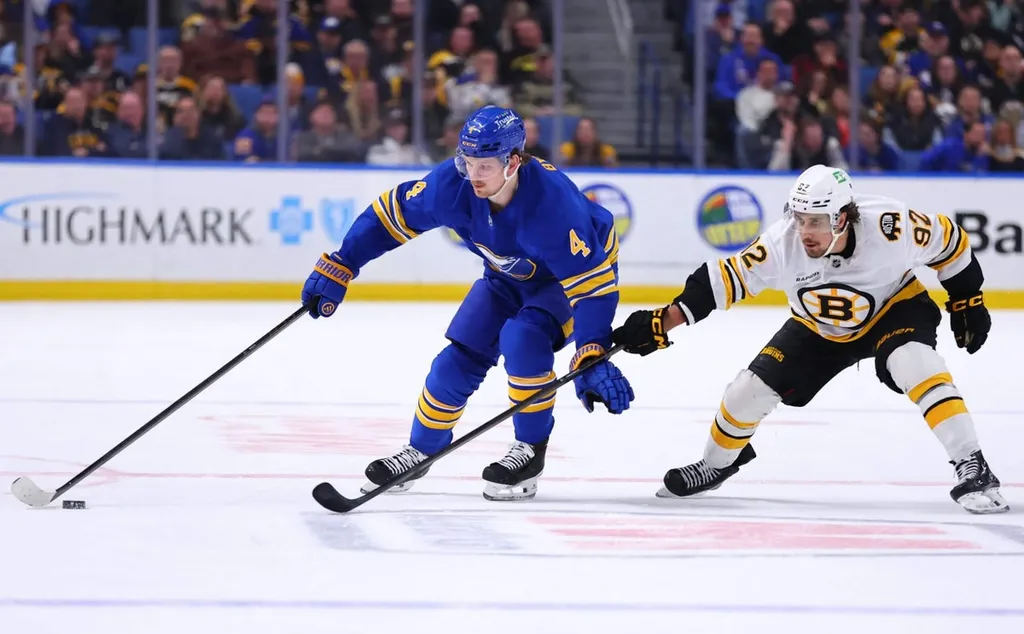
BOSTON -- The Boston Bruins call it The Clog. Their 1-2-2 neutral-zone system is designed to squeeze the air out of the opposition's rush game.
They have had 82 opportunities to practice it for the perfect opportunity.
The Buffalo Sabres are excellent off the rush. Rasmus Dahlin, Tage Thompson and Alex Tuch excel at bombing into the offensive zone and raining pucks on net. According to Clear Sight Analytics, the Sabres finished No. 9 in expected high-danger goals per 60 minutes of five-on-five play in this category. The Bruins will be up against it if they settle for high-event hockey.
"They take off right away," coach Marco Sturm said. "Their rush game, it's not just the forwards. It's the defensemen, too, if you look at all their stats and all their games. They have four really talented D. They always join. It's not a three-man rush. It's almost like a four or five automatic every time. So if you don't manage the puck very well, we're going to see this picture a lot. That's something we just can't play. We can't play their way and their style. Because if we do, we lose."
The Bruins, however, are even better at defending such opponents.
The Bruins were No. 3 in expected high-danger goals against per 60 off rush chances. It is a critical pillar for postseason success. According to Clear Sight Analytics, each Stanley Cup champion in the last six seasons was No. 5 or better defending the rush.
"It tells us the team has bought in to what the coaching staff has been asking," Clear Sight Analytics chief operating officer John Healy said. "Rush defense is, a lot of times, detailed from the two D and the high forward. It's just an honest effort from that forward to remain above the puck in the O-zone. A lot of guys and teams around the league cheat for offense or make bad reads. It could be a combination of the two. But then this number drops significantly. So that's a good start for Boston."
But defending stoutly against the rush can be a series-swinging strength. The Clog could stretch the Bruins' unexpected run past Round 1.
The roots of Sturm's system were planted in 2019-20 in Los Angeles. The Kings, under then-coach Todd McLellan, rolled a 1-3-1 forecheck with the same intention: turn the neutral zone into mud. Sturm was one of McLellan's assistants.
In 2023-24, Jim Hiller replaced McLellan. Hiller went to the 1-2-2. Sturm, then in his second season as head coach for the Ontario Reign, installed the same setup for L.A.'s AHL affiliate. Sturm imported it to Boston with the belief it was a good fit for a team undergoing reconstruction.
"It's a system that tries to keep things out of the middle of the ice," said Sean Kuraly. "It keeps our guys in the middle of the ice. We want to be on the inside of them, keeping them on the outside."
One forward is higher in the forecheck. His linemates are behind in center ice, usually outside the dot lines and under the red line. The defensemen are in the rear, inside of the two forwards and gapped up to reinforce The Clog.
Once the five skaters fall into formation, F1 dictates which direction the puck carrier has to go. Up the middle is not preferred.
"The No. 1 thing," said Kuraly,"is just keeping the puck on one side of the ice."
If F1 does his job, he steers the puck carrier left or right. His next mandate is to occupy enough real estate to discourage a cross-ice outlet pass. If F1 checks off both boxes, he has the green light to pursue the puck carrier to initiate a turnover.
Meanwhile, F2 and F3 are tasked to hold the red line and pick up trailers. If Dahlin, for example, scoots up the ice as the fourth attacker, one of the two forwards is responsible for slowing him down. If a trailer slips through, a defenseman is gapped up to take him on. This allows F1 to peel off to the weak side.
If the forwards execute their responsibilities, they force turnovers or reduce the opposition's speed through the neutral zone. They also allow the defensemen to gap up, account for middle-drive threats, and maintain their speed in the event of a breach. The defensemen can live with the Sabres advancing with pace as long as it’s on the outside.
"It's just about the forwards doing a really good job of not letting that speed get through the middle. Then the puck comes up on the walls a lot," said Mason Lohrei. "That's where we can come from inside ice, come from the dots and push out to the wall. It forces them to dump a lot of pucks in, rim a lot of pucks."
For example, Hampus Lindholm, Lohrei’s second-pair partner, could close on the puck carrier on the left-side wall. If Lohrei anticipates a chip because of Lindholm’s confrontation, he has the green light to go after the puck and get the first touch.
If the opponent sends in a hard rim, Lohrei also has permission to pursue the puck. The Bruins’ weak-side wing is responsible for holding up Buffalo’s first forechecker. This would give Lohrei some breathing room to chase down the rim and initiate the breakout.
The Sabres do not want to enter from the perimeter. Their goal is to possess the puck with speed and gain entry through interior ice. But if the Bruins’ F1 holds the middle, F2 and F3 stack up under the red line and the defensemen gap up inside the dots, the Sabres will have to contend with rush-hour-level traffic. Impatience benefits the Bruins.
"You're not moving the puck easily through the neutral zone," Florida Panthers coach Paul Maurice said of playing the Bruins. "If that's your game plan, then you're going to be very frustrated. It's not really our style anyway. We don't spend a lot of time countering to attack. Counter to forecheck is more our style of game. Either way, you have to have patience. I hate using that word in the room. But you have to be singularly focused on what you're trying to accomplish in that neutral zone."
The Bruins prefer to take care of business up the ice. Things can go sideways if they let the Sabres spend too much time in their zone.
The Bruins use a hybrid zone system in their end. They are in man-to-man coverage up high with no switches. Lower in the zone, they are free to outnumber opponents if they believe they can recover the puck.
There's room for improvement.
By Clear Sight Analytics' measurements, the Bruins were No. 27 in five-on-five expected high-danger goals against per 60 in the defensive zone. This could flare up in Round 1. The Sabres were among the regular-season best at multi-faceted offensive creation: No. 7 in net-front (a Dahlin point shot, for example, with traffic in front), No. 5 in dots-down (a Thompson walk-in off the half-boards), No. 10 in east-west (a Peyton Krebs slot-line pass for a Thompson one-timer), No. 4 in odd-man rush (a Thompson and Tuch two-on-one).
The Bruins plan to flex their muscle to deter Buffalo's offense. In the defensive zone, Jonathan Aspirot, Charlie McAvoy, Andrew Peeke and Nikita Zadorov are their most physical defensemen. Up front, Sturm expects fourth-liners Tanner Jeannot and Mark Kastelic to lead the hit parade.
"Guys being very physical and nasty without taking any penalties, that's going to be huge," said Sturm. "I think that could be a game-changer. That could be a series-changer. That could be a lot of things. We just have to be smart about it. Because I know a lot of teams, they're afraid of us. I can tell. You can see it. You can hear it. That's what we have to do in Buffalo."
The Clog could be the best route for the Bruins to play a smashmouth style. It's designed to steer pucks toward the walls. The strong-side defensemen and forwards are eager to hammer their opponents through the glass. If a rogue Sabre finds a way through the middle, the Bruins will be happy to deliver an open-ice wallop.
The purpose is to smother Buffalo's coast-to-coast skill. Healy compared Sturm's message to that of former New England Patriots coach Bill Belichick's philosophy of negating an opponent's No.1 strength.
"Make them beat us with something else," Healy said."You make sure you don't let them beat you in full-ice transition rush."